The market has finally realized that AI's biggest bottleneck is not electricity, not chips, but money


Author: Long Yue
Source: Wallstreetcn
Money is becoming the scarcest chip in AI's great gamble.
Over the past two years, global capital markets have believed that compute is truth, but power shortages can be expanded and chip supply can catch up. Recently, with CoreWeave plunging and tech giants' CDS soaring, the entire industry chain seems to be waking up to a brutal fact: the ultimate physical limit of AI's breakneck advance is actually the supply capacity of capital and the cost of financing.
When capital is no longer unlimited and no longer cheap, AI retreats from a technological myth to the most basic arithmetic problem of return on investment (ROI).
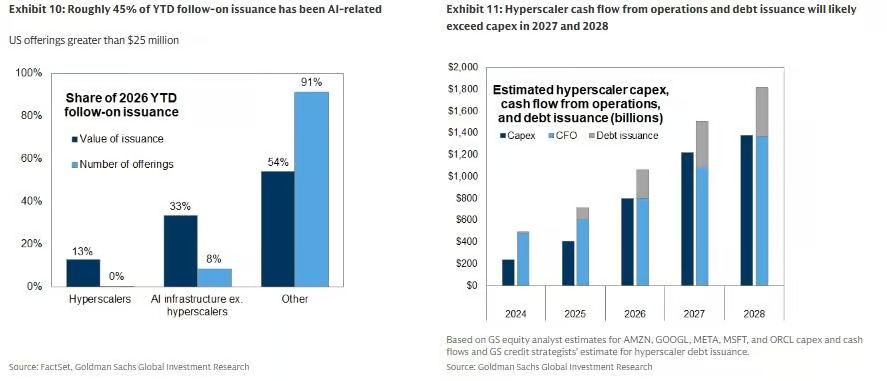
Goldman Sachs' latest estimates show that hyperscale cloud giants' capital expenditure will reach $1.2 trillion next year, while their operating cash flow over the same period will be only $1.1 trillion. At least 35% of construction spending will be forced to rely on debt issuance, totaling more than $400 billion. Meanwhile, the 10-year U.S. Treasury yield recently broke through 5.3% at one point. The AI industry's annual debt issuance demand in the hundreds of billions of dollars is directly competing head-on with the United States' nearly $2 trillion fiscal deficit for limited funds in the long end of the bond market.
Goldman Sachs warns that tightening credit and rising capital costs are creating delay risks for compute infrastructure construction, and the semiconductor supply chain may face an order cliff in 2027 to 2028, where demand cannot be converted into actual purchases.

The Trigger Is Lit: The Math of Borrowing to Build Compute No Longer Works
CoreWeave, a core compute leasing target and "the bellwether of AI sentiment," was the first to tear open the crack in the funding chain.
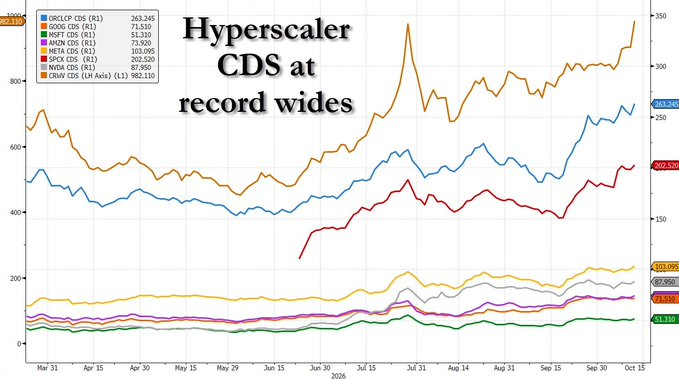
On Wednesday, October 14, CoreWeave plunged more than 15% in a single day and fell nearly another 6% after hours. Its $2.75 billion unsecured bonds issued in April this year traded below 80 cents on the dollar, deep in distressed territory, with yields to maturity surging past 15%. Dow Jones market data showed that its five-year credit default swap (CDS) jumped to 881 basis points, with market pricing implying a probability of default within five years of more than 50%.
Even though CEO Michael Intrator urgently issued an internal memo emphasizing that the company carries $104.2 billion in undelivered orders and more than $25 billion in new customer commitments in the third quarter, the market chose to vote with its feet.

Orders are expectations for the future, but buying GPUs, leasing data centers, and building high-voltage power grids require real money today. Gil Luria, head of technology research at D.A. Davidson, said bluntly:
"They have lost the ability to borrow at a 9% interest rate. If CoreWeave borrows at a cost of 9% while the return it can obtain is only 5%, then no matter how large it scales, it is meaningless: they are destroying value at every step."
Panic quickly spilled over. That day, Oracle fell more than 7%, Dell dropped more than 10%, and data center names such as Applied Digital and IREN plunged nearly 10%. Goldman Sachs' TMT sector index showed that over the past five days, U.S. memory stocks fell 8.5%, the AI data center sector fell 7.9%, and the semiconductor sector fell 7.6%, while the S&P 500 fell 0.17%. Musk left a telling sigh on social media: "yikes."

The heads of chip giants also no longer hid their concerns about the funding chain. Broadcom CEO Hock Tan and Intel CEO Lip-Bu Tan appeared together at a DBS Bank summit in Singapore and directly labeled capital as the industry's biggest bottleneck. Hock Tan publicly stated:
"I think the biggest constraint is capital." "Many investors have no idea what they are investing in."
Musk then bluntly echoed on social media: "Don't cry in a casino." Intel CEO Lip-Bu Tan added:
"If there is any challenge ahead, it is capital and the cost of capital; on the other hand, in the long run, people need to see ROI."
Cash Flow Inversion: Even the Most Profitable Giants Need to Borrow $400 Billion
If only small and medium-sized AI companies were short of money, the storm would not be enough to shake the broader market. The core issue is that even the world's most cash-generating hyperscale cloud giants have had their own ability to generate cash devoured by AI.
Goldman Sachs' equity strategy team disclosed a set of figures in its latest flow report: by 2027, the total capital expenditure of global hyperscale cloud service providers will climb to $1.2 trillion, while the combined expected operating cash flow of these giants is only $1.1 trillion.
This is a rare cash flow inversion in the history of tech giants. Alphabet posted negative free cash flow for a single quarter for the first time in its history in the second quarter of this year, with a net outflow of $5.9 billion; Amazon's free cash flow turned negative by $7.6 billion over the past 12 months.
The cash earned is not enough to burn, and the remaining gap is entirely filled by debt.
Goldman Sachs' credit strategist team estimates that at least 35% of cloud giants' capital expenditure next year will need to be solved through external debt issuance, which means the public market will see more than $400 billion in massive tech company bonds. On the equity financing side, of the roughly $430 billion in follow-on offerings in the U.S. stock market this year, 45% flowed to AI-related companies.
The Goldman Sachs research report pointed out the fragility of this game of passing the parcel:
"As long as interest rates rise and the gap between debt costs and equity costs narrows, the path for companies to sustain valuation expansion through debt issuance and buybacks will be severely suppressed."
Squeezed by Massive Treasury Debt: 10-Year U.S. Treasury Breaking 5.3%, a Liquidity Siphon
The greatest misfortune of borrowing to build compute is running into a sovereign debt inflation of a scale rarely seen in the postwar world.
For fiscal year 2026 through the end of September, the U.S. federal fiscal deficit climbed to $1.993 trillion, with annual spending as high as $7.4 trillion, and net interest expense alone consumed $1.1 trillion in tax revenue.
To pay for the massive deficit, the Treasury Department is pressing historically enormous supply onto the Treasury market. Recently, the 10-year U.S. Treasury yield once again broke through the 5.3% mark, the two-year U.S. Treasury yield jumped more than 7 basis points in a single day, and the awarded yield at the 30-year U.S. Treasury auction hit its highest level since August 2000.

AI's debt issuance wave is being forced to compete in deep waters with the U.S. Treasury for the same pool of existing dollars.
Ilir Xholi, head of swap trading at Goldman Sachs, pointed out that between September 22 and October 7, the U.S. dollar 10y10y forward swap rate moved violently, surging 47 basis points, while the 2-year rate representing short-term Fed policy expectations did not budge. Xholi wrote in a report:
"This move has completely detached from the Fed's rate path. In essence, when buying long-term assets, the market is demanding extremely harsh risk premium compensation."
"The massive debt issuance by AI hyperscalers and semiconductor companies in September directly engaged in hand-to-hand combat with U.S. Treasuries for money in the long-duration market."
At the same time, global sources of funds are still flowing back home. Japan's 10-year government bond yield broke 3%, and overseas institutions sharply reduced their purchase positions in U.S. and European bonds. The global liquidity pool continues to shrink, and the cost of capital is being systematically pushed higher.
Credit Buffer Goes to Zero: The Entire Industry Encounters Hard Capital Rationing
With the benchmark rate climbing to a high of 5.3%, the protective cushion of downstream credit spreads has already vanished.
Goldman Sachs credit strategist Sara Grut warned that in current U.S. dollar investment-grade corporate bonds, credit spreads as a share of total nominal yields have fallen below 15%, far below the historical average of 45%:
"In the past, when government bond yields rose, credit spreads often narrowed to absorb the shock. But in recent months, credit spreads and Treasury yields have begun to rise in the same direction, and credit assets are facing dual headwinds."
On the high-risk financing side, this capital rationing is even harsher. Rich Privorotsky, head of Goldman Sachs' London trading desk, pointed out that CCC-rated spreads in the junk bond market have jumped to around 1,250 basis points, widening by more than 200 basis points within a month.
The prices of credit derivatives for core AI leaders are flashing warnings across the board:
- Broadcom's 5-year CDS rose to 136 basis points, a record high;
- Oracle's 5-year CDS broke through 261 basis points, a record high; its stock price, however, kept falling.
- CoreWeave's unsecured bond spreads directly pierced 1,000 basis points;
- The $5 billion leveraged loan launched by Norwegian data center operator Volta has an all-in financing rate approaching 11%.

Privorotsky warned in a client report:
"Close attention should be paid to the spread of credit stress into single-B and leveraged loan markets. If credit pressure continues to spread, its destructive power will extend from AI to small and medium-sized enterprises, real consumption, and the entire macroeconomy."
JPMorgan CEO Jamie Dimon previously offered the same assessment: when the cost of capital remains high, with the private sector needing to borrow to buy GPUs and the public sector needing to borrow to cover deficits, capital allocation will no longer tell stories, but will instead be brutally rationed by price—that is, by elevated interest rates.
Goldman Sachs Warns: Semiconductor Supply Chain May Face Order Gap Risk in 2027-2028
The cutoff of funding and high financing thresholds are transmitting to the end procurement chain.
ASML's third-quarter earnings released on Wednesday are a microcosm: although results greatly exceeded expectations, the lower end of its 2026 guidance was raised, and management emphasized that future capacity would be in short supply, the stock still fell as much as 3% after the earnings release.
The core logic behind the market selloff is that ASML did not raise its performance expectations for 2027 and beyond. Goldman Sachs TMT experts pointed out:
"Credit tightening has caused a large number of AI infrastructure projects to delay delivery, and this variable has become the biggest worry for the stock market."
Based on this, Privorotsky laid out the "air pocket" for the semiconductor supply chain:
"The real risk now is that high capital costs and real delivery bottlenecks are preventing end demand from translating into actual capital expenditure.
If you are an intermediary in the supply chain caught between strong end demand and the reality that you cannot deliver, at some point you will face the risk of orders suddenly falling into a gap. The semiconductor supply chain is deeply worried about this, especially whether it will turn into a crisis in 2027 or 2028."
At the end of the report, Privorotsky wrote one of the most precise characterizations of the current AI boom:
"We remain bullish on the prospects of this technology at a fundamental level, but we must increasingly recognize clearly: the ultimate bottleneck limiting this industrial revolution has long ceased to be on the demand side, and instead lies in whether we have the will and the ability to raise sufficiently cheap money for these super supplies."