



US chip stocks are just one step away from a bear market


- Core Thesis: The AI trade led by chip stocks is rapidly cooling, with the Philadelphia Semiconductor Index approaching a technical bear market. Market focus has shifted from the scale of AI investment to commercial returns. Capital is flowing from high-valuation chip stocks to economically sensitive sectors like financials and consumer goods, awaiting earnings reports to validate the AI investment thesis.
- Key Elements:
- The Philadelphia Semiconductor Index has fallen approximately 19% from its June peak. A further decline to 20% would confirm entry into a technical bear market, with all 30 constituent stocks down from their record highs.
- Capital is moving out of high-valuation chip and memory stocks and rotating into sectors directly benefiting from economic resilience, such as banks, retail, and transportation. Market breadth is expanding.
- The chip industry's Q2 earnings growth rate is projected to be as high as 131%, but the market questions the sustainability of this growth. Strong earnings performance has failed to prevent stock price declines.
- Goldman Sachs warns of tension between AI capital expenditure and monetization returns, with hyperscale cloud companies investing at a pace exceeding their own cash flow growth.
- The reversal of the AI trade is dragging down global risk appetite. Japan's Nikkei 225 index closed down 4%, while chip stocks like TSMC and ASML are under pressure.
Author: Zhao Ying
Source: Wall Street CN
The AI-driven chip trade is experiencing a rapid cooldown. The Philadelphia Semiconductor Index has fallen about 19% from its June peak, just a stone's throw away from confirming a bear market. Capital is beginning to flow out of high-valuation chip and memory stocks, rotating into sectors like financials, retail, and transportation, which more directly benefit from economic resilience.
In Thursday's US stock trading, the Philadelphia Semiconductor Index fell 4.3%, with all 30 component stocks declining from their record highs set on June 22. According to Dow Jones Market Data, if the index falls further into the 20% decline territory from its peak, it would confirm a technical bear market. On Friday, the sell-off spread to Asian and European markets. Japan's Nikkei 225 index closed down 4%, with TSMC, Kioxia, and European chip equipment maker ASML all under pressure.
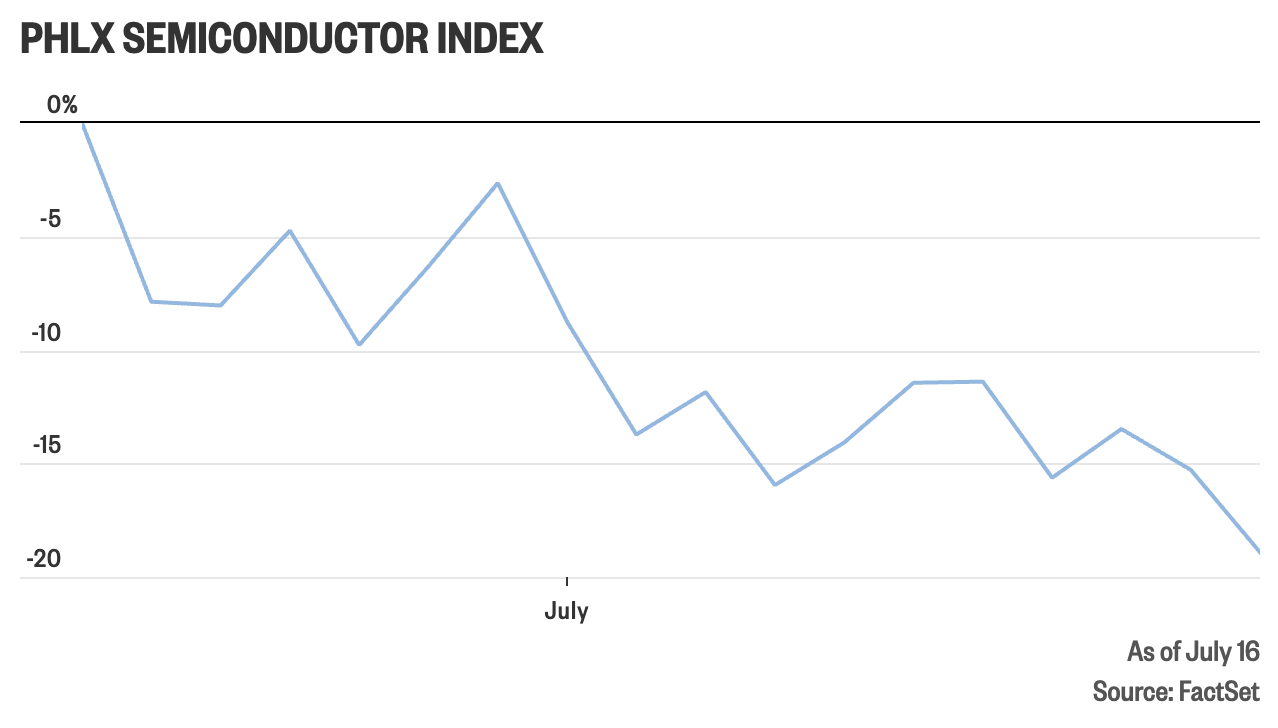
The reversal of the AI trade is dragging down global risk appetite. The Philadelphia Semiconductor Index has fallen a cumulative 8.5% this week, on track for its worst weekly performance since the "Tariff Day" tariff shock last year. Nasdaq 100 futures fell 1.6%, and S&P 500 futures fell 0.9%, as market concerns simultaneously intensify over returns on AI infrastructure investment, inflation risks, and the outlook for monetary policy.
The head of Goldman Sachs trading desk describes the current AI market as a "rubber band" being stretched ever tighter. As hyperscale cloud companies continue to increase capital expenditure, the key question for the market has shifted from "how big is the scale of investment" to "when and how will these investments translate into returns." The upcoming earnings reports from tech giants could be the first key inflection point to validate this logic.
Chip Index Nears Bear Market, Profit-Taking Morphs into Broad Cooldown
Chip stocks were among the most sought-after trades this spring. As investors once worried that the "Magnificent Seven" would bear most of the cost of building AI data centers, capital shifted instead to chip manufacturers, memory, and semiconductor equipment companies, betting they would be direct beneficiaries of the capital expenditure cycle.
But this trade is rapidly reversing. As of Thursday, the Philadelphia Semiconductor Index was down 19% from its all-time high set on June 22. The index fell 4.3% that day, just shy of the 20% decline threshold that typically confirms a bear market.
Individual stock movements are even more volatile. Marvell Technology has fallen nearly 40% since the Philadelphia Semiconductor Index peaked, though it is still up 121% for the year. This reflects that the current adjustment is more concentrated in the AI beneficiaries that had previously seen significant gains, as investors reassess whether high-growth expectations have been fully or even excessively priced into the stocks.
In Thursday's US stock market, Sandisk, Western Digital, and Seagate all fell over 9%, while Intel and Micron dropped around 6%. The sell-off continued in Asian markets on Friday, with Japanese memory chipmaker Kioxia at one point falling over 16%, more than halving from its June high. TSMC's stock also fell sharply.
Earnings Remain Strong, but Market Begins to Question Growth Sustainability
The challenge facing the chip sector is not an imminent earnings collapse. FactSet data shows the market expects S&P 500 index component earnings to grow 23.6% year-over-year in the second quarter, while earnings for the semiconductor and related equipment industry are expected to surge by 131%.
The issue is whether these robust current earnings are sufficient to support valuations that already reflect years of anticipated growth. David Russell, Head of Global Market Strategy at TradeStation, noted that while tech companies might deliver stellar results, the market is now questioning whether this growth can be sustained over the next one to three quarters.
TSMC's performance highlights this contradiction. Despite reporting a record quarterly profit, its stock price weakened significantly this week. The Financial Times reported that TSMC fell over 7% on Friday. Earnings beating expectations failed to prevent the stock price from declining, indicating the market's focus has shifted to order sustainability, returns on capital expenditure, and the trajectory of AI demand growth, rather than single-quarter profits themselves.
Kevin Gordon, Head of Macroeconomic Research and Strategy at the Schwab Center for Financial Research, believes the sharp correction in chip stocks may not necessarily be a serious warning signal. Over the past decade, the Philadelphia Semiconductor Index has experienced six declines of over 20% and 31 corrections of at least 10%, showing significantly higher volatility than the S&P 500. However, this frequent adjustment also means the sector is highly sensitive to changes in valuations, inventory cycles, and capital expenditure expectations.
Capital Rotates into Cyclical Sectors, Market Breadth is Expanding
As chip stocks come under pressure, a clear rotation of capital is occurring within the US stock market. The financial sector closed at a record high for a second consecutive day on Thursday, boosted by strong bank earnings. The Dow Jones Transportation Average is up over 30% year-to-date, nearing its all-time high, and retail ETFs have also risen to levels not seen since early 2022.
David Royal, Chief Financial and Investment Officer at Thrivent, stated that expanding market breadth is a healthy sign. Recent employment and retail sales data also indicate the economy remains resilient. The rotation of capital from high-valuation tech sectors into financials, consumer, and transportation suggests investors are not fully abandoning risk assets, but are instead reallocating towards assets more sensitive to economic growth.
This rotation also diminishes the previous relative advantage of chip stocks. When the economic outlook remains stable, investors have more choices and don't need to continue concentrating their bets on the highest-valuation, most crowded companies within the AI infrastructure chain.
Goldman Sachs Warns: Tension Between AI Capex and Monetization Returns
Goldman Sachs' Mark Wilson, Head of EMEA Equity Hedge Fund Sales, and Rich Privorotsky, Head of EMEA Equity Flow Intermediation, believe the mismatch between AI infrastructure investment and commercialization returns is becoming the core risk variable for the market.
They point out that hyperscale cloud companies like Microsoft, Amazon, Alphabet, and Meta are investing in AI infrastructure at a scale exceeding their own operating cash flow growth rates. However, in the near term, there remains significant uncertainty about how much revenue, profit, and cash returns these investments will generate.
Privorotsky describes the AI market as a "rubber band," stressing that the key isn't whether the market still believes in AI's long-term direction, but how long this stretching of valuations and capital expenditure can continue. Goldman Sachs also notes that the accelerating diffusion of frontier models and declining inference costs could shift the AI value chain: the scarcity premium on hardware and computing power might decrease, while platform companies that control distribution channels and workflows could capture more value.
If any one of the hyperscalers were to be the first to cut capital expenditure, the market could quickly reassess demand expectations for the entire AI hardware chain, triggering broader ripple effects.
Earnings Season to Test Whether AI Trade Can Regain Support
The market's focus will now shift to the earnings reports and capital expenditure guidance from big tech companies. Alphabet and Tesla are scheduled to report results on July 22. Their comments on AI investment, data center construction, and commercialization progress could influence whether the chip sector can halt its decline.
In the short term, the high earnings growth rate of chip stocks still provides some support for valuations. However, the market is no longer satisfied with "high growth" alone. Investors need to see improvements in revenue, margins, and cash flow driven by AI investments. They also need confirmation that hyperscalers' capital expenditure won't slow down due to financing pressures, rising inflation, or disappointing returns.
Whether the Philadelphia Semiconductor Index officially falls into a bear market may just be a technical boundary. For the broader market, a more important dividing line is whether the AI trade can transition from pre-paying for years of future growth to validating a realistic path to returns.