






Surpassing $90 Billion: TRON’s On-Chain USDT Issuance Reaches a New All-Time High


- Core Thesis: The issuance of TRC20-USDT on the TRON network has surpassed $90 billion, setting a new all-time high. This reflects the sustained global growth in demand for stablecoins and is driving TRON's expansion from on-chain transfers into broader financial scenarios, including AI payments, cross-border settlement, and institutionalized compliant markets.
- Key Elements:
- TRC20-USDT issuance broke through $90 billion on July 9th, with over 8 billion tokens issued year-to-date. The number of holding accounts has exceeded 74.9 million, and cumulative transfers have surpassed 3.5 billion.
- The TRON network has long hosted nearly half of the global USDT supply (approximately 48%). In Q1 2026, the stablecoin settlement volume on TRON approached $2 trillion.
- TRON has joined the Mastercard Crypto Credential program, holding a 32% share of the crypto card transaction market, extending its reach from on-chain activity to traditional commercial payment scenarios.
- The ecosystem project B.AI, which has integrated with the TRON network, has surpassed 2 million users. B.AI provides a low-cost, automatically executable high-frequency micro-payment infrastructure tailored for the AI Agent economy.
- TRON has activated post-quantum signature functionality (FN_DSA_512) on its testnet and has jointly established the T3 Task Force, which has frozen over $450 million in illicit funds, enhancing security and compliance capabilities.
On July 9, according to data from TRONSCAN and Tether on-chain, the circulation of TRC20-USDT on the TRON network officially surpassed $90 billion, setting a new historical record.
Since the beginning of the year, TRC20-USDT has continued its growth trend. In January, the circulation of USDT on the TRON chain was approximately 82.4 billion tokens; in just over six months, this figure climbed to 90 billion tokens, with a cumulative increase of about 8 billion tokens this year. From 80 billion to 90 billion, TRON has once again steadily crossed a new ten-billion-dollar milestone, continuously consolidating its important position in global stablecoin issuance and on-chain settlement networks.
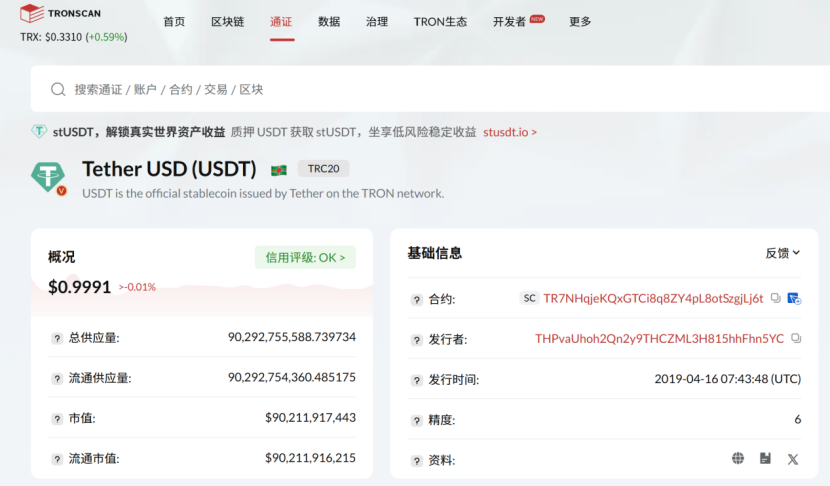
Stablecoin Demand Drives TRON's Continued Expansion
Stablecoins have always been TRON's largest use case. Since TRON partnered with Tether to launch TRC20-USDT in 2019, the TRON network, leveraging its fast transfer speeds, low transaction fees, and stable operation, has gradually become a major network for global USDT transfers and value settlement. Currently, TRON has long been responsible for nearly half of the global USDT circulation, accounting for approximately 48%.
Entering 2026, stablecoin activity on the TRON chain continues to expand. As of now, the annual increase in TRC20-USDT issuance has exceeded 8 billion tokens, the number of holding addresses has surpassed 74.9 million, and cumulative transfers have exceeded 3.5 billion. The total number of accounts on the TRON network has surpassed 390 million, with cumulative transactions exceeding 14.6 billion.
Data from Messari shows that in the first quarter of 2026, the stablecoin settlement volume on the TRON network approached $2 trillion. Throughout 2025, the annual transfer volume of USDT on the TRON chain was approximately $7.9 trillion. These figures indicate that the growth of TRC20-USDT is not only driven by expanding issuance but also by sustained demand for on-chain transfers, cross-border settlements, and peer-to-peer payments.
This demand is particularly concentrated in emerging markets. For small-value cross-border transfers, high-frequency payments and collections, and dollar-denominated settlements between individuals, users are more sensitive to transaction fees and confirmation times. Based on the DPoS consensus mechanism, TRON can support approximately 2,000 transactions per second, with block confirmations completed in seconds and low cost per transfer. For users who cannot afford high transaction fees, TRC20-USDT offers a more accessible digital dollar transfer method.
Beyond native on-chain scenarios, TRON is also accelerating its integration into traditional finance and real-world payment networks. In March, TRON announced its participation in Mastercard's Crypto Partner Program, exploring cross-border settlements and B2B transfers. According to data from the crypto card analytics platform PaymentScan, TRON's market share in crypto card transactions has reached 32%, with a transaction volume exceeding that of Ethereum and BNB Chain combined. Furthermore, the decentralized prediction market Polymarket has natively integrated TRON TVM network support for deposits. These developments show that TRON is extending from an on-chain transfer network to a wider range of payment and commercial scenarios.
AI Payments and Institutional Markets Open New Avenues
With USDT issuance surpassing $90 billion, TRON is also strengthening its layout in the AI payment sector. With the development of the AI Agent economy, the market demands a low-cost, automatically executable, globally settling payment network. TRON's high throughput and low cost characteristics make it suitable for high-frequency scenarios such as machine-to-machine payments, model call fees, and on-chain automated settlements.
The TRON AI Development Fund has been expanded to $1 billion this year, focusing on supporting AI infrastructure, on-chain payments, and open finance innovation. In this direction, B.AI, an underlying financial infrastructure built for the AI Agent era, has become a crucial entry point for the TRON ecosystem to explore the AI Agent economy. As an underlying financial infrastructure for AI agents, B.AI has integrated with the TRON network and aggregated leading domestic and international large models like Claude, ChatGPT, Gemini, MiniMax, and Kimi.
Through B.AI, AI agents can use a single on-chain wallet address for identity verification, model invocation, and on-chain payments. For developers, this means they can access multi-model capabilities at a lower cost and embed payment, settlement, and account systems directly into application processes. For users, B.AI lowers the barrier to using AI services and on-chain payments, turning the wallet from just an asset storage tool into an account entry point for AI agents to invoke services, execute tasks, and complete transactions.
Currently, B.AI's user base has surpassed 2 million. As more AI applications evolve from "conversational tools" to "agents capable of autonomously executing tasks," model calls, data services, plugin usage, on-chain transactions, and cross-border settlements could all generate high-frequency micro-payment demands.
The combination of B.AI and the TRON network aims to provide a scalable payment and settlement base for this scenario: AI handles task execution, while TRON provides a low-cost, high-efficiency value transfer channel.
This strategic layout also provides a new growth narrative for TRON's stablecoin network. Previously, the core use cases for TRC20-USDT were primarily focused on personal transfers, cross-border payments, exchange flows, and dollarization needs in emerging markets. Looking ahead, as the AI Agent economy expands, stablecoins could become a crucial payment medium for settlements between agents, purchasing computing power, invoking models, and executing automated transactions. The integration of B.AI allows TRON to participate earlier in this emerging payment scenario and extend its stablecoin settlement capabilities to the AI application layer.
On the security front, TRON is accelerating its network security upgrade for the quantum era. On July 2, 2026, the TRON Nile testnet passed committee proposal No. 20628, officially enabling the post-quantum signature function and initially adopting the FN_DSA_512 signature algorithm. This means TRON's quantum resistance capability has entered the testnet validation phase, providing long-term security guarantees for larger-scale on-chain assets, stablecoin settlements, and automated payment scenarios in the future.
On the compliance front, TRON is also making continuous investments. The T3 Financial Crime Unit, jointly established by TRON, Tether, and TRM Labs, has assisted global law enforcement agencies in freezing over $450 million in illicit funds. With Nasdaq-listed TRON.Inc implementing the TRX treasury strategy and advancing the TRX spot ETF application, TRON is expanding simultaneously towards decentralized innovation and institutional-grade compliance markets.
The TRC20-USDT circulation surpassing $90 billion is a new milestone for the TRON stablecoin ecosystem and also reflects the expanding global demand for stablecoins. As regulatory frameworks become clearer, traditional financial institutions accelerate their entry, and the AI Agent economy demands more efficient payment layers, the competition among stablecoin networks will increasingly return to four foundational capabilities: efficiency, cost, security, and compliance.
For TRON, $90 billion is not the end point. Stablecoins have become the core fulcrum connecting on-chain finance, cross-border payments, AI payments, and institutional markets. As the issuance scale, settlement volume, and real-world application scenarios continue to expand, TRON is steadily advancing towards its goal of becoming a core settlement layer for global financial transactions.


