






Oracle (ORCL) Stock Price Forecast 2026 to 2030: OCI Revenue Roadmap, Analyst $400 Price Target, and Key Risks


- Core Thesis: Oracle is transitioning from a traditional database company into an AI cloud infrastructure competitor. The primary driver of its stock price appreciation is the explosive growth of its cloud infrastructure (OCI) business. Analysts are generally bullish, but model predictions diverge, with the outcome hinging on the Q4 FY2026 earnings report and the execution of the OCI revenue roadmap (targeting $144 billion by FY2030).
- Key Factors:
- On June 1, 2026, Oracle shares surged 9.9% to nearly $248, as the market "upgraded" its positioning to an AI cloud infrastructure competitor.
- 35 Wall Street analysts maintain a "Buy" consensus, with a 12-month average price target of $261.29, while Guggenheim sets the highest target at $400.
- In Q1 FY2026, OCI revenue was $3.3 billion (up 54% YoY), and Remaining Performance Obligations (RPO) reached a record $455 billion (up 359% YoY).
- Chairman Larry Ellison committed to a four-year OCI revenue roadmap: growing from $18 billion in FY2026 to $144 billion by FY2030, serving as the core baseline for long-term forecasts.
- The 2030 stock price forecast ranges from $300 to $600, with the optimistic scenario dependent on OCI execution; however, GuruFocus notes the current stock price is approximately 45% above its GF Value estimate, presenting a bearish risk.
- The Q4 FY2026 earnings report, to be released on June 10, 2026, is the most significant near-term catalyst, with a focus on OCI growth rates and any revisions to the $144 billion roadmap.
Oracle Corporation (NYSE: ORCL) is no longer the traditional database company it once was.
On June 1, 2026, Oracle's stock surged approximately 9.9% in a single day, approaching $248—a move that forces every investor to reconsider: In the age of AI, what kind of company is Oracle?
As Wall Street increasingly views Oracle as a formidable contender in the cloud infrastructure space, Oracle stock price forecasts have become one of the hottest search topics for investors seeking AI infrastructure investment opportunities.
This article will comprehensively analyze ORCL's current market position, analyst predictions, and forecast data year by year through 2040, while delving into the key factors that will determine which scenario ultimately comes true.
Key Takeaways
- Oracle (ORCL) surged 9.9% on June 1, 2026, closing near $248—reflecting the market's accelerating reassessment of Oracle from a traditional software vendor to an AI cloud infrastructure contender.
- As of April 2026, 35 Wall Street analysts maintain a "Buy" consensus rating for ORCL, with a 12-month average price target of $261.29; Guggenheim sets the highest target at $400 (Strong Buy), and Citigroup has a target of $320 (Strong Buy).
- Oracle Cloud Infrastructure (OCI) generated $3.3 billion in revenue in Q1 of fiscal 2026, up 54% year-over-year; the company's Remaining Performance Obligations (RPO) surged 359% to $455 billion, an all-time high for Oracle.
- Oracle Chairman and CTO Larry Ellison publicly committed to a four-year OCI revenue roadmap: $18 billion in fiscal 2026, increasing annually to $32 billion, $73 billion, $114 billion, and ultimately $144 billion by fiscal 2030—this is the most critical benchmark for any long-term ORCL stock price forecast.
- Forecast models generally set ORCL's 2030 target range between $300 and $600, with the bullish scenario hinging on OCI execution; GuruFocus issues a cautionary note, estimating the current stock price is about 45% above its GF Value, indicating bearish risk.
- Oracle's Q4 fiscal 2026 earnings report, due in June 2026, is the most significant near-term catalyst for ORCL, with key focus on OCI revenue growth rate and any revisions to the $144 billion roadmap.
ORCL Stock Current Dynamics: What 35 Wall Street Analysts Really Think About Oracle
According to price data from GuruFocus, Oracle (NYSE: ORCL) closed near $248 on June 1, 2026, posting a single-day gain of approximately 9.9%.
The stock's 52-week trading range between $134.57 and $345.72 amply illustrates the dramatic shift in investor sentiment over the past year—views on Oracle's transformation from a traditional software vendor to a cloud infrastructure competitor have swung considerably during this period.
Amid these fluctuations, however, the analyst community remains broadly positive.
According to StockAnalysis, as of April 2026, 35 Wall Street analysts tracking ORCL maintain a consensus "Buy" rating with a 12-month average price target of $261.29.
The individual price targets span a wide range:
- Low end: $160 (most conservative analyst on the street)
- Guggenheim: $400, Strong Buy
- Citigroup: $320, Strong Buy
- Mizuho: $320, Buy
With ORCL trading near $248, the $261 average consensus target implies only modest single-digit upside in the near term, but the cluster of institutional targets at $320 to $400 suggests significant appreciation potential remains, provided Oracle delivers on its cloud guidance.
This divergence reflects genuine uncertainty over near-term margins and profitability, not a disagreement about the long-term opportunity.
Oracle Stock Price Forecast: Complete Yearly Predictions from the Near Term to 2040
For any investor researching ORCL stock price forecasts, the most useful approach is to separate Oracle's 12-month analyst consensus from longer-term model-based projections.
These two time horizons are driven by entirely different variables, carry vastly different confidence intervals, and often lead to starkly different conclusions about whether now is an opportune entry point.
Short-Term ORCL Stock Price Forecast
Based on Wall Street consensus from StockAnalysis, the average ORCL price target from 35 analysts as of April 2026 is $261.29.
At the current stock price around $248, this consensus implies near-term upside of roughly 5 to 6%—a figure that may seem modest but was established when ORCL shares were trading at much lower levels.
Perhaps more telling is the high end of the distribution: Guggenheim's $400 target implies 62% upside; both Citigroup and Mizuho set targets at $320 (approximately 30% upside).
Near-term price action is most likely to hinge on Oracle's upcoming quarterly earnings report—the company has scheduled its next earnings release for June 10, 2026—along with any updates to OCI revenue guidance and overall market sentiment toward enterprise tech stocks.
ORCL Stock Price Forecast for 1 to 3 Years
Beyond the 12-month window, model-based forecasts for Oracle generally become more optimistic.
LongForecast predicts ORCL will climb to approximately $300 by the end of 2027, driven primarily by accelerating cloud revenue growth and sustained improvement in earnings per share as Oracle's infrastructure build matures.
The same model is even more bullish for 2028, forecasting ORCL in the $450 range—representing roughly 82% upside from current levels—as OCI contracts begin converting into durable margin expansion rather than growth-stage capital expenditure.
Looking at year-by-year data, the medium-term five-year Oracle stock price forecast reflects two powerful structural tailwinds showing no signs of reversal:
- Sustained enterprise demand for large-scale AI cloud infrastructure
- The massive migration of large enterprises from Oracle on-premises database licensing to Oracle cloud services
Both are secular trends rather than cyclical phenomena, and the pace of adoption appears to be accelerating rather than plateauing.
Oracle 2030 Stock Price Forecast
The 2030 target is where Oracle stock price forecasts diverge most sharply between bullish and cautious scenarios.
LongForecast's model projects ORCL approaching approximately $500 by the end of 2029 and around $600 by end of 2030—representing roughly 143% upside from current levels if this trajectory materializes.
TradersUnion's statistical model is more conservative, forecasting a range of $345 to $360 by end of 2026, and tracking ORCL in the $260 to $290 range through 2031.
The gap between the two approaches ultimately boils down to one variable: the speed at which Oracle converts its $455 billion backlog of remaining performance obligations into recognized revenue.
Both models ultimately depend on Oracle's ability to achieve its publicly stated OCI revenue milestones:
- Fiscal 2026: $18 billion (+77%)
- Fiscal 2027: $32 billion
- Fiscal 2028: $73 billion
- Fiscal 2029: $114 billion
- Fiscal 2030: $144 billion
If Oracle's execution stays close to this roadmap, the high-end scenario of 2030 Oracle stock price forecasts becomes a credible outcome rather than an outlier.
If OCI quarterly growth rates show material deceleration, the base-case scenario models provide the more relevant reference point.
Oracle 2040 Long-Term Stock Price Forecast
For investors with a 10 to 15-year investment horizon, Oracle 2040 stock price forecasts offer a cautiously optimistic outlook, provided the cloud business theme continues to compound.
StockScan's long-term model estimates ORCL's average stock price around $430 in 2040, representing roughly 75% upside over 14 years from current levels.
Applying a 14 to 16x P/E multiple to that EPS range implies a 2040 price window between $420 and $640.
These are model estimates, not analyst price targets, and are highly sensitive to Oracle's ability to sustain revenue growth and protect profit margins in an increasingly competitive enterprise cloud market—one that will be far more contested a decade from now.
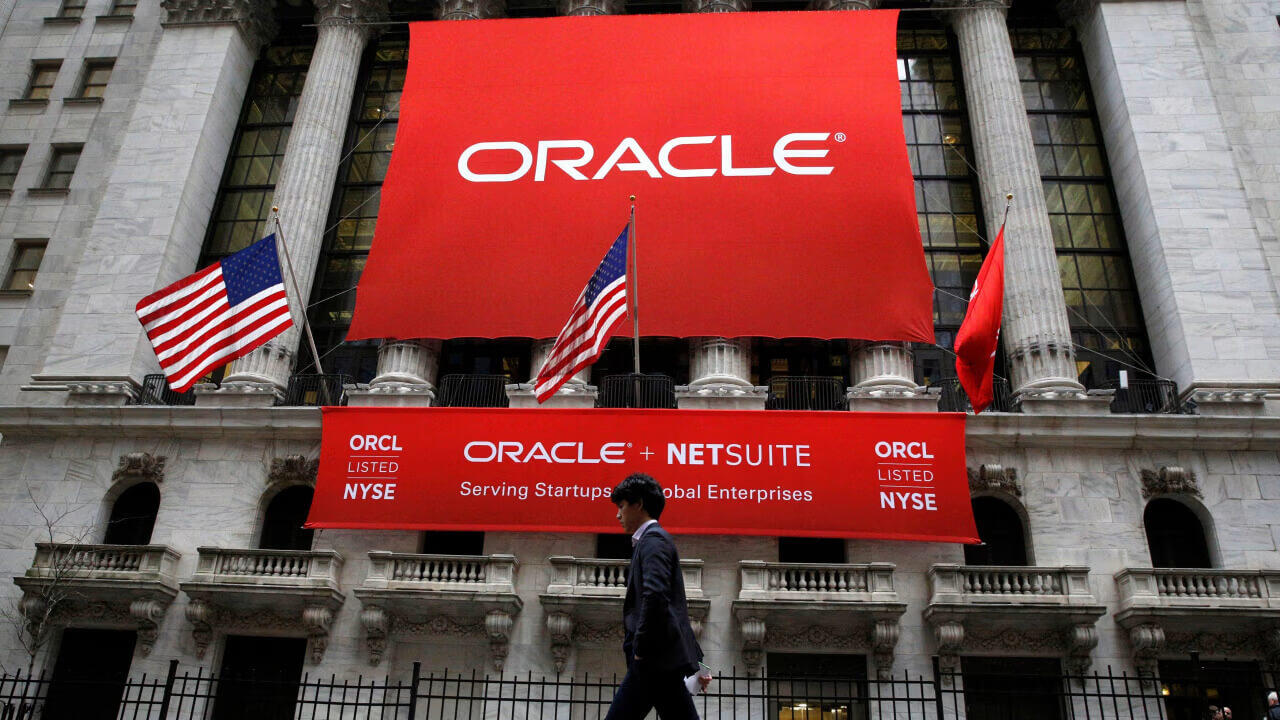
Factors That Could Drive ORCL Higher, and Factors That Could Create Headwinds
Two clear and competing narratives define Oracle's stock trajectory for the coming years.
Which narrative prevails will depend on a set of publicly defined metrics—making this a rare, trackable growth story compared to most AI-era plays.
Bullish Scenario—OCI Revenue Acceleration and Oracle's AI Infrastructure Footprint
The bullish thesis begins with the data already evident in Oracle's own earnings reports.
In Q1 of fiscal 2026, Oracle Cloud Infrastructure revenue reached $3.3 billion, up 54% year-over-year—with an OCI consumption growth rate of 57%, according to Oracle's Q1 fiscal 2026 earnings press release published at investor.oracle.com.
At this growth rate, the AI client roster includes OpenAI, xAI, Meta, NVIDIA, and AMD—Oracle CEO Safra Catz confirmed signing four multi-billion-dollar contracts with three customers in Q1 of fiscal 2026 alone.
Wall Street's revenue consensus reinforces this momentum:
- Fiscal 2026 Total Revenue: approximately $68.6 billion (up 19.5% YoY, StockAnalysis consensus)
- Fiscal 2027 Total Revenue: approximately $90.6 billion (up 32.1% YoY, StockAnalysis consensus)
The growing backlog, accelerating cloud infrastructure revenue, and high-profile AI client


