






XMAQUINA (DEUS) Complete Guide: Analysis of the Humanoid Robot Tokenization Market


- Core Thesis: XMAQUINA (DEUS) is a decentralized ecosystem designed to break the traditional venture capital monopoly through tokenization, bringing liquidity to the humanoid robot industry. Its core value lies in fractionalizing physical robot assets, enabling retail investors to indirectly invest through a compliant SPV structure and enjoy 40% of the actual treasury profits.
- Key Elements:
- The project is built on the Base network, utilizing the ERC-20 standard. Through a "Staking-Minting-Governance" closed loop, it transforms the DEUS token into the governance token xDEUS, achieving decentralized autonomy.
- Core value capture: Users holding xDEUS can share in 40% of the actual profits generated by the physical robot assets in the DAO treasury, realizing on-chain dividends.
- The total supply of DEUS tokens is fixed at 1 billion, with permanent deflation and no additional minting. 71% of the supply is allocated to the community to ensure asset scarcity and ecosystem decentralization.
- The ecosystem launches a "Humanoid Robot Card" system containing 1,111 digital collectibles, corresponding to 17 types of physical robots. Unlocking higher-tier rewards requires meeting tiered DEUS staking thresholds.
- Future plans include launching on Solana in 2026, introducing a Robot Capital Market (RCM) protocol, and expanding derivative functions such as decentralized options and synthetic assets.
Core Highlights
- Decentralized Underlying Ecosystem: XMAQUINA (DEUS) aggregates global capital and an automated machine revenue distribution mechanism, establishing a secondary market trading foundation for the humanoid robotics industry.
- Ecosystem Architecture: The project builds a rigorous "Stake·Mint·Govern" system on the Base network, converting circulating DEUS tokens into non-transferable xDEUS governance tokens.
- Value Capture Mechanism: Stakers holding xDEUS can claim 40% of the actual profit dividends from physical robot assets within the DAO treasury, according to set rules.
- Ecosystem Incentive Mechanism: The platform has launched a plan to activate governance with 1 million DEUS, providing strong structural incentives for on-chain asset lock-up pools.
- High-Yield Staking Products: The ecosystem introduces a humanoid robot card system, including 1,111 exclusive digital collectibles. Users must meet tiered DEUS staking thresholds to unlock higher-yield benefits.
What is XMAQUINA (DEUS)?
XMAQUINA (DEUS) is a novel cryptocurrency designed to revolutionize the humanoid robotics capital market. Leveraging innovative models of tokenized robotics and physical AI, XMAQUINA (DEUS) aims to provide users with accessible investment channels, lower entry barriers, transparent on-chain mechanisms, and a programmed profit distribution model.
As a decentralized ecosystem centered on governance, the XMAQUINA crypto project aims to precisely channel global digital asset liquidity into the traditionally closed-off humanoid robotics industry. Production scenarios in the human world are suited to humanoid device forms, making humanoid robots the ultimate universal automation assets. Unlike traditional industrial equipment with single functions requiring extensive factory retrofitting, humanoid robots offer strong versatility. By utilizing the DEUS token, the project deeply integrates compliant real-world asset legal structures with secondary liquid trading markets, fundamentally solving the long-standing industry pain point of insufficient liquidity for high-end tech investments.
Project Background of XMAQUINA (DEUS)
XMAQUINA (DEUS) was co-founded by blockchain developers, compliance and risk control experts, and automation industry professionals, aiming to break the monopoly of traditional venture capital in the tech industry. The project was launched via a decentralized community and a dedicated treasury fund, dedicated to accelerating the global development of the humanoid robotics tokenization industry.
To further refine its strategic layout, the ecosystem has officially appointed Rubén Portela as a DAO Strategic Advisor and member of the internal Strategy Committee. As the head of the renowned VC firm Wise3 Ventures, he has advised multiple governments on digital asset frameworks and deeply participated in building leading Web3 infrastructure projects like ChainGPT and Minima. Leveraging extensive industry experience, he will help XMAQUINA (DEUS) expand its global footprint in the physical AI market.
The crypto industry continues to evolve, but high-end tech investments still face issues like high entry barriers, long capital lock-up periods, and the inability for ordinary investors to participate in early-stage hardware equity investments. XMAQUINA (DEUS) specifically addresses these by creating decentralized real-world asset (RWA) financial solutions, a hardware asset fractionalization mechanism, and an automated value circulation system. It aims to build a more inclusive tech-finance system, break down barriers between blockchain and physical hardware, and create a stable, efficient, and yield-empowered on-chain trading ecosystem.
XMAQUINA (DEUS) Development History
Since its launch, the XMAQUINA (DEUS) token has developed steadily, initially landing with the core innovation of "mapping physical robot assets onto the blockchain." It has since undergone continuous iterative upgrades, achieving key milestones such as building the DAO governance structure, deploying the public treasury transparency system, and expanding the ecosystem on multiple fronts.
The development path of the XMAQUINA token ecosystem is clear and steadily advancing, with core milestones as follows:
- Core Infrastructure Setup: Completed initial construction of the DAO governance framework, establishing a comprehensive community governance system via Snapshot and Discord.
- Genesis Auction Completion: Successfully concluded five rounds of the DEUS Genesis Auction, fairly distributing tokens to global users and building the project's foundational treasury pool.
- Strategic Asset Allocation: Completed a high-value strategic investment in Apptron, a leading humanoid robotics company, marking the first core physical asset allocation.
- Mainnet & Token Launch: Officially released the complete DEUS token whitepaper, initiated the Token Generation Event (TGE), and launched the V2 version of the governance staking system.
Difference Between the XMAQUINA (DEUS) Project and the DEUS Token
XMAQUINA (DEUS): Refers to the complete project ecosystem.
DEUS: Refers to the project's native cryptocurrency token. It is the core circulating asset of the ecosystem, primarily used for staking, community governance, on-chain transaction fees, and data verification for the Robotico data analysis system. It is the fundamental building block for the ecosystem's operation.
When users refer to the project's infrastructure, legal entity structure, or SPV compliance framework, they generally refer to it as the XMAQUINA DAO or the overall ecosystem. When users trade, stake, or calculate yields on exchanges, the corresponding circulating asset is the DEUS token.
Core Advantages of XMAQUINA (DEUS)
XMAQUINA (DEUS) is built on the Base network, adhering to the ERC-20 token standard. It offers advantages such as high transaction efficiency, low gas fees, secure smart contracts, and full compatibility with the entire EVM ecosystem. This enables near-instant on-chain finality, seamless interaction with dApps, and deep integration across various on-chain ecosystems.
The ecosystem employs a four-layer collaborative operational architecture: the XMAQUINA DAO Governance Layer, the Ecosystem Architecture Layer, the DEUS Token Governance System, and the DEUS Labs Incubation System. It supports features like automated asset locking, physical hardware oracle data transmission, and lightweight Web3 user tools. This infrastructure effectively reduces transaction costs, enhances global capital flow efficiency, and eliminates single points of failure risk in hardware financing.
XMAQUINA (DEUS) Ecosystem Advantages
- Faster Transactions: Leveraging Base's high-performance Rollup scaling architecture, it achieves ultra-high throughput and near-instant block confirmations.
- Lower Transaction Fees: Significantly reduces on-chain Gas costs for deposits, trading, and staking for global users, lowering the entry barrier.
- Decentralized Governance: Through a timelock governance framework, the community autonomously decides on project asset allocation and ecosystem development direction.
- Multi-Layered Scaling: Supports multi-chain adaptation and expansion, helping the project achieve mass adoption in the global AI economy.
XMAQUINA (DEUS) Real-World Use Cases
Currently, the project's core use cases include: tokenizing specialized physical robot assets, processing decentralized equipment data oracles, tracking automated production line data, and distributing value dividends from physical assets. It possesses strong potential for real-world implementation and growth within the physical AI and advanced robotics sectors.
Through a compliant Special Purpose Vehicle (SPV), the project fractionalizes equity in physical robots and maps it onto the blockchain. This allows on-chain capital to be directly invested in robot production line construction and the procurement of high-end execution equipment, enabling transparent value capture from the physical industry and its circulation on-chain.
XMAQUINA (DEUS) Tokenomics Model
The total supply of DEUS tokens is fixed at 1 billion, employing a deflationary capped model with no possibility of future minting, ensuring asset scarcity at the base level.
Token Basic Parameters
- Token Code: DEUS
- Maximum Supply: 1,000,000,000 (1 Billion)
- Circulating Supply: 1,000,000,000 (1 Billion)
- Inflation Mechanism: None. Permanently capped, no minting.
- Token Standard: ERC-20 (Supports cross-chain interoperability)
- Governance Model: veToken Lock-up Governance (xDEUS)
The total supply of DEUS tokens is permanently fixed at 1 billion, with no minting mechanism whatsoever.
Token Distribution Details
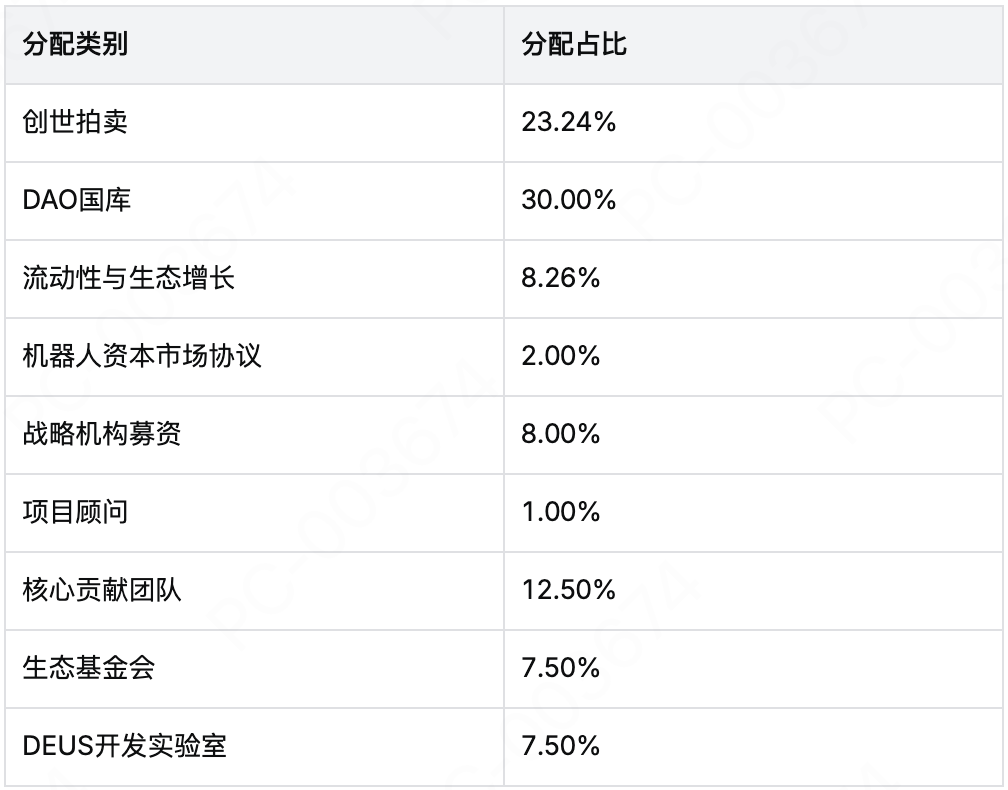
Community-Controlled Tokens Total: 71%
This portion includes the Genesis Auction, DAO Treasury, Liquidity & Ecosystem Building, and Robot Capital Market Protocol allocations, fully reflecting the project's core positioning of community autonomy and decentralized ecosystem development.
To ensure secondary market stability, participants in the public auction and strategic fundraising will unlock 33.33% of their tokens at the Token Generation Event (TGE). The remaining 67% will be linearly vested over 12 months, fundamentally mitigating token sell pressure and inflation risks.

1 Million DEUS Governance Activation Plan
Core Functions of the DEUS Token
The DEUS token is the core vehicle for ecosystem operation. Its main functions are as follows:
- On-Chain Transactions: Supports transaction settlement and computational verification for the Physical AI data network.
- Staking: Unlocks passive yields and computational power bonuses through the DEUS staking module.
- Governance Voting: Participates in core ecosystem decisions, fund allocation, protocol upgrades, and other governance matters.
- Unlocking Benefits: Gains access to premium data analysis tools, exclusive platform features, RWA ecosystem benefits like physical asset yield cards, and more.
To consolidate consensus among holders, users can lock their circulating DEUS tokens into a governance contract to mint corresponding governance rights vouchers.
Detailed Explanation of the xDEUS Lock-up Governance Mechanism
To achieve full community-driven decentralized autonomy, the project, in collaboration with Aragon, has launched a transparent on-chain governance system. Users can participate in ecosystem building through a complete "Stake·Mint·Govern" cycle:
- Stake: Lock DEUS tokens in the governance contract on the Base network.
- Mint: The staked position generates xDEUS tokens, which serve as the user's DAO governance weight credential.
- Govern: xDEUS holders can vote on core proposals, including treasury fund allocation, profit distribution rules, and protocol parameter adjustments.
Users holding xDEUS are entitled to a share of 40% of all profits generated by physical robot assets within the DAO treasury. Concurrently, the project has officially launched the 1 Million DEUS Governance Activation Plan, incentivizing users to lock tokens long-term through dedicated staking rewards, thereby ensuring network security and ecosystem stability.
<


