






Coin Market Observer × LTP Bing: As Wall Street Moves Closer to Crypto, Real Opportunity Might Lie Behind Trading


- Core Insight: Bing, a seasoned trader with a background in traditional finance, believes that the long-term development of the crypto industry depends on the maturity of its infrastructure, not price volatility. He is dedicated to building a prime brokerage service—a rare commodity in the crypto space—that connects multiple exchanges and provides unified risk control, paving the way for genuine institutional capital inflow.
- Key Elements:
- The primary reason institutional capital has yet to flood in is not a lack of demand, but the absence of mature infrastructure like unified custody, risk control, and clearing and settlement that traditional finance offers.
- Prime Brokerage is an underestimated infrastructure in the crypto world. Its core challenge lies in risk management, including margin calls, forced liquidations, and tail risk management during extreme market conditions.
- Liquidity is not simply about market makers setting prices. Market makers mainly influence short-term order book depth, while long-term price direction is still determined by capital flows, sentiment, and the macroeconomic environment.
- AI will not replace traders in the short term, as AI does not bear the consequences of decisions (such as trading losses). Humans remain in charge of final decision-making. In the long run, if AI can achieve optimal resource allocation, it might fundamentally change the nature of trading.
- The biggest change in the coming years could be the convergence of traditional finance and Crypto: Crypto will learn risk control, while traditional finance will learn on-chain clearing and settlement. The boundaries between the two will gradually fade away.
In the crypto industry, most people's attention is perpetually fixated on price.
How much has Bitcoin risen, will ETH hit a new high, will the next narrative shift to AI, RWA, or prediction markets. The market generates new hotspots daily, and people constantly enter or leave the industry due to price fluctuations. But if you talk long enough with those who have truly stayed in the market for a long time, you'll notice they talk less and less about price itself.
They start talking about structure, mechanisms, and risk. They also begin discussing the underlying changes that ordinary users can barely perceive. Because price is merely a result; what truly determines how far a market can go is often the infrastructure hidden behind trading.
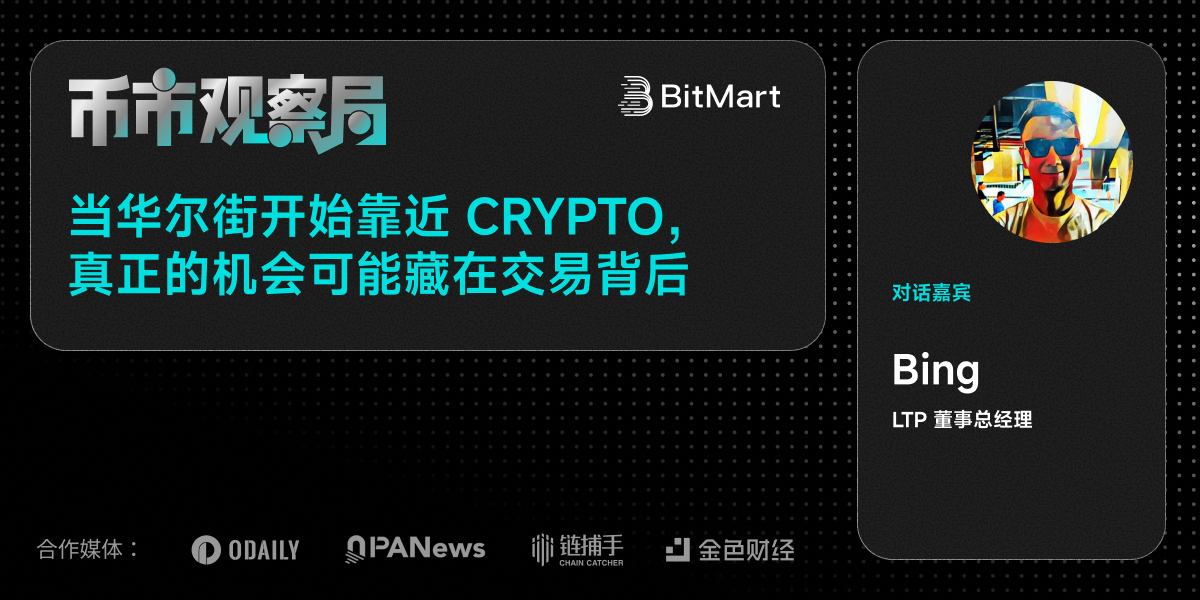
In this episode of "Crypto Market Insights," we invited Bing, Managing Director of LTP. From handling foreign exchange options trading at Lehman Brothers' Tokyo office, to working at top global hedge funds and proprietary trading desks, and later founding his own fund in Hong Kong, Bing's career spans nearly two decades of traditional finance development cycles. After experiencing different phases of traditional finance, he ultimately chose to enter Crypto and began doing something very mature in traditional finance but still extremely rare in the crypto industry—Prime Brokerage.
Guest: Bing, Managing Director of LTP
Host: yuanyuan, Marketing VP at BitMart
(Listen link for this episode: https://www.xiaoyuzhoufm.com/episode/6a1507f2e59ebca936498313)
From Wall Street to Crypto: What Attracts Him Isn't Making Money, But Change Itself
Many assume that people from traditional finance enter Crypto primarily for higher returns. But what truly attracted Bing wasn't the "wealth effect," but the change within the industry itself.
Bing's first job was at Lehman Brothers' Tokyo office, mainly responsible for foreign exchange derivatives trading. He later moved to top European and American hedge funds and bank proprietary trading desks, long engaged in macro and volatility arbitrage trading. Subsequently, he founded his own fund in Hong Kong, experiencing entrepreneurship and the changes brought by market cycles.
Rather than identifying as a manager or entrepreneur, he prefers to see himself as a trader. In his view, trading itself is a very interesting endeavor—constantly understanding the market, seeking patterns, and repeatedly overturning previous knowledge.
In fact, he got involved with Crypto very early on. He started mining as early as 2016, stating that much of his early Crypto accumulation was "mined." But his professional entry into Crypto came many years later.
For a long time, Bing believed that Crypto and traditional finance were two different systems. But he gradually discovered that the once clear boundaries between them are becoming increasingly blurred.
Traditional finance has begun to pay attention to on-chain assets and digital clearing, while Crypto has started to establish increasingly mature financial systems. Two sets of logic that were once completely separate are now moving closer towards each other.
Why Institutions Have Always Wanted to Enter Crypto, But Haven't Truly Done So
Over the past few years, the phrase "institutional entry" has been frequently mentioned in the industry. However, in Bing's view, this statement isn't entirely accurate. Institutional demand has always existed; the market just wasn't ready. In the traditional financial system, before a large fund enters the market, a very mature infrastructure is in place: trading, financing, custody, risk control, clearing and settlement—every link corresponds to a professional service provider. But Crypto is not like this.
For a long time, whether individuals or institutions, almost everyone opened accounts directly on exchanges. Exchanges simultaneously took on too many roles, acting as trading venues while also responsible for financing, custody, and risk management. This model worked fine in the early stages of the industry, but as market scale expanded, it became increasingly unsuitable for large institutions. Large capital is unwilling to spread assets across multiple exchanges or accept completely different risk systems from each platform. What they need is a more unified and mature underlying architecture. This is precisely the problem LTP is trying to solve.
Prime Broker: One of the Most Underestimated Infrastructures in the Crypto World
In traditional finance, Prime Brokers are very common. Almost all large funds use this service system. Simply put, it's responsible not just for trading access, but also for financing, risk management, clearing, settlement, and asset custody. If exchanges are the market, then a Prime Broker is more like an operating system connecting to the market. However, the real difficulty isn't connecting multiple exchanges. Bing mentioned that building a Prime Broker is like the barrel theory. Its height is never determined by the longest plank, but by the shortest one. And the hardest part is risk control.
Because when a platform starts offering financing and leverage, it stops being just a fee-collecting platform. When clients are profitable, there's no issue. But once a client suffers extreme losses, the platform itself begins to assume risk. Knowing when to issue margin calls, when to force liquidate, how to handle extreme market conditions, and how to control systemic, technical, and legal risks—these things are barely noticeable in normal times, but when they happen, they often determine survival. In Bing's view, a Prime Broker essentially bears tail risk. In the Crypto world, this capability remains extremely scarce.
Liquidity Isn't Just "Someone Buying, Someone Selling," and Market Makers Aren't Price Setters
When discussing trading, we also talked about a frequently mentioned but often misunderstood concept: liquidity. Many ordinary users think liquidity simply means there are buyers and sellers in the market. But this is only a superficial understanding.
In traditional financial markets, a large portion of liquidity comes from natural trading demand. Because there are enough participants, orders themselves form depth. But Crypto is different. Especially on many new exchanges, without market makers, the order book can be very sparse. Therefore, many exchanges specifically set up market-making incentive programs, hoping market makers will maintain market depth, control spreads, and provide two-sided quotes.
However, this leads to another common misconception: if liquidity is provided by market makers, does that mean prices are also determined by them? To this, Bing gave a very clear answer: No. Because market makers are essentially passive execution agents. They determine the short-term thickness and depth of the order book, but what truly dictates market direction remains capital, sentiment, narratives, and the macroeconomic environment.
In the short term, market makers shape the order book; in the long term, the market decides where prices go.
Will AI Replace Traders? The Question Might Be Bigger Than Imagined
In the past year, AI has become an unavoidable topic in the industry. More and more trading platforms are launching AI Trading features, and more people are discussing whether traders will be replaced in the future.
But Bing believes it won't happen in the short term. His reason isn't that AI isn't smart enough, but that AI doesn't bear the consequences.
In his view, trading isn't just about making judgments; it's about making decisions. Decisions imply responsibility.
When humans make mistakes, they lose money, get fired, and their lives are affected. AI doesn't. If a program has issues, it can be deleted and restarted. So, at least at the current stage, humans will still be making the final decisions, with AI primarily playing a supporting role.
However, later in the conversation, he offered an even more interesting thought.
Financial markets are essentially about resource allocation—moving funds from one place to another, transferring risk from one entity to another. If AI can truly achieve optimal resource allocation in the future, then many "trading activities" themselves might no longer be necessary. Because AI would have directly accomplished the work that the market was originally supposed to do. This might sound distant, but perhaps many changes are already underway.
The Biggest Future Changes Might Not Happen at Exchanges
Towards the end of our talk, we discussed where the biggest changes in the industry might occur in the coming years. Many people focus on new hotspots, new assets, or new trading venues, but Bing is more concerned with the infrastructure itself.
In his view, the biggest change in the coming years might be the further integration of traditional finance and Crypto. Crypto is learning from traditional finance's risk management and institutional frameworks; traditional finance is starting to learn from Crypto's on-chain clearing, settlement, and asset digitization capabilities. Two completely different systems are continuously moving closer to the middle. So, the biggest future change might not be a specific new hotspot, but rather that the existing boundaries will slowly disappear.
After listening to the entire conversation, you'll notice that Bing rarely predicts prices or judges the rise or fall of specific sectors. For someone who has been trading long-term, understanding the market is more important than predicting it.
After all, truly big opportunities are often not found in the most crowded places, but in places most people haven't yet noticed.
—-----
Recording time for this episode: May 9, 2026
Full content available by searching and following "Crypto Market Insights" on Xiaoyuzhou FM, Apple Podcast, and Spotify.
Also, feel free to follow BitMart's TwitterX for more industry insights, market trends, and platform updates.
Risk Disclaimer
The statements or views expressed in this program are solely those of the guest and do not represent the views of BitMart or its affiliates, nor should they be construed as professional financial investment advice.
Cryptocurrency investments are highly speculative and carry significant risk of loss. Past performance, hypothetical scenarios, or simulated results do not guarantee future returns. The value of digital currencies can fluctuate, and buying, selling, holding, or trading digital currencies may involve significant risks. Before engaging in trading or holding digital currencies, please carefully evaluate their suitability based on your own investment objectives, financial situation, and risk tolerance. BitMart does not provide any investment, legal, or tax advice.


