




Conversation with Bitwise Advisor: Don't Buy a House, Buy Bitcoin


- Core Viewpoint: Bitwise advisor Jeff Park believes the current financial system has failed young people; real estate is a depreciating asset that exacerbates intergenerational inequality, while Bitcoin is the ultimate financial safe haven. Simultaneously, the disruptive development of artificial intelligence (AI) will trigger large-scale labor displacement and become a key catalyst driving Generation Z and Generation Alpha to embrace Bitcoin.
- Key Elements:
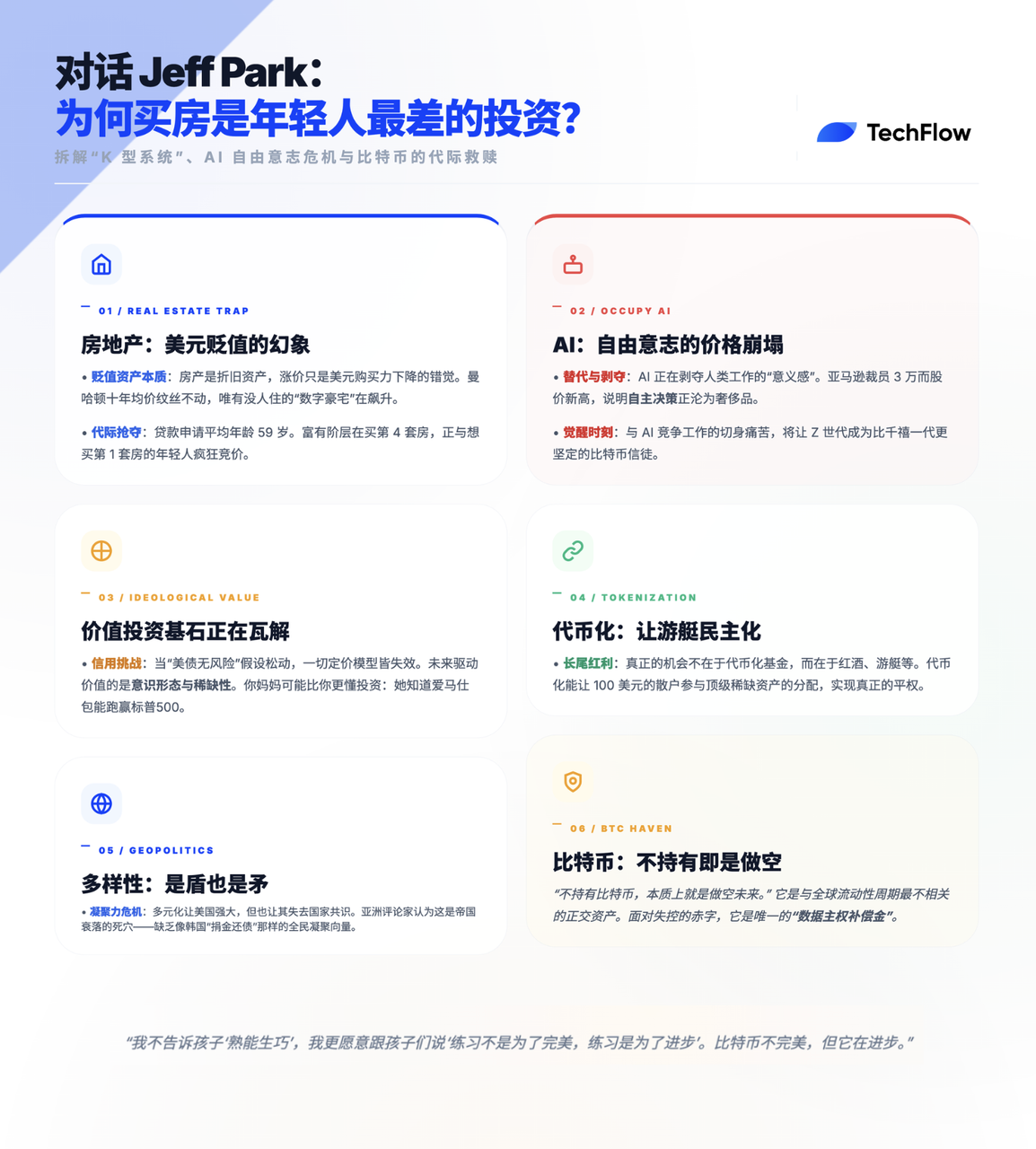
- Real estate is inherently a depreciating asset; its price increases are primarily due to the devaluation of the US dollar, not appreciation of the house itself. In cities like New York, renting is often more economically beneficial than buying.
- The average age of US mortgage applicants has reached 59, highlighting the intergenerational competition and affordability crisis faced by younger generations in home buying.
- Bitcoin, as a wealth storage method requiring no maintenance, occupying no physical space, and being resistant to confiscation, can effectively divert the store-of-value demand from the real estate market, alleviating housing price pressures.
- AI technology may replace human labor on a large scale, leading to corporate profit growth decoupled from labor value, creating a more extreme "K-shaped" economic divide.
- "Occupy AI" will become the "awakening moment" for Generation Z and Generation Alpha. Driven by the personal pain of competing with AI for jobs, they will turn to Bitcoin and cryptocurrencies for solutions.
- Decentralization is crucial for the AI era; cryptocurrencies hold promise for providing the technological foundation to attribute and compensate value for data contributors.
- Within an investment portfolio, Bitcoin is one of the assets with the lowest correlation to traditional global capital markets. Not holding Bitcoin essentially means being exposed to the downside risk of continuous fiat currency devaluation.
Compiled & Edited by: TechFlow
Guest: Jeff Park, Bitwise Advisor
Host: Kevin Follonier
Podcast Source: When Shift Happens
Original Title: Why Buying a House Is the Worst Investment You Can Make - Bitwise Advisor - Jeff Park | E167
Release Date: April 16, 2026
Key Takeaways
Jeff Park is a seasoned macro strategist and an advisor at Bitwise. He firmly believes that the current financial system has lost its relevance for young people, especially in the context of high housing costs and the potential for AI to replace an entire generation's jobs. He points out that real estate is actually a depreciating asset, while Bitcoin is the ultimate financial safe haven. Furthermore, he predicts that the rapid development of AI will trigger the largest wave of Bitcoin adoption globally.
He proposes that "Occupy AI" will become a pivotal turning point for Gen Z and Gen Alpha. At this moment, these two generations will discover Bitcoin's potential through an "aha moment" similar to what Millennials experienced during the financial crisis. Through this process, they will gain a deeper understanding of the nature of digital assets and investing.
Additionally, Jeff is very optimistic about the potential of real estate tokenization. He believes tokenization has the power to revolutionize the existing financial system and provide fairer investment opportunities for ordinary people.
This content explores how these critical moments influence our understanding of digital assets and investing, and the profound implications they may bring for the future.
Highlights Summary
The Truth About Real Estate and Wealth
- "The reason house prices go up isn't because the house itself becomes more valuable; it's because the dollar keeps depreciating. A house is a depreciating asset—it's written in black and white in the tax code that you can deduct depreciation over 20 to 30 years. We've known all along that houses are depreciating assets."
- "The average home price in Manhattan over the past decade hasn't actually increased; it's been flat. What's gone up are the ultra-luxury penthouses treated as wealth storage tools—they're not even lived in, just a line item on a rich person's balance sheet."
- "The average age of someone applying for a home loan in the US this year is 59. That's not someone buying their first home—that's someone buying their third or fourth. And these people are competing directly with that 25-year-old trying to buy their first home."
- "In New York, renting is the economically correct answer. When you own, you pay taxes, maintenance fees, repair costs, mortgage insurance, property insurance... your net yield ends up below 2%, sometimes even below 1% if you're unlucky. You're better off putting that money in a money market fund."
- "Now there's a better way to store wealth. This wealth doesn't need maintenance, doesn't take up physical space, isn't taxed annually, and you don't have to worry about it being confiscated if the government puts you on a list—that's Bitcoin."
About AI and "Occupy AI"
- "We've never seen a technology as disruptive as AI, which has the potential to completely replace labor while allowing corporations to achieve record profits. Amazon lays off 30,000 people, the stock market hits all-time highs—that's the most straightforward footnote to the 'collapse of the price of free will.'"
- "AI is stripping away humanity's capacity for autonomous decision-making. Every technological revolution in history—electricity, airplanes, mail—amplified human capability. AI has the potential to make 'work itself' disappear."
- "The essence of AI is ultimately to centralize all your data, harvest it, and then use it to replace you. If my data is making the model smarter, I need to be compensated in some form—and that compensation mechanism, in theory, can only be achieved through cryptocurrency."
- "Every generation needs an awakening moment to discover Bitcoin. For Millennials, it was the financial crisis. For Gen Z and Gen Alpha, the awakening will be Occupy AI—they will find Bitcoin through the personal pain of competing with AI for jobs."
- "AI and Bitcoin share a common logical core: energy consumption. If you don't agree with the negative externalities brought by AI, then the other side of that same energy coin is a scarce asset—Bitcoin. You can vote with your choice of Bitcoin."
About Investment Frameworks and Logic
- "The foundational assumption of value investing—pricing everything against the risk-free rate—is crumbling because the credit quality of the US itself is being challenged. Remove that assumption, and you see the world more clearly: what truly drives value is ideology, not cheapness."
- "Your mom actually understands investing better than you think. She knows the most valuable things sometimes exist in the physical world—a Hermès bag has consistently outperformed the S&P 500 over the past 20+ years."
- "Diversification isn't dead; you just need to broaden your horizons to find assets truly uncorrelated to the global liquidity cycle—gold, fine art, fine wine... the logic of these assets has nothing to do with whether the S&P is at 6800 or 6200."
- "The tokenization I'm truly interested in isn't BlackRock's money market fund tokenization, but those long-tail assets—top-tier wine, yachts—allowing ordinary people to own a piece for $100. That's the real opportunity for tokenization."
- "Instead of thinking about the upside of owning Bitcoin, think about—what downside risk are you exposed to if you don't have Bitcoin? Not owning Bitcoin is essentially shorting Bitcoin."
- "If I had to choose only two assets, Bitcoin must be one of them—it's the most uncorrelated, most orthogonal asset to everything else in global capital markets. The other is a dollar-based, income-generating asset."
About Society and the Future
- "America's greatest strength is also its greatest weakness: population diversity. This is actually a known attack vector from the East... diversity will destroy this country."
- "When you realize that everyone upstairs, downstairs, and across the street is united under the same patriotic call, unable to control their own destiny—it's a strange feeling."
- "I don't tell my kids 'practice makes perfect.' I tell them practice isn't for perfection; practice is for progress. Nothing is perfect—Bitcoin isn't either, but it's progressing. Everything we do is chasing that ideal direction."
Jeff's Early Exposure to Currency Devaluation
Host Kevin: You mentioned before that you had early exposure to currency devaluation as a child. Can you talk about that?
Jeff Park:
I grew up between the US and Korea, spending part of my elementary school years in Korea. I experienced the 1997 Asian Financial Crisis there, which shocked the world and left a deep mark on me. I was just a second or third grader, but you could feel the entire country in a strange collective state—everyone, upstairs, downstairs, neighbors across the street, united by the same patriotism, facing a destiny they couldn't control. It was a peculiar feeling: when you realize a country's sovereign currency devaluing can unite everyone to that extent. For most Americans, the closest analogy might be 9/11—that national trauma brought everyone, left and right, together to think about what America is and what it represents. Currency devaluation can create the same cohesion.
The 1997 experience was a huge shock to me, but it also showed me the power of a country—when its people are mobilized to face a sovereign crisis in a principled way, defending the people's interests. Another thing I remember clearly: the Korean government at the time asked all citizens to donate gold to replenish the national treasury and help repay IMF bailout loans. In the US, the IMF might sound like a neutral institution, but in many emerging markets, IMF is an extremely politically charged term, viewed with suspicion, disdain, even seen as having political agendas. I saw this side very early, and sometimes I think these experiences were perhaps, in some way, a prelude to me going down the cryptocurrency path twenty years later.
Who is Jeff Park?
Host Kevin: So who are you?
Jeff Park:
I'm Jeff Park, but in a sense, I represent a confluence of many forces. On one hand, I'm Korean-American, raised in the US, with an Eastern-thinking undercurrent, so I can act as a kind of bridge between Eastern and Western narratives—whether it's the prosperity brought by globalization or the resulting social tensions. On the other hand, from a generational perspective, I entered the workforce in 2008—my first job after graduation was at Morgan Stanley, right on the front lines of the global financial crisis.
But that also makes you realize quickly—nothing in this world is truly unbreakable, a lot of what they teach you in school isn't that solid. It's humbling, but you can also turn it into motivation to build your own way of thinking. This experience also made me an epitome of a generation—a Millennial who entered society during the financial crisis, developing a deep distrust of institutions and intermediaries, and desiring non-custodial, autonomous solutions in social networks, various endeavors, and all aspects of life.
How American Diversity is Both a Strength and a Weakness
Host Kevin: You personally experienced currency devaluation as a child, and saw the illusion of the financial system shatter when you started working in 2008. Now we're in New York—the world's financial center, with ridiculously high prices. I'm from Switzerland, live in Singapore, neither is cheap, but coming here still feels outrageous. I can't figure out how ordinary people survive. All of this is related to that thing from your childhood, just more urgent now. What are we looking at? What should we do?
Jeff Park:
America's greatest strength is also its greatest weakness: population diversity, and how this diversity permeates the entire demographic structure and social fabric. You often hear Asian commentators predicting the decline of the American empire, and they usually latch onto a core point: diversity will kill this country. I heard this a lot growing up. This has always been subtly present in Korea's geopolitical relations with China and the US, and now these trends have fully surfaced in domestic US political movements. The core issue is: when the demographic structure is so diverse, it's hard to form genuine national cohesion. In Korea, it's much simpler; we're all Korean, share a common historical foundation, experienced colonial oppression—these shared hardships give us a vector for cohesion. In America, the history is so rich and complex, it's hard to find that obvious, tangible point that makes everyone feel "we've sacrificed together." Korea has mandatory military service—all men, regardless of class or education level, must serve—which plays a huge role in creating a sense of social homogeneity, as does Israel. In America, you ask: what is that shared American experience that everyone has? That's a hard question to answer. American politics typically draws dividing lines between left and right, class, old and young, but I think these dimensions are distractions, ways to evade. The real core is—the lack of a sense of national cohesion among the younger generation, which is the most precious and hardest thing to build.
What We See Today from a Broken Financial System
Host Kevin: What's wrong with the current financial system?
Jeff Park:
We are seeing all the manifestations of a completely out-of-control, utterly broken financial system. People use "K-shaped economy" to explain what's happening at the societal level. A K-shaped economy refers to one part of the population experiencing massive economic prosperity due to asset inflation, while another part of the citizenry is on a downward trajectory—for them, it's a recession. They don't have jobs, can't find jobs. The gap between the two keeps widening—that's the meaning of the K shape: one line going up, one line going down.
How the "K-Shaped System" Manifests in the Real Estate Market
Jeff Park:
You can see it in New York through the asset class of real estate. You might be surprised, but the average price of New York City real estate over the past 10 years hasn't actually increased; it's been flat. You'd be surprised because many narratives make it seem like New York real estate experienced an incredible boom, especially with those astonishing towers, skyscrapers, and reports of Chinese and Russian capital entering residential development. But that's not entirely wrong either.
What we see in real estate is also a K-shaped economy, where ultra-luxury units demanded as store-of-value tools perform well. They aren't actually lived in; they are assets, bought and placed on balance sheets to preserve wealth. That part performs well. If you have a $20 million penthouse bought 7 years ago, you might now trade it for a $30 million penthouse; you're making money.
But if you buy an ordinary home—one you actually intend to live in, raise a family, make some productive economic contribution to the city—and the price is closer to the so-called "affordable" range, those homes have actually performed flat or down.
Manhattan has something called a mansion tax, levied on apartment sales over $1 million. But today in New York, $1 million might only buy a studio. This tax was established maybe thirty or forty years ago when a $1 million apartment might indeed signify some luxury. Because it's not indexed to inflation—the government certainly won't proactively adjust something that expands the tax base for inflation—now almost every secondary market apartment transaction gets hit by this mansion tax.
Homes that contribute more to the city's economic life actually see prices fall or stay flat. New York itself is a paradox. It's a city where two life stories unfold in the same place. Coming here from Singapore or Switzerland, you see everyone's experience can be completely different. All of this, in my view, is a symptom of a shortage of good assets.
The real estate problem isn't new. When many people talk about the decline of capitalism, they point the contradiction at real estate because land is, by definition, scarce. Land is scarce, communities formed around physical space are scarce. Manhattan real estate is expensive because people want to work in commercially vibrant places, where people are close to each other. When you layer these social components on top, land value rises above its historical level due to this convergence of social power. Human civilization has seen this time and again: wherever a core of activity is released, land prospers.