




I Used AI to Analyze 221 Contract Coins and Finally Found the Only Viable Path for Trading Pump-and-Dump Coins


- Core Viewpoint: By studying over 220 Binance contract coin pairs and numerous manipulation events, it was found that predicting the "pump" or "topping out" of pump-and-dump coins is not feasible. The only viable positive-expectancy strategy is to short during a sharp price rise followed by a pullback, with strict moving stop-losses set based on naked candlestick indicators. The emphasis is on early entry, short holding periods, and fast exits.
- Key Elements:
- Pump-and-dump coins are characterized by spot market control exceeding 96%. Volatility is created through violent pump-and-dump actions in the contract market. Manipulation is sustained based on profits from counterparties; otherwise, the coin is abandoned.
- Research shows that strategies predicting the start of manipulation (training F1 score of 0.72, dropping to 0.1 on holdout) and shorting at highs (Sharpe ratio of -0.28) have both failed.
- The successful strategy, V4A, is based on naked candlestick signals. It enters a short position when selling pressure is confirmed to exceed buying pressure for the first time, with a median holding period of only 1 hour. Trades occur in the volume-rich zones of the manipulation cycle.
- After adjusting for real-trading costs like slippage and funding rates, V4A achieved a 100% win rate in live testing (though the sample size is small), with a PnL of approximately 25%, significantly outperforming V3's slightly negative returns.
- The core of the strategy is strict stop-loss (exiting when drawdown exceeds a threshold) to control single-trade risk (average loss ~1%) and profiting through high-frequency trading.
Original Title: "I Used AI to Find a 100% Win Rate 'Contract Demon Coin' Strategy, and What Actually Worked Was..."
Original Author: Crypto Skanda (X: @thecryptoskanda)
TL;DR:
1. By studying over 220 Binance contract coin pairs, hundreds of manipulation event samples, and 60+ data dimensions, we found a potentially viable positive EV trading strategy for "demon coins".
2. Data proves: Predicting the start and "catching the top" are not feasible.
3. The only viable strategy: Shorting during a sharp pullback after a pump, and strictly closing the position upon a rebound.
4. The only effective indicator: Naked candlesticks.
5. Enter early, hold short positions, exit fast.
Full Article:
This week's report from @coinglass_com actually highlights two issues:
First, Binance, Binance, it's still Binance @binance.
Second, the fact that 90% of the trading volume is in contracts has made one thing very clear:
"Gambling" has, in fact, become the consensus among the entire industry's users.
Even though I'll probably get criticized for saying this.
Even though I'll most likely get criticized for saying this.
But since it's gambling, don't pretend you're value investing.
Gambling should be bold and unrestrained.
Gambling should be about extreme, high-speed volatility games.
And Binance's contract "demon coins" are one of the few sources of Alpha in this boring market that retail traders can truly participate in, get real results from, and see real volume.
Many pundits have criticized these manipulated coins, calling them "negative EV" and saying they only reduce the number of "retail lambs" in the market.
But the reality is, the capital that manipulators bring in to play these coins, and the capital participating in trading them, is itself one of the few remaining sources of what could be considered substantial incremental funds in the secondary market.
Moreover, it has several key characteristics:
Non-quantitative.
Directional.
Volatile.
When you trade traditional markets, you're fighting against all sorts of inside information from Capitol Hill and Wall Street.
When you trade demon coins, you just need to beat a contract manipulator who isn't necessarily any more professional than you are.

The question is here:
How do we find the patterns to duel with these contract manipulators and snatch food from the tiger's mouth?
Using AI + personal experience, I've begun to find a way.
Of course, the title is definitely clickbait.
Otherwise, you wouldn't have clicked to read this.
1. First, Understand What a "Demon Coin" Is
The "demon coins" I'm talking about here aren't just coins that rise quickly. Essentially, the "demon coins" I refer to are a type of asset that fits this description:
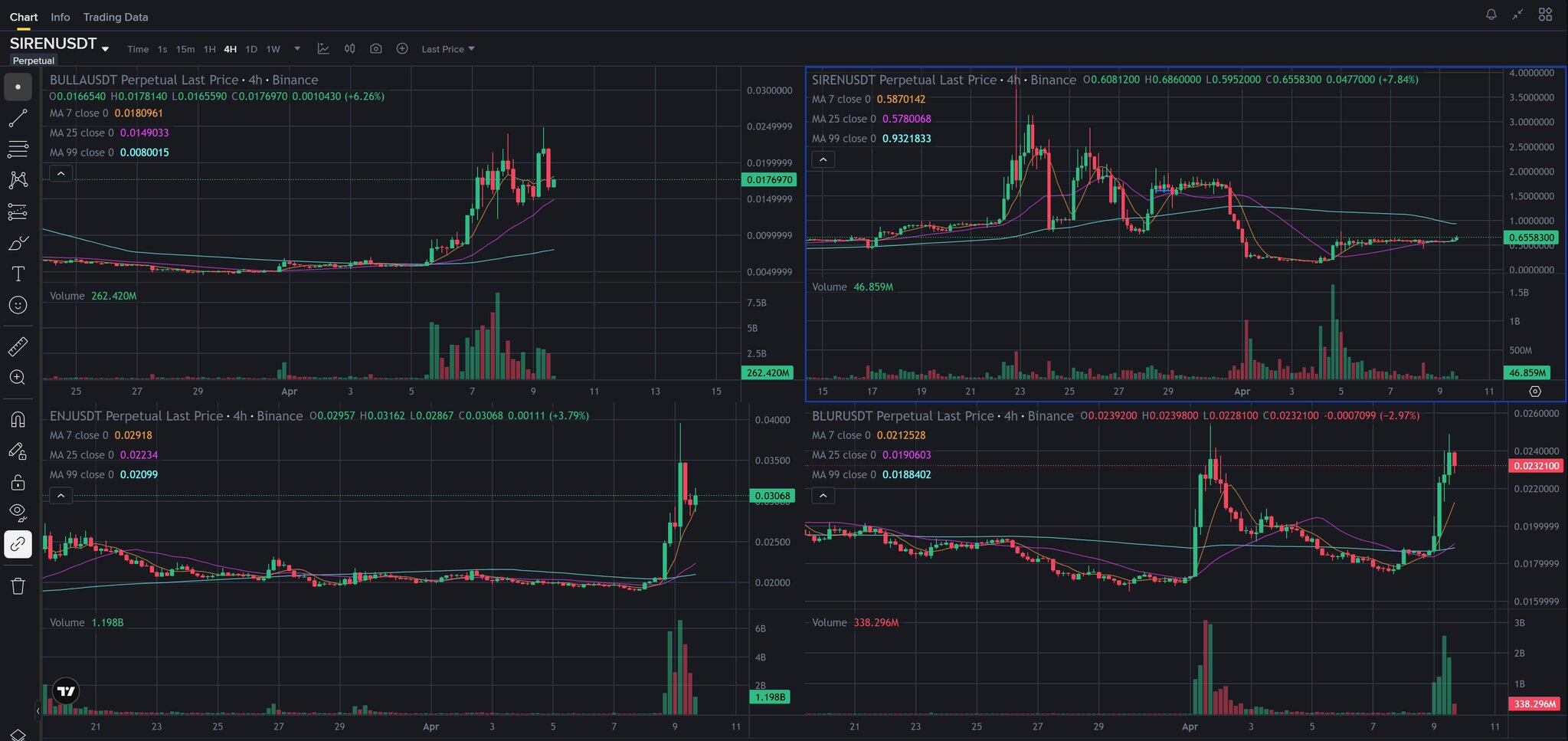
- Spot market control rate is basically above 96%.
- Has a Binance contract listing; whether it has a spot listing is less important.
- Typically uses off-exchange financing to create massive liquidity and counterparty positions through violent pump-and-dump waves in a short time.
- Profits by triggering long/short liquidations and collecting funding fees from counterparties, ultimately completing the harvest cycle by dumping spot holdings.
In short, it's an art of manipulation.
The manipulator needs to understand contracts, cross-exchange spot trading, on-chain activity, operations, and even human psychology.
2. The Manipulator Isn't Invincible
Many people think: The manipulator is invincible.
But the truth is quite different.
The actual participants in a demon coin game include:
- The manipulator (the "whale" or "operator")
- Insiders / "rat warehouse" traders
- Retail traders
- The exchange and its insurance fund
- Other whales
It's a case of the mantis stalking the cicada, unaware of the oriole behind—not simply "the manipulator unilaterally beating up retail."

First, the manipulator often needs financing themselves.
Whether it's a project that raised over $15 million or those "famous" market makers, relying solely on their own capital for manipulation at this level in the secondary market is often just a drop in the bucket.
And financing has costs.
Manipulation is for profit, not performance art.
So the manipulator can't just "pump and be done with it" because they have enough chips.
They face a bunch of practical problems:
- What if retail doesn't follow?
- What if retail follows, but in the wrong direction or at the wrong pace?
- What if a bigger whale specifically comes to snipe them?
- Even if none of the above happens, what if they cut through the exchange's insurance fund and trigger ADL (Auto-Deleveraging)?
Then you might not be able to withdraw a single cent. Our friends in Singapore know who I'm talking about.

So there's a very simple iron rule for demon coin manipulation:
- As long as the profit I can take from counterparties now is greater than the cost of continuing the manipulation, I will continue to pump, continue to dump, continue to harvest.
- Otherwise, abandon the play and leave.
The wording is crude, but this serves as a framework for a demon coin manipulator's decision chain.
3. Scientific "Fighting the Manipulator" Starts with Experimentation
Since the question is "how to fight the manipulator," I tried to quantify this.
1) How the Tool Was Built
Problems of the modern age require modern solutions.
Referencing @karpathy's ideas on the Autoresearch loop, I built one myself. As long as you give it clear goals, constraints, and an experimental methodology, the agent will keep running until the data can't be improved further.
The LLM used is Opus 4.6.
My 20x Claude Max subscription can still handle this task.
For the sandbox, I directly used an idle iMac as a remote experimental machine;
Then used Tailscale to control it remotely from VSCode on my Windows workstation.
For data, the most helpful for this research was undoubtedly @coinglass_com.
Thanks also to @AlbertCoinGlass for sponsoring the API for this research.
Candlesticks, order book, OI, funding rate, liquidations—they have it all.
Besides that, I also used:
- Binance API
- Skill Hub (shoutout to @0xOar, it's really good)
- Etherscan V2 API to pull historical on-chain records
2) What Data Was Examined
I finally organized 12 major categories, 60+ sub-dimensions, including:
- Funding Rate
- OI (Open Interest)
- Long/Short Ratio (retail / large holders / positions / accounts)
- Taker buy/sell ratio
- Liquidation volume
- Order book
- On-chain transfers
- Candlesticks
The initially selected coins, including $RIVER, $STO, $MMT, totaled 16 coins I judged to be manipulated based on experience.
4. Phase One: I Initially Wanted to Predict "Pre-Pump Signals"
Then I adopted an assumption that retail loves to fantasize about but is usually the most problematic: predicting pre-pump signals.
"There must be signals before a demon coin manipulation. Like abnormal FR, OI buildup, on-chain anomalies. Find these signals, position early, and print money."
It turns out, this is the fastest way to lose money.
At that time, I didn't have a particularly strict definition of "manipulation."
I just manually截取 several of the most obvious "manipulation events" from the candlesticks of $RIVER, $STO, $MMT, then looked for commonalities from these events, and expanded to the other 16 coins to form the experimental set.
To prevent overfitting, Autoresearch did strict time splitting:
- Early data for training
- Later data for holdout (persistence validation)
- The holdout set was completely invisible during the training phase
The experimental method was also crude:
Start from extreme values of a single signal, like funding rate,
Then gradually layer on other indicators until the F1 score improves.
Result:
Training set F1 reached 0.72.
Looks like it's about to succeed.
Once applied to the holdout set, it almost completely failed, F1 dropped to around 0.1.
That is to say:
The path of "predicting when manipulation will occur" is basically a dead end.
5. The Problem Is: You're Thinking About Causality Backwards
After the first version failed, I realized a fundamental problem:
A coin doesn't become a demon coin because it meets certain indicators.
Rather, because it is inherently a demon coin, it develops those indicator characteristics.
This logic is actually very consistent with everyone's gut feeling.
No matter how bad the overall market is, there will always be demon coins going crazy on their own.
Demon coins never play by the market's rules; they only care about one thing:
Is there a manipulator?
So we can't try to predict when a manipulated coin will start its move.
The truly viable direction is:
Wait until it has already started, identify that "this is a manipulated coin, it's being manipulated right now," and then find trading strategies based on this state.
So I completely changed my approach.
This time I started strictly defining the "manipulation cycle":
A complete cycle of manipulation is a rapid pump followed by a rapid dump within a short period.
The problems to solve next became:
- How much pump and how much dump constitutes a complete cycle?
- Once the cycle is identified, what trading method to use?
I left all of this for the AI to discover on its own.
The experimental sample size was also greatly expanded:
- 16 coins, identified 415 manipulation cycles
- Later expanded to 55 coins that fit the market's perception of "manipulated coins"
- Finally annotated 1447 cycles

The sample size finally didn't feel like fortune-telling, and then I started failing continuously...
6. Several Strategy Versions, Continuous Beatings
V1: Shorting at Highs
The first version strategy produced a "short at highs" idea.
Backtest Sharpe +0.72.
Sounds okay.
Once run on the holdout set, the training set and test set were completely different universes.
Later复盘 revealed the problem was:
I gave too few constraints, and Opus arbitrarily defined what "highs" meant.
Turns out I was doing a double-slit interference experiment for fortune-telling.
V2: After Banning Arbitrary Definitions, Results Were Worse
So for V2 I directly added restrictions:
- No arbitrary definitions allowed
- Every indicator must have data support
- Also need to distinguish between different manipulation styles
Like violent pump & dump, slow pump & violent dump, violent pump & slow dump, etc.
I wanted it to find different manipulators' "voiceprints."
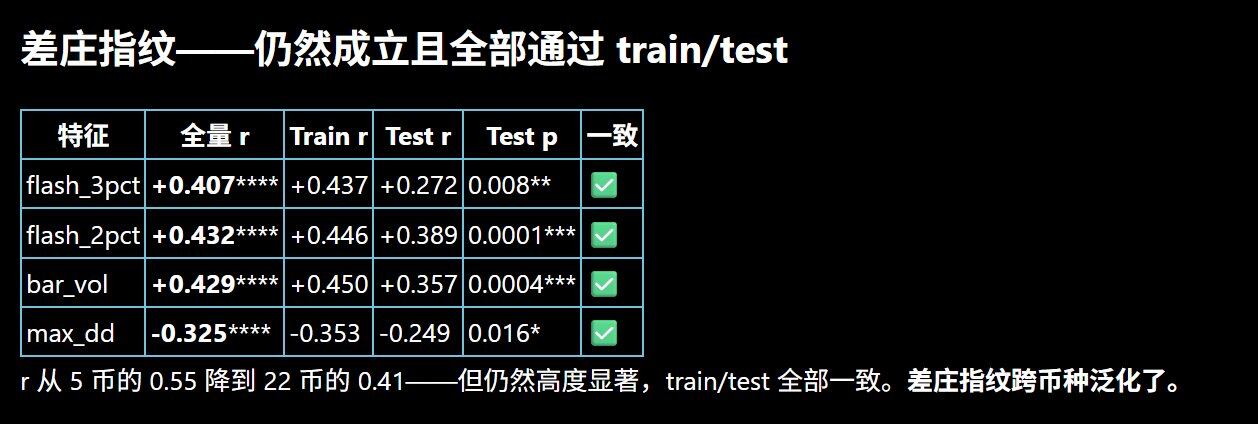
结果 it very scientifically gave me a:
Sharpe of -0.28.
Then I asked Opus to explain the decision logic of V1 and V2 to me,
And I suddenly realized that both strategies were essentially doing the same thing:
Shorting the top.
This is fundamentally no different from those "top-catching immortals" who stubbornly short while paying funding fees.
The only difference is, they hang themselves on the tree manually, I use AI to hang myself automatically.
That's when I realized:
It's not that the method isn't advanced enough.
The thinking itself is wrong.
Note: Considered long strategies, but the problem is:
The start of a demon coin's move is hard to trace. Although some demon coins show obvious anomalies when starting, like "creating pullbacks to wash out positions" is a common feature, the problem is the same: how to distinguish the entry direction?
Going long after "catching the top" or during a downtrend is certain death. But this kind of "false positive" signal is hard to validate in advance, and there's no good way to distinguish between manipulated and non-manipulated rises, so it's not feasible.
7. V3: Thinking from the Manipulator's Perspective
Going back to the earlier decision framework:
Profit comes first.
The manipulator will always go with the flow, moving in the direction of least resistance to reduce costs.
What does that mean?
- When selling pressure is high, let the market dump, or even dump along with it
- When it can't dump further and short positions pile up, then pump up
- Pumping the spot price doesn't necessarily cost a lot of money
- Short positions either get burned by funding fees or liquidated
So there must be a point:
Where the manipulator thinks continuing to defend the price is no longer worthwhile.
After this point, the manipulator will let the market fall.
Because defending further has no cost-benefit.
So what we should really be looking for is not the top.
But this:
The abandonment point.
Then design trading and stop-loss logic around this point to avoid getting stopped out by ordinary rebounds, while also not losing big when the direction is wrong.
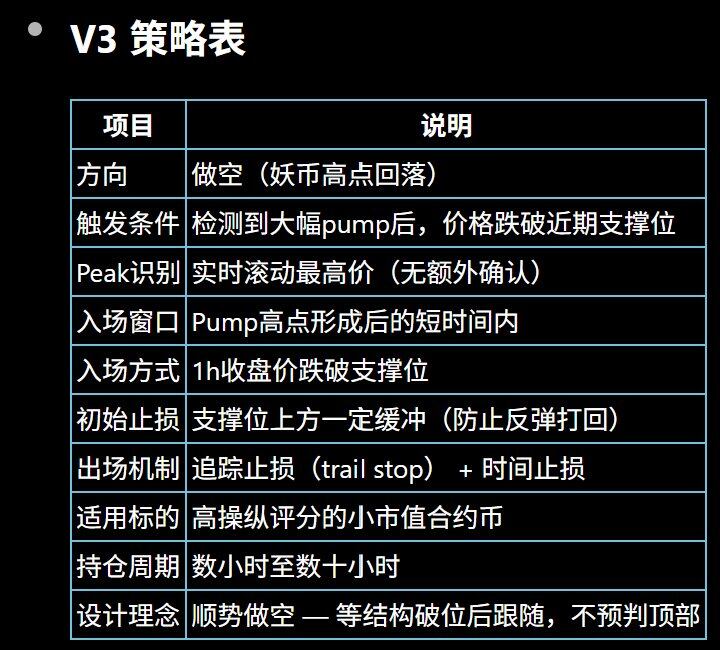
The experimental results at the time looked extremely漂亮:
- Logic based on the 1H chart
- Two consecutive 1-hour candlesticks with bodies breaking below support by 5%
- Paired with a 3% trailing stop
- Average PNL also above +3%
But here's the problem:
Sharpe 15+, and it even passed the overfitting test.
With numbers like that, only a fool wouldn't know something's wrong.
8. V4: Aiming for "Can Be Traded Live"
After V3, I started doubting a few things.
First, it was likely already overfitted, and the current experiment didn't truly define what a "manipulated coin" is