




When AI Becomes the "User": OKX Global Business Officer Lennix on Onchain OS and the Next Generation of On-Chain Trading


- Core Viewpoint: OKX believes AI Agents will profoundly change how users interact with blockchains and is building an operating system called Onchain OS, designed for AI Agents. It aims to integrate secure execution environments with underlying capabilities to support a future large-scale on-chain ecosystem dominated by AI Agents.
- Key Elements:
- AI Agents are moving from concept to practical application. Users have already begun using them for market monitoring and strategy deployment, representing a major trend that will alter trading behavior and on-chain interaction methods.
- The core challenge currently facing AI Agents is the lack of a secure, controllable execution environment, making it difficult to ensure user control while maintaining freedom of action.
- Onchain OS is built upon the existing capabilities of OKX Wallet. Its system handles over 1.2 billion daily API calls on average, supports more than 60 chains and over 500 DEXs, providing a solid foundation for Agent calls.
- The system aims to allow users to drive Agents through natural language instructions to complete complex operations (such as conditional trades), with underlying processes like security and liquidity handled uniformly by the system.
- The future will be an environment of multi-Agent interaction, requiring efficient settlement layer support. X Layer (an L2 based on Enhanced OP Stack) is positioned as a low-cost infrastructure supporting payments and interactions between Agents.
- The goal is to build an open ecosystem, expanding Agent capabilities (Skills) through a Plugin mechanism and community contributions, lowering the barrier for individual users to participate in complex financial operations and granting them capabilities close to those of institutions.
The annual Hong Kong Web3 Carnival has once again kicked off, with global crypto professionals gathering at the summit.
As one of the largest and most influential Web3 events in the industry, the "2026 Hong Kong Web3 Carnival" brought together numerous heavyweight speakers and over a hundred participating projects, attracting widespread attention and participation from developers, institutions, and industry participants worldwide.
On the first day of the summit, Lennix, Global Chief Commercial Officer of OKX, was invited to deliver a keynote speech titled "Start building on Onchain OS" at the main forum. The following is the content of the speech (edited for clarity):
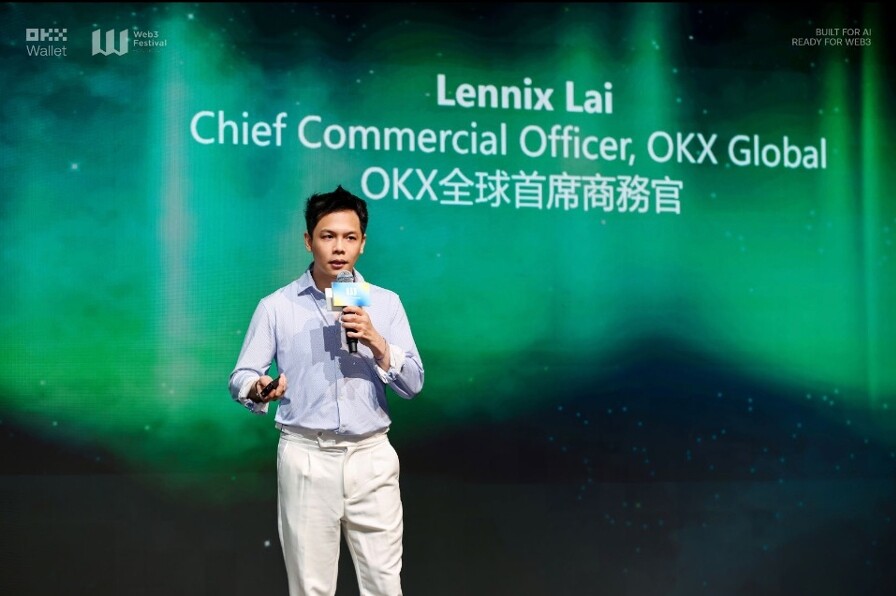
Today, I want to talk about the future, and also about the role of AI in our entire financial system, especially within our industry.
AI is Not Just a Tool Upgrade, But the Beginning of a Trend
The past year to a year and a half has seen incredibly rapid change. Everyone is talking about AI and using Agents. With the development of large language models, we are beginning to see Agents not just as a concept, but truly starting to integrate into our business operations. We see users creating various Agents to achieve different goals. Some use OKX Wallet data, combined with AI models, to monitor markets, generate signals, and then deploy different strategies.
These applications have led us to realize one thing: this is not just a tool upgrade, but a significant trend that is taking shape. And this trend could be extremely important because it will change trading behavior itself and the way we interact with the blockchain.
In the past, OKX Wallet spent a lot of time optimizing the user experience, transitioning from Web2 to Web3, from the interface to the transaction flow. But if Agents become part of the user, or even the primary user in the future, the entire logic of interaction needs to be redesigned.
So the current issue is clear. You can use Agents for deep data analysis, and AI can generate many trading signals. But the most critical step, or what Agents currently lack the most, is how to execute, and how to execute safely? How can we maintain user control without sacrificing the Agent's freedom? These are the truly difficult problems.
We now see some Agents capable of performing tasks like managing accounts, initiating payments, and executing simple operations, but these capabilities are fragmented. The problem isn't the lack of capability, but that these capabilities are not integrated and running within a secure, controllable execution environment. So we started thinking: if Agents are users, should we build an operating system for Agents? This is our starting point.
Onchain OS: An Operating System Built for Agents
We don't just view users as human users; we believe Agents themselves are also users. Therefore, we need a system that can serve different types of Agents, enabling them to call capabilities, execute operations, and collaborate with each other.
Onchain OS is not built from scratch; it is built upon the existing capabilities of OKX Wallet. The OKX Wallet system itself is API-first. We handle over 1.2 billion API calls daily, with approximately $300 million in trading volume. It currently supports over 60 chains, aggregates more than 500 DEXs, and the overall system stability reaches 99.9%. Precisely because everything is API-ready, we can build MCP (Model Context Protocol) on this foundation, allowing future Agents to directly call these capabilities to accomplish their intended tasks.
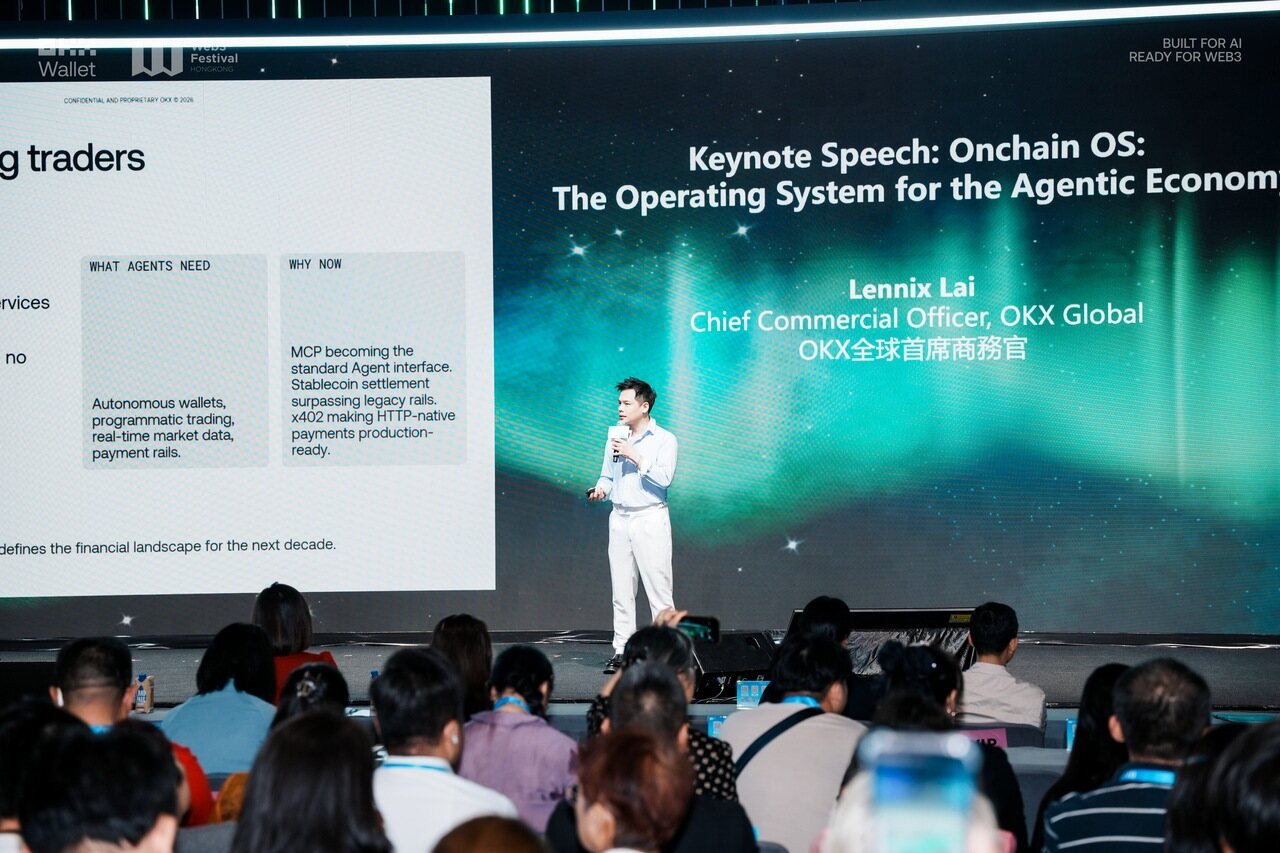
Within this system, we have also introduced payment capabilities, enabling Agents to complete payments and transactions; we use X Layer as the execution layer, which is extremely low-cost, even free; and we have introduced a Plugin mechanism, allowing the community and developers to build more capabilities. We hope users can perform actions directly using natural language, rather than clicking through layers of interfaces.
For example, if you say, "When ETH drops to $2000, swap it to USDC for me," the Agent will continuously track the market price, use OKX Wallet data to make judgments, and then automatically complete price comparison, liquidity sourcing, verification, and transaction execution when the conditions are met. Therefore, future crypto users may no longer focus on specific interface experiences as they do today, because all operations will be distilled into a common language for expression. Underlying security, liquidity, asset management, and various complex processes will all be handled uniformly by OKX Wallet's native underlying system.
But what's even more interesting is that this won't be a world with just one Agent. There will be many Agents in the future. Your Agent will interact with others' Agents, collaborate with third-party Agents, and even engage in payments and settlements with each other. We will enter an environment of Agent-to-Agent and Agent-to-human interactions. In such an environment, we need an infrastructure to support these payment scenarios, which is the role of X Layer. It is a Layer 2 based on Enhanced OP Stack, supporting fast, low-cost settlements, as well as payments and interactions between Agents.
We believe that in the future, more and more Agents will participate in transactions and interactions on-chain, even forming an on-chain ecosystem far larger than one dominated by humans. Therefore, to achieve this, a truly efficient settlement layer is needed. This is also why we want to build an open ecosystem. This is just the beginning; we need ecosystem partners to participate together, such as continuously expanding different types of Skills.
At the same time, we are continuously opening up the ecosystem, allowing the community to submit Skills, which are reviewed by AI Agents and security teams before being listed. Users can install them with one click. We also provide tools like SDKs and CLIs to help developers build Agents, bringing them closer to application forms. In Onchain OS and the Plugin Store, we hope to see more real-world use cases, ultimately enabling a single person to manage a project or even an entire investment system.
Conclusion
Over the years, financial infrastructure has been highly reliant on top-tier professionals. It required assembling a complete team, including roles like analysts, traders, risk controllers, and developers, establishing a full set of standardized investment processes, while also complying with regulatory requirements like Anti-Money Laundering (AML), and needing to operate in synergy with such a system. But the future may be different. One person, plus multiple different types of Agents, has the opportunity to complete similar work, perhaps even more efficiently.
When we interact with the on-chain ecosystem, we no longer need to rely entirely on a team to build all of this. Every user has the potential to gain capabilities and competitiveness close to that of large institutions. This means ordinary users can also possess advantages that were once only available to professional institutions. I believe this is a very crucial development. This is not only the change happening in our ecosystem but also explains why AI will play an increasingly important role in this industry.
We can even imagine that in the future, the scale of Agent-driven transactions and interactions might surpass that of human-dominated markets.
Thank you. If you are interested in Onchain OS and want to work together on something, please feel free to contact us.