






Crypto Market Observer × Bagel Chess: When Information Begins to Be Priced with Money, Prediction Markets Are Redefining the Boundaries of Trading


- Core Viewpoint: Chess, founder of Bagel, believes that Web3 prediction markets represent the next generation of trusted media for reconstructing information distribution, pricing information with real money, and are poised to explode in 2026. Simultaneously, he emphasizes the importance for founders in a highly uncertain industry to maintain judgment through extreme physical management and a sense of order.
- Key Elements:
- Entrepreneurial Reflection: Chess reviews his early experiences, pointing out that the Web2 logic of "scale first, model later" fails in Web3. Entrepreneurship must directly confront the essence of business, pursuing products with positive returns and long-term iteration.
- Value of Prediction Markets: Through the mechanism of "placing bets on specific yes/no questions," prediction markets express consensus via price, filter out noise from those without skin in the game, and form the most authentic public judgment, representing the next generation of trusted media.
- Market Outlook: Prediction markets are expanding from professional to ordinary users. Due to events like the World Cup, major elections, and the potential for ordinary people to monetize knowledge, 2026 will become the inaugural year for this sector.
- Founder Discipline: Chess views physical management practices like ice baths as "clearing the brain's cache," serving as a crucial foundation for maintaining calm judgment and an entrepreneurial state in a highly volatile industry.
- Industry Trend Judgment: The integration of AI and Crypto is inevitable. Future startups will shift towards a "special forces" model heavily armed by AI, with core costs transitioning from human resources to computing power and Tokens.
In the crypto industry, Chess is an entrepreneur who defies a single label. He possesses both the obsession with product details of a Web2 veteran and the calm, analytical approach to underlying logic of a Web3 geek. From the vision of a "crypto Alipay" during the Cobo era to his current deep dive into the prediction market track with Bagel, Chess's journey is more like a process of self-evolution centered on "finding genuine demand."
In this episode of "Crypto Market Observer," we spoke with Chess about prediction markets as he sees them—a market for betting on outcomes and a mechanism for expressing judgment through price. We also touched upon his almost brutally disciplined habits, attempting to glimpse, through "ice baths" and a "sense of order," how a Web3 founder anchors certainty within amidst an extremely uncertain market.
Host: yuanyuan, BitMart Marketing VP
Guest: Chess, Founder of Bagel
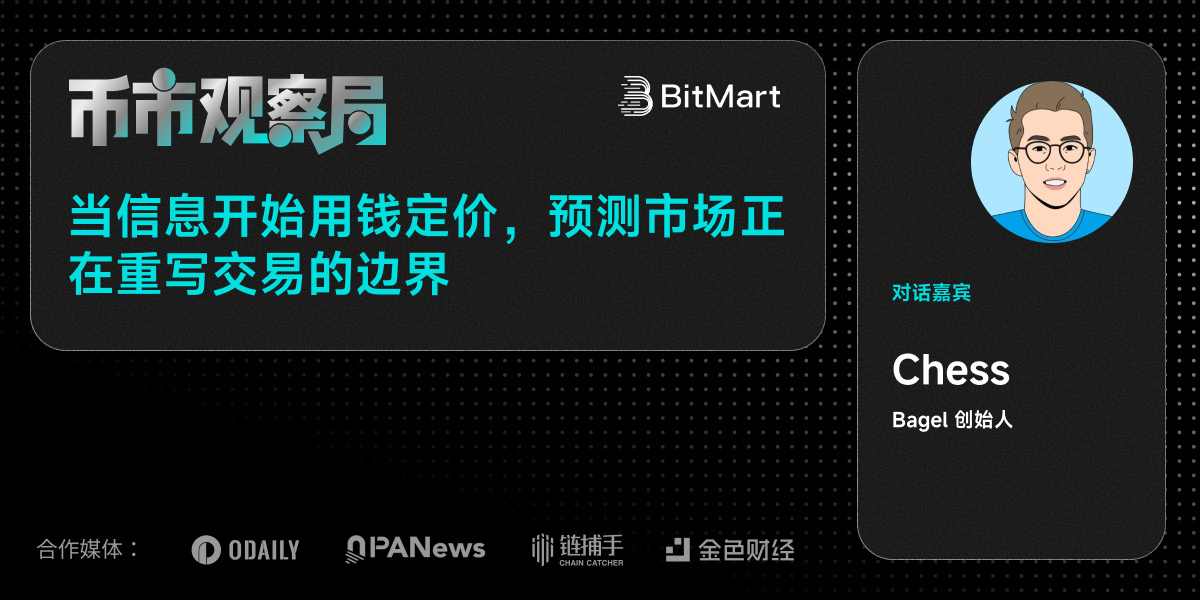
Link to this episode: https://www.xiaoyuzhoufm.com/episode/69e59bc01e94ae6921ac0cdc
Entrepreneurial Review: From the Failure of Internet Thinking to Facing the Essence of Business
Chess's Web3 past is a long process of correction in the search for "rigid demand." Before entering the crypto industry, he experienced the shifts of the Web2 mobile internet era, from 360's utility products to O2O used car trading, and then to the live-streaming sector. After entering Web3 in 2017, he worked in operations at Cobo, participating in attempts to turn the wallet into a "crypto Alipay." However, reviewing that experience, Chess believes that in an era without DeFi, NFTs, and frequent on-chain interactions, wallet products at that time lacked scenarios for rigid demand.
This reflection on "pseudo-demand" continued into his subsequent entrepreneurial ventures. He once founded a task platform product, which had users and revenue, but the lack of a clear business model and path to capitalization made him realize that the Web2 logic of "accumulating user scale through subsidies first, then figuring out the business model later" completely fails in Web3.
He admits that he once had a "scholar's aloofness," looking down on the "unconventional methods" in the industry, but ultimately discovered that "when in Rome" in this industry means facing the essence of business head-on. He no longer believes in user scale sustained by VC funding, but instead turns to pursuing products with positive returns that can iterate over the long term.
Prediction Markets: The Next Generation of Trustworthy Media, Pricing Information with Real Money
In Chess's view, only two things in Web3 are truly viable: either directly engaging in trading, or selling shovels around trading. Prediction markets represent a reconstruction of traditional information distribution logic. He simplifies it to one sentence: for a definite question, provide an answer and place a bet.
Behind this lies a complete overhaul of information distribution logic. Web1 was centralized editors deciding what you see, Web2 is algorithmic recommendations deciding what you see (often based on platform commercial value, aiming to keep you hooked), while prediction markets make the true results closer to consensus emerge through "information pricing." Chess believes prediction markets are the next generation of trustworthy media because they filter out those "shilling without skin in the game." When an event has massive trading volume on Polymarket, the resulting price is the most authentic public opinion and judgment.
Currently, prediction markets are in their early stages. Their audience is also expanding from professional users to ordinary users. For example, centralized platforms like BitMart have already launched a prediction market section. What Chess is building with Bagel is positioned as a "mobile broker" role that understands Asians, has a more user-friendly UI, and offers richer gameplay, with entry points being mobile, the Asian market, and decentralization.
Chess believes that 2026 is undoubtedly the inaugural year for prediction markets, not only because of the turnover rate brought by the World Cup and major elections, but also because prediction markets give ordinary people's "useless knowledge"—whether it's their eye for Netflix shows or their research into Premier League data—the possibility of monetization for the first time.
Sense of Order and Physical Management: The INTJ's "Cache Clearing"
In conversation with Chess, it's hard not to be drawn to the strong "sense of order" he exudes. As a typical INTJ, he loves the polite and orderly social structures of Singapore and Japan and has internalized this pursuit of order into physical management. Starting from a low point in 2024, he began a "system optimization" for his body through genetic testing and scientific validation: 16:8 intermittent fasting, cold showers, and the signature ice baths.
For him, ice baths are not just a process of reducing inflammation and boosting energy, but also a form of "brain cache clearing." In extremely cold water, all worldly human worries disappear, leaving only the purity of survival instinct. Chess has labeled this self-discipline and made it part of his founder IP. Chess believes that in a high-volatility, long-cycle industry like Web3, physical condition is the most important capital for entrepreneurship. He wants to live longer and with higher quality so he can "step up" when opportunities arise. This ability to remain calm in extreme cold is also the foundation for maintaining judgment in complex trading markets.
Future Vision: AI-Armed Elite Special Forces
Regarding future industry narratives, Chess's views are direct and carry a "sharp-tongued" clarity. He believes many grand narratives like DeSci mostly lack real commercial closed loops at the current stage, while the integration of AI and Crypto is an inevitable trend. He has even begun implementing this transformation within his team: equipping all members with computing power devices and experimenting with locally deployed AI Agents.
In his eyes, future startups will shift from large-scale operations to a "special forces" model, evolving into elite units akin to "Navy SEALs." A company's core cost structure is changing: from human resource costs to AI computing power and token costs. Everyone should be a highly AI-armed individual, using minimal scale to compete against the efficiency of formerly massive organizations.
The flip side of this efficiency revolution is unavoidable social upheaval. Chess admits that while it's currently unclear what new types of jobs will emerge besides AI trainers and operations personnel, the reshaping of occupational structures is imminent. He predicts: "In the future, it will definitely be the cheapest human labor competing for robots' jobs, while robots compete for the jobs of those expensive humans."
Conclusion
At the end of the conversation, we talked about how the outside world defines him. Chess hopes people remember only two labels about him: one is "the ice bath guy," representing his control over his own state; the other is "the prediction market guy," representing the cause he wants to dedicate himself to.
If he achieves financial freedom in the future, what Chess most wants to do is become a director, make films, and write stories. He cited a point mentioned by Wang Ning in an interview: science and technology are used to solve the problem of humans "living well," while culture and art determine how humans "find themselves." In his view, the more advanced AI becomes, the more irreplaceable those uniquely human emotional values—such as anger, joy, and irrational impulses—become, and they are worth recording.
—-----
Recording date for this episode: March 31, 2026
For the full content, search for and follow "Crypto Market Observer" on Xiaoyuzhou, Apple Podcasts, and Spotify.

Also welcome to follow BitMart's TwitterX for more industry insights, market trends, and platform updates.
Risk Disclosure
The opinions or views expressed in this program represent the personal stance of the guest and do not represent the views of BitMart or its affiliates, nor should they be considered professional financial investment advice.
Cryptocurrency investment is highly speculative and carries significant risk of loss. Past performance, hypothetical scenarios, or simulation results do not guarantee future returns. The value of digital currencies may be volatile, and buying, holding, or trading digital currencies may involve substantial risks. Before participating in trading or holding digital currencies, please carefully assess their suitability based on your own investment objectives, financial situation, and risk tolerance. BitMart does not provide any investment, legal, or tax advice.


