






Freezing Satoshi's Bitcoin? BIP-361 Proposal Ignites Community's Most Intense "Quantum Threat" Debate


- Core Viewpoint: Bitcoin developers Jameson Lopp and others have submitted the BIP-361 proposal, advocating for the phased freezing of Bitcoin addresses using old signature schemes (ECDSA/Schnorr) to address potential threats from future quantum computers. However, this mandatory migration plan has sparked intense community backlash for allegedly "confiscating" user assets.
- Key Elements:
- The proposal aims to freeze old addresses vulnerable to quantum attacks, affecting approximately 34% (over 1.7 million) of all BTC with exposed public keys on the network. This includes Satoshi Nakamoto's holdings of about 1.1 million BTC, valued at roughly $74 billion.
- The plan is to be executed in three phases: Phase A prohibits sending BTC to old addresses; Phase B completely invalidates old signatures and freezes the associated funds; Phase C (not yet finalized) envisions providing relief to legitimate owners through zero-knowledge proofs.
- The proposal authors argue that proactively freezing vulnerable assets (including approximately 5.6 million dormant BTC that may already be lost) constitutes an "upgraded private incentive" to prevent the devaluation of the entire network's assets due to a quantum attack.
- The community has voiced strong criticism, arguing that the proposal violates Bitcoin's core principle of "unconditional ownership," exhibits authoritarian and compulsory confiscation characteristics, and undermines its promise as "unstoppable money."
- The market reaction has been relatively mild so far. Related prediction market odds suggest the proposal is seen more as a governance discussion rather than an imminent threat catalyst.
Original Author: Claude, Deep Tide TechFlow
Introduction: Bitcoin developer Jameson Lopp and others officially submitted the BIP-361 proposal on April 14, planning to phase out ECDSA and Schnorr signatures in three stages, ultimately freezing all early wallets that have not migrated to quantum-resistant addresses.
The proposal involves approximately 1.7 million BTC in P2PK addresses (including Satoshi Nakamoto's holdings of about 1.1 million BTC, valued at approximately $74 billion). About 34% of all Bitcoin is at risk of quantum attacks because their public keys have been exposed. The proposal immediately faced fierce criticism from the community, with critics labeling it "authoritarian confiscation." However, Lopp responded that he would rather freeze 5.6 million dormant BTC than let them fall into the hands of quantum hackers.
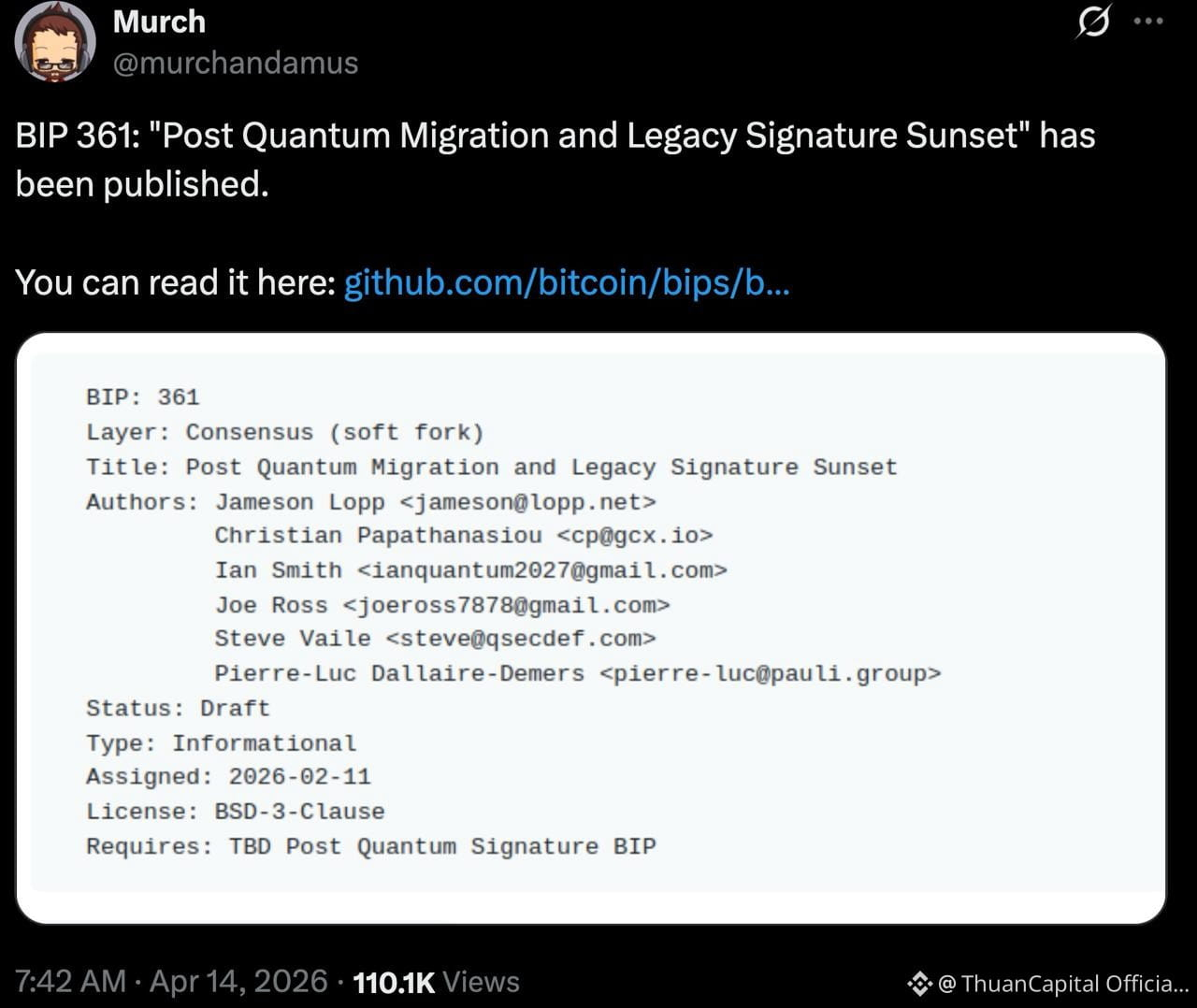
Renowned cypherpunk and Casa CTO Jameson Lopp, along with five other researchers, submitted a draft named BIP-361 to the bitcoin/bips repository on GitHub on April 14. Its full title is "Post Quantum Migration and Legacy Signature Sunset."
The core proposition of this proposal is straightforward: Before quantum computers can crack existing cryptographic algorithms, the network should proactively freeze all Bitcoin wallets that rely on old signature schemes.
According to a CoinDesk report, Lopp stated in an interview that he does not currently believe these measures are immediately necessary, but emphasized he is engaging in "adversarial thinking about potential future threats." He further admitted on platform X: "I know people don't like this proposal. I don't like it either. But I wrote it because I like the alternative even less."
Three-Phase "Sunset Plan": From Restriction to Freeze
BIP-361 builds upon BIP-360, which was released in February this year. BIP-360 proposed a new address format called P2MR (pay-to-Merkle-root), similar to existing Taproot addresses but removing the key path vulnerable to quantum attacks, providing forward protection for new coins.
BIP-361 aims to address the existing stock problem: as of March 1, 2026, public keys for over 34% of all Bitcoin have been exposed on-chain, a figure directly from the BIP-361 document itself.
The proposal designs three progressive phases:
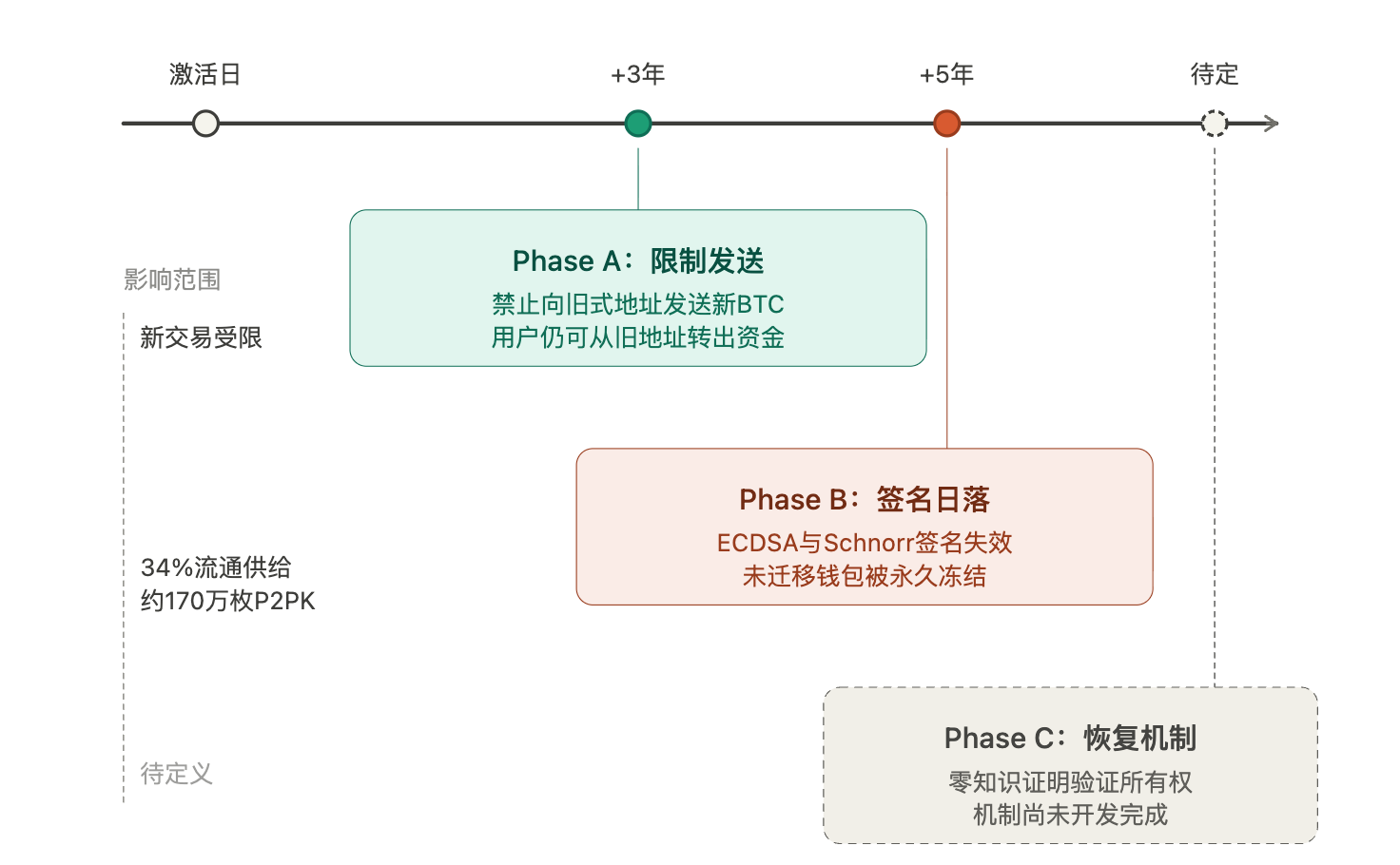
Phase A becomes effective approximately three years after activation. At that point, the network will prohibit sending new BTC to legacy addresses, and all users should have migrated to quantum-resistant address types.
Phase B becomes effective five years after activation. At that point, legacy ECDSA and Schnorr signatures will be completely deprecated, and any Bitcoin remaining in vulnerable addresses will be effectively frozen.
Phase C is a yet-to-be-completed relief mechanism, envisioning the use of zero-knowledge proofs to allow legitimate owners holding mnemonic phrases to recover frozen funds.
According to a Live Bitcoin News report, GitHub reviewer Conduition believes Phase C is "the most critical component of any proposal involving confiscatory freezing" and argues that BIP-361 is incomplete without this mechanism.
The proposal authors describe the freezing mechanism as a form of "upgraded private incentive": lost or frozen coins would only slightly increase the value of everyone else's coins, whereas coins recovered via quantum attacks would devalue everyone's holdings.
5.6 Million Dormant BTC and $74 Billion of Satoshi's Holdings
This debate touches a nerve due to the enormous scale involved.
According to Lopp's estimate, approximately 5.6 million Bitcoin (28% of the total supply) have not moved for over a decade, which he and other analysts believe are likely lost. At current prices, these dormant tokens are worth about $420 billion.
The most symbolic among these are Satoshi Nakamoto's holdings. According to a Cointelegraph report, early P2PK addresses lock up roughly 1.7 million BTC, including Satoshi's holdings of about 1.1 million BTC, currently valued at approximately $74 billion. The public keys for these addresses have long been publicly exposed on-chain. Once quantum computing power reaches a critical threshold, attackers could use Shor's algorithm to derive the private key from the public key and directly control the funds.
Lopp warned in the CoinDesk interview that even without a large-scale sell-off, "any credible evidence that someone has the ability to recover lost or vulnerable coins with a quantum computer would immediately cause massive panic in the market."
The odds on Polymarket for "Will Satoshi move any Bitcoin in 2026?" are currently around 9.3%, up from 4.5% at the beginning of the year, but the reaction to BIP-361's release has been muted, suggesting the market still views it as a governance discussion rather than an urgent catalyst.
Fierce Community Backlash: "Stealing Money to Prevent It From Being Stolen"
BIP-361 touches on one of Bitcoin's deepest philosophical tenets: ownership should be unconditional. As soon as the proposal was made public, a wave of criticism emerged.
Bitcoin Magazine editor Brian Trollz outright rejected the proposal; TFTC founder Marty Bent called it "ridiculous"; Metaplanet Head of Business Development Phil Geiger sarcastically remarked: "We must steal people's money to prevent their money from being stolen."
A comment by X platform user Cato the Elder was widely shared: "This quantum proposal is highly authoritarian and confiscatory... There is no reasonable justification for forcing an upgrade and invalidating old spending paths. Upgrades should be 100% voluntary."
Cysic founder and former Algorand quantum resistance lead Leo Fan pointed out from a technical governance perspective: "Ownership becomes conditional. Holding the key no longer guarantees you can spend. This undermines Bitcoin's promise of being 'unstoppable money'." However, Fan also acknowledged that removing millions of Bitcoin from circulation could tighten supply and potentially drive up the price.
Discussion on the Reddit community r/cryptocurrency was equally intense (the post received 631 upvotes and 311 comments). The top-voted comment read: "If you fork to freeze wallets to hedge your investment risk, BTC is no longer BTC." Another user held the opposite view: "Let them get hacked, let the price crash for a month. We'll buy the dip, just like the last existential crisis."


