






Is There a Secret to Finding "Meme Coins" That Multiply Dozens of Times in Days?


- Core Viewpoint: The article delves into the nature of the "meme coin" phenomenon in the cryptocurrency market, pointing out that its essence lies in the information asymmetry game between market makers and retail investors under conditions of high market control. It summarizes community methods for identifying manipulation traces and predicting crash signals by analyzing anomalies in data such as open interest, but ultimately emphasizes that due to market makers holding absolute control, it is extremely difficult for retail investors to achieve stable profits.
- Key Elements:
- "Meme coins" are defined as tokens where market makers have a high degree of control (over 96% spot control rate), triggering liquidations through violent pump-and-dump cycles and ultimately completing the harvest. Their existence is based on Binance futures and over-the-counter leveraged funding.
- Key clues for identifying "meme coins" include abnormally consistent open interest data across exchanges and an abnormally high ratio of futures trading volume to open interest, which may indicate data manipulation.
- The two main signals for predicting a "meme coin" crash are: price increases accompanied by a continuous decline in open interest (indicating whales closing long positions and opening shorts), and a sharp drop in open interest due to mass liquidations (indicating market makers losing the will to support the price).
- The cost for market makers to manipulate data is relatively low. For example, based on a daily trading volume of $7 billion, the fee cost is only about $350,000 per day, making such manipulation sustainable.
- The article's core conclusion states that due to the extremely high control rate of "meme coins" and market makers holding the "script," it is extremely difficult for retail investors to consistently profit by analyzing and predicting market maker actions, approaching a level that is "inhuman."
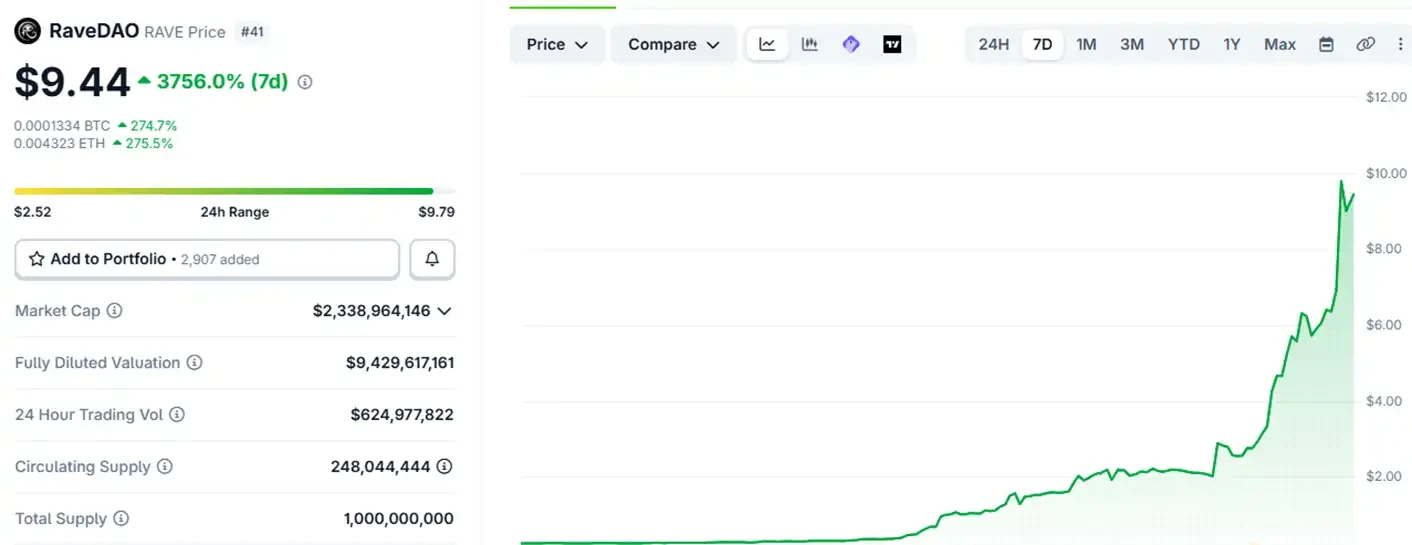
This year in the crypto world, there's an unavoidable concept: "pump-and-dump coins." Over the past week, the price of $RAVE has been continuously rising, reaching a peak of approximately 40 times its value from a week ago. Currently, $RAVE's market cap has climbed to the 41st position in the market.
From the recent $SIREN and $STO to earlier ones like $PIPPIN, $RIVER, $BEAT, $MYX, and others. Regardless of how sluggish the market is, and even though "pump-and-dump coins" represent an information asymmetry game between retail players and whales, there are always players chasing volatility, diligently analyzing, trying to capture the logic behind these "pump-and-dump coins," and searching for a winning strategy.
In fact, within the Chinese-speaking crypto community, a comprehensive "study of pump-and-dump coins" has gradually emerged.
What is a "Pump-and-Dump Coin"?
If the definition of a "pump-and-dump coin" were simply "fast and sharp price increases," then the "study of pump-and-dump coins" wouldn't exist. The essence of retail players trading "pump-and-dump coins" is a direct game against the whales, an attempt to snatch a piece of meat from the whale's manipulation.
Based on this essence, KOL Crypto Skanda (@thecryptoskanda) provided a detailed definition of "pump-and-dump coins," establishing the foundation for this "study":
- Spot market control rate is basically above 96%
- Has Binance Futures contracts; whether it has a spot listing is less important
- Typically uses off-exchange financing to create massive liquidity and counterparty positions through violent pump-and-dump waves in a short time
- The whale profits by triggering long/short liquidations and collecting funding rates from counterparties, ultimately completing the spot sell-off and finishing the entire harvesting process
How to Identify a "Pump-and-Dump Coin"?
On this issue, different players have provided excellent reference ideas from various angles.
Abnormalities in Open Interest (OI) can manifest in several ways. First is "data manipulation." On April 11th, @Arya_web3 noticed that the 24-hour OI data for $RAVE on that day was $60 million, $60 million, $60 million, $26 million, and $26 million on Binance, Bitget, BingX, OKX, and Bybit, respectively. Based on this data and the overall OI data of each exchange, she speculated that, through horizontal comparison, the data from BingX and Bitget appeared abnormal, suggesting possible manipulation of OI data.
Furthermore, $RAVE's 24-hour futures trading volume that day was $6.9 billion, with futures open interest at $300 million. The whale pumped the price 10x from the bottom, yet there wasn't a single large liquidation order, which further increased the possibility of futures data manipulation. She also mentioned that observing which exchanges see concentrated liquidation orders can serve as a basis for judging whether OI data is being manipulated on certain exchanges.
@thecryptoskanda summarized and added to the above observations:
- The lower the median percentage of Binance's OI share, the higher the degree of whale manipulation
- A high futures trading volume / OI ratio means a higher likelihood of OI data manipulation
- This implies that all strategies solely monitoring futures trading volume or OI are flawed because the whale might intentionally stop manipulating OI data to lure retail traders in
You might say this analysis identifies "pump-and-dump coins" based on data that is already or currently happening. Is there a way to analyze them *before* they launch?
No. In the words of @thecryptoskanda:
"A coin doesn't become a pump-and-dump coin because it meets certain metrics. It's because it *is* a pump-and-dump coin from the start that it develops those characteristic metrics. Pump-and-dump coins never play by the rules of the broader market. They are only related to one thing—is there a whale behind it?"
How to Judge When a "Pump-and-Dump Coin" is About to Crash
The first angle, proposed by @wuk_Bitcoin, is the "divergence between price and Open Interest," which can be used to judge if a "pump-and-dump coin" is nearing a crash. @wuk_Bitcoin stated that rising prices coupled with continuously declining OI is a sign before a crash.
"The main force closes all their long positions at high levels, then props up the price to continue finding counterparties, letting retail traders or algorithmic traders come in to long for arbitrage. Once there are counterparties, they can quietly add short positions. After the short positions are established, they remove the price-supporting orders,顺势砸盘顺势 crash the price, continuing to add short positions while crashing until the final complete collapse."
He also emphasized the need to look at 1-hour level data, as smaller timeframes cannot confirm the main force's intent.
This angle also has certain flaws, as mentioned earlier regarding "data manipulation." However, if we缩小缩小 the observation timeframe for OI, another angle emerges: "massive liquidations and a sharp drop in OI leading to whale exit."
This angle was proposed by @CryptoRounder and elaborated on by @thecryptoskanda:
"A price level triggering massive liquidations, causing a sharp drop in OI and the disappearance of short-side counterparties, leading the whale to lose willingness to maintain high prices and start the decline, is a more definitive top signal."
Although the above two angles emphasize "how to escape before a pump-and-dump coin crashes," this is already the most rational decision retail players can make in the highly information-asymmetric "pump-and-dump coin" game—find the point where the whale decides to abandon the coin and design trades around that point. After all, before the crash, the whale can repeatedly liquidate both longs and shorts. Once the whale truly exits and stops supporting the price, the downtrend of the "pump-and-dump coin" becomes irreversible.
Conclusion
Although various experts strive to find stable profit paths in "pump-and-dump coins," offering us many sharp analytical angles, it's crucial to always remember: the reason a coin can be called a "pump-and-dump coin" is because its market control rate is as high as 95% or even more.
While we can discover traces of whale manipulation from many dimensions and even achieve victory in the "pump-and-dump coin" game through such data analysis, the situation of each "pump-and-dump coin" is difficult to归纳归纳 through analysis and replicate in every game.
The whale behind a "pump-and-dump coin" is the one holding the script. They can manipulate data to confuse retail players and have multiple ways to harvest them for profit.
According to @Arya_web3's speculation, the cost for whales to manipulate OI data is not high. Based on a 24-hour futures trading volume of $7 billion and a fee rate of 0.005%, the 24-hour cost is only $350,000.
If the core replicable point of trading "pump-and-dump coins" lies in "predicting the whale's moves," the difficulty is akin to betting against someone holding the script on what the next scene will be. This level of difficulty is like having divine foresight and can be described as "superhuman."


