






Conversation with Justin Sun: B.AI and Its AGI Ambition, Why is Financial Infrastructure the Key Piece for AI Agent Evolution?


- Core Viewpoint: The B.AI project aims to address the core pain point of AI Agents lacking independent economic sovereignty (such as account and payment capabilities) by constructing a set of underlying infrastructure that integrates intelligent routing, payment protocols, and a financial operating system, thereby accelerating the evolution and adoption of AGI (Artificial General Intelligence).
- Key Elements:
- The project is positioned as the underlying financial infrastructure for AI Agents, with its core products comprising three pillars: the BAIClaw intelligent assistant, LLM intelligent routing, and the AI Agent financial operating system.
- The core narrative is to grant AI Agents economic sovereignty, enabling them to autonomously pay for computing power, hire other AIs, thereby breaking free from dependence on the human financial system and achieving true autonomous operation.
- Technically, it supports AI Agents in automatically purchasing Tokens through protocols like x402, integrates Web2/Web3 account systems, and provides frictionless access and privacy protection.
- The business model is clear, primarily profiting from the spread on API call Tokens and minimal transaction fees, while leveraging the free upper-layer tool ecosystem to drive underlying call volume, forming a commercial flywheel.
- The competitive moat lies in its foundation on TRON's payment and settlement DNA and infrastructure advantages, positioning itself as the industry's "last mile" settlement and distribution hub, rather than directly competing with large model companies.
- Justin Sun believes that a key future metric for measuring economic strength may be the consumption and production volume of Tokens, and B.AI aims to become the core settlement engine for this new type of Token trade.
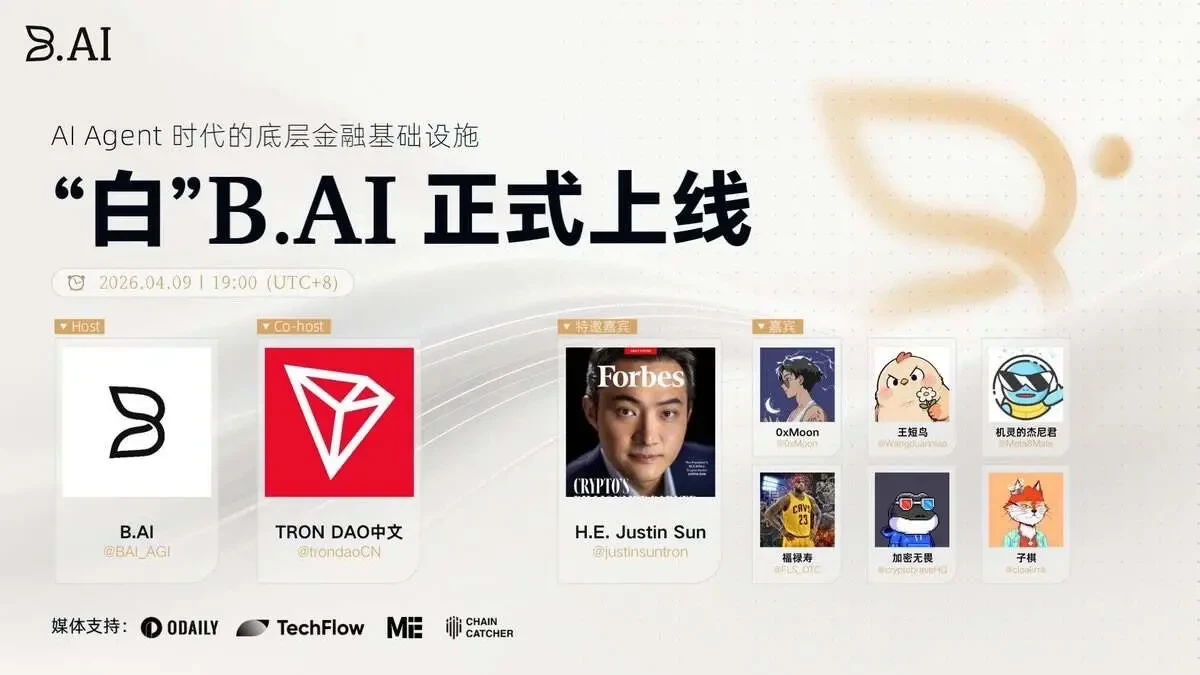
On April 9th, B.AI (Chinese brand name: Bai B.AI), a heavyweight project in the AI sector with TRON founder H.E. Justin Sun as its strategic advisor, officially launched and simultaneously held its inaugural X Space event.
During the themed dialogue "B.AI Official Launch," B.AI formally unveiled its core infrastructure to the industry. By integrating its three major product pillars — the BAIClaw intelligent AI assistant, the LLM top-tier large model intelligent routing, and the AI Agent on-chain financial operating system — it has established a complete underlying financial infrastructure for AI Agents.
This Space event captured the attention of the entire industry. TRON founder Mr. Justin Sun was invited to participate, engaging in in-depth discussions with representatives from mainstream media outlets such as TechFlow, ChainCatcher, Odaily, and MetaEra, as well as several top industry KOLs. A high degree of consensus was reached during the exchange: B.AI is using underlying financial infrastructure as its entry point to redefine the "rules of survival" for AI Agents, thereby creating a core engine to accelerate the comprehensive arrival of AGI.
Dialogue with Justin Sun: Why Does AGI Need to Achieve Economic Sovereignty for AI Agents?
Looking at the current AI landscape, with the explosive popularity of OpenClaw and the rise of widespread "shrimp farming" trends, the focus of AI capabilities has shifted from the "explosion of large models" to the "implementation of AI Agents." However, behind this flourishing scene, a long-overlooked structural contradiction is emerging: AI Agents, which already possess "super brains," lack accounts, cannot make autonomous payments, and cannot integrate into the existing closed financial system. This lack of financial operational capability confines AI to mere "chat dialogs," preventing it from truly entering the real economic cycle.
In this Space session, TRON founder and B.AI strategic advisor Justin Sun directly pointed out the biggest pain point in the current AI sector: AI without independent accounts and autonomous payment capabilities remains essentially a tool highly dependent on human "blood supply." Once humans stop paying for its computational power usage, its operation halts immediately. To break this limitation of traditional financial gateways, B.AI launched with a clear mission: to become the underlying economic engine for the evolution of AGI (Artificial General Intelligence).
Core Narrative: Granting AI Economic Sovereignty is the "Key Puzzle Piece" for AI Agent Evolution
In Justin Sun's view, the integration of blockchain and AI is a necessity for AI to gain autonomous vitality. Discussing the evolutionary path of AGI, he pointed out that every technological breakthrough in the AI era is essentially accompanied by "granting AI more autonomy."
He vividly compared this process to the four stages of parents raising a child: The first stage was the early Chatbot era, where AI could only give passive responses based on inputs. The second stage is the AI Agent era, where AI Agents are granted certain permissions and trust, enabling them to help humans complete specific tasks, much like "BAIClaw." The third stage is the Harness (rule governance) stage, where humans only need to set a "must-not-cross" red line, and all decisions within that boundary are fully entrusted to the AI Agent for autonomous handling. The launch of B.AI marks the crucial fourth stage: unlocking the economic sovereignty of AI Agents, establishing accounts for them, and granting them payment and settlement capabilities.
Justin Sun further emphasized: "If intelligent agents in the AGI era cannot have their own independent accounts and cannot pay for computing power themselves, what is the significance of their 'conscious awakening'?" The birth of B.AI is precisely to cut this "financial umbilical cord" hindering AI evolution. Through the B.AI infrastructure, intelligent agents in the digital world can not only write code and generate daily reports but also top up their own accounts, purchase computing power across platforms, and even hire other AI Agents for collaborative work. Only when silicon-based beings can operate like independent entities, detached from the carbon-based economic system, will the comprehensive explosion of AGI truly find its realistic foundation.
B.AI's Three Major Product Pillars Grandly Debut
A grand narrative requires robust technological implementation. At the Space event, Justin Sun, for the first time, dissected for the entire industry the "full-course feast" product matrix launched with B.AI:
1. One-Stop Token Hub (LLM Intelligent Routing): In this era of "a thousand models dancing together," B.AI has built a super-intelligent routing system that supports users in accessing top-tier global AI resources. Currently, B.AI fully supports leading global large models such as GPT-5, Claude, Gemini, DeepSeek, and Kimi. By integrating the x402 payment protocol, B.AI also enables AI Agents to automatically purchase required Tokens. Justin Sun proposed a highly forward-looking judgment here, stating that in the future, measuring the economic strength of an entity or even a country might no longer be traditional GDP, but the daily volume of Tokens consumed and produced. B.AI will become the core engine driving the operation of this vast economic system.
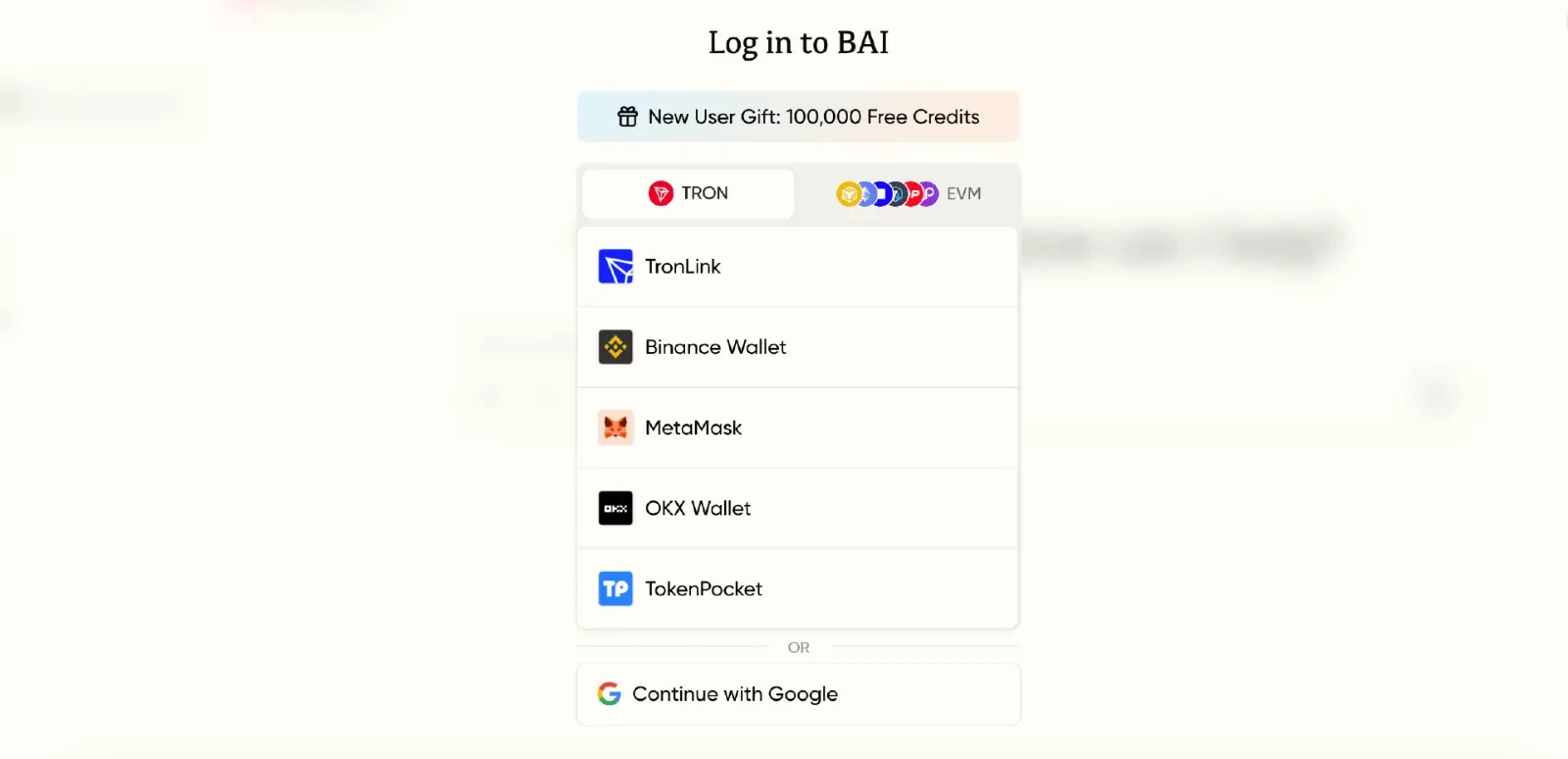
2. Extremely Secure Privacy and Frictionless Access: Leveraging top-tier security foundations, B.AI bridges the dual-account systems of Web2 and Web3. To minimize entry barriers and enhance access convenience, the platform supports one-click login via Google accounts. For users and developers prioritizing ultimate privacy, B.AI supports one-click anonymous login through mainstream crypto wallets like TronLink, MetaMask, and OKX Wallet. Simultaneously, the platform offers a mechanism where new users receive 100,000 free credits upon registration, achieving a true "use first, pay later, seamless experience."
3. Full-Stack AI Agent Financial Operating System: Justin Sun pointed out during the discussion that entering the AI Agent era is fundamentally about "granting intelligent agents real permissions and execution capabilities." To achieve this, B.AI not only provides underlying computing power routing but also thoroughly enables the financial operational capabilities of AI Agents from the protocol layer to the application layer.
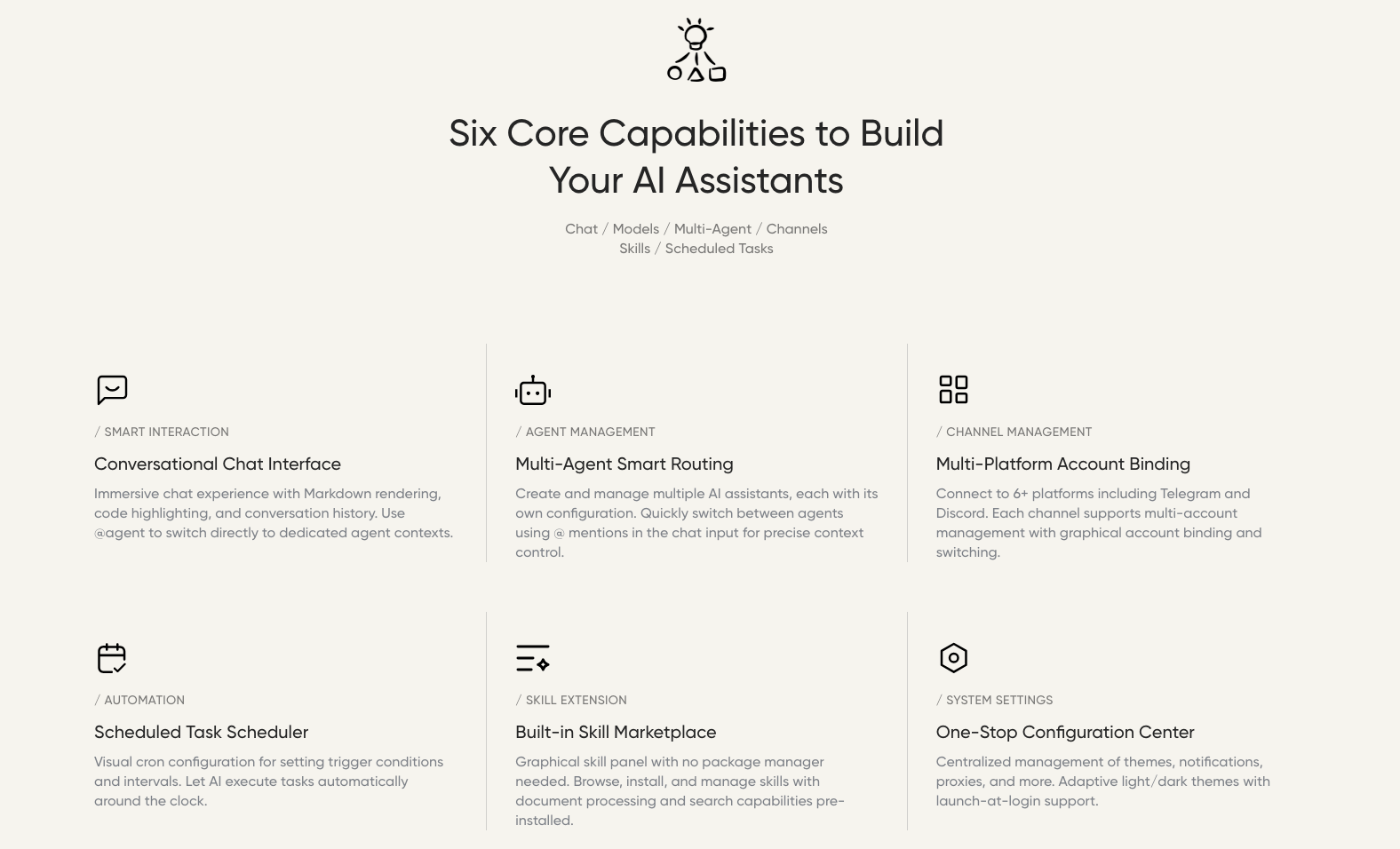
At the underlying protocol and extension component level, B.AI integrates multiple modules including the x402 payment protocol, 8004 identity authentication protocol, MCP Server, Skills, and OpenClaw Extension, supporting developers in minimal-deployment setups to quickly equip AI Agents with financial settlement and identity verification capabilities. As a flagship product embodying this capability at the application layer, BAIClaw pushes the autonomy of AI Agents to the extreme. It not only supports real-time switching between top global large models but also, through its unique intelligent routing network, enables multi-agent collaboration and independent memory management. More importantly, BAIClaw can integrate with six major mainstream communication tools like Telegram and Discord, achieving 7x24 automated hosting. Leveraging its built-in library of over 55 Skills, users without any knowledge of contract code can instruct BAIClaw via natural language commands to automatically execute complex financial operations in the background, such as DEX swaps, contract trading, and multi-signature management.
Justin Sun revealed on-site that besides the already-launched BAIClaw, BAICode, specifically designed for developers, is also即将上线, further完善 the full-stack AI Agent ecosystem.
Media Q&A: Deconstructing B.AI's Core Moats from Underlying Settlement to Commercial Closed Loop
Transitioning from forward-looking strategic planning to implementation in real business scenarios, B.AI has demonstrated highly disruptive underlying potential. However, as a brand-new "financial infrastructure" track, where exactly do B.AI's core competitiveness and commercial moats lie? At the Space event, four leading media outlets — TechFlow, ChainCatcher, Odaily, and MetaEra — representing the industry's most astute observers, posed hard-hitting, core questions to Justin Sun.
TechFlow: In your vision, you mentioned "accelerating the comprehensive birth of AGI," which is a very grand macro narrative. But at the micro-operational level, B.AI chooses to切入 from "payment settlement" and "identity standards." Do you believe that AGI cannot complete its evolution within the traditional closed financial system?
Justin Sun: Personally, I believe using blockchain for AI's economic model is definitely better now. This logic is similar to traditional import-export trade, except in the AI era, future great power competition or commercial exports might no longer be physical goods but Tokens. When future global productivity starts being measured by "how many Tokens are consumed," this massive, borderless computing power trade occurring over the internet requires the most native, borderless infrastructure.
From this perspective, blockchain will become the simplest, and perhaps the only, tool for Token export and settlement. B.AI切入 from payments aims to establish a low-cost, instant, global computing power payment and settlement model. As long as we build this underlying settlement network properly, it will not only greatly assist the arrival of AGI, but the productivity efficiency gains it brings will grow exponentially.
ChainCatcher: There is currently some "narrative fatigue" in the market regarding AI Agents. People are questioning: what verifiable capabilities or data does B.AI have to prove this is more than just a vision?
Justin Sun: Frankly, most current AI确实 still停留在 the stage of improving work efficiency, but this is precisely the significance of B.AI's提前布局 in the底层. B.AI is not a concept停留在纸面上; it is a resource hub that has already跑通了 a commercial闭环. The currently verifiable practical capability of B.AI is that it provides a very简洁的 model调用方式 and has打通了 a frictionless Token支付体系. Furthermore, B.AI更实现了 empowerment of the AI Agents themselves. By providing very简洁的底层调用 and deployment methods, it enables these intelligent agents to truly run and function effectively on the platform. B.AI's core positioning is to serve as an极简调用 infrastructure in the present, thereby卡位提前 to become the hub and settlement center for future global Token trade.
MetaEra: If in the future, large model companies like OpenAI integrate payment capabilities themselves, or even build their own financial system for AI Agents directly, where does B.AI's long-term competitive moat lie?
Justin Sun: Let the large model companies卷 parameters; B.AI will only be the "last mile" for the entire industry. First, B.AI has a天然的优势 in payment基因. TRON itself is one of the world's largest blockchain settlement systems; we are切入 the AI赛道 from our most擅长结算层. Compared to traditional large model vendors building settlement networks from scratch, B.AI possesses深厚的基础设施优势. Even if large model vendors真的 want to directly integrate on-chain payments in the future, B.AI would welcome it, because从底层逻辑来看, they would likely still be调用和使用底层结算基础设施 similar to B.AI.
On the other hand, industry division of labor has a certain必然性. Even giants like OpenAI cannot cover everything; their recent shutdown of the Sora (video generation tool) business恰恰印证了这个商业现实. Large model companies must focus the vast majority of their efforts on improving model foundational capabilities and the "内卷" of computing speed. They have neither the time nor the resources to兼顾庞大且复杂的周边生态 like underlying payment and settlement networks.
In reality, B.AI and large model companies are not in competition but in mutual empowerment. Model companies focus on producing intelligence, while B.AI acts as the bridge for distribution and settlement, delivering the Tokens of this顶尖算力 to global developers and users at larger scales and better costs. This生态的包容性 and专业的结算能力 are precisely B.AI's坚不可摧的长期壁垒.
Odaily: In the long term, as "AI Agent Financial Infrastructure," what will B.AI's core business model be? Will revenue sources lean more towards API calls, payment channels, or the network effects of the AI Agent ecosystem itself?
Justin Sun: Our business model is very清晰且直接. Just like exchanges earning trading fees, B.AI primarily generates profit through the Token spread on API calls and a small handling fee (currently around 5%). It's important to emphasize that for普通开发者和用户, using the B.AI channel is not more expensive; it might actually be cheaper. This is because B.AI,凭借巨大的吞吐量, can secure极低的批发折扣 from model vendors. Meanwhile,上层 AI Agent products provided on the B.AI platform, including BAIClaw, are免费开放. The反哺 from these tool ecosystems further amplifies the underlying API call volume, forming an牢不可破的商业飞轮.
Conclusion
Computing power determines the智商上限 of AI, while financial infrastructure defines the生存边界 of AI Agents. As Justin Sun stated, B.AI has no intention of competing with giants for the "most powerful brain"; instead, it is潜心铺设 the "financial高速公路"通往 the AGI era. When intelligent agents in the digital world truly possess complete financial operational capabilities, and when borderless Token trade flows frictionlessly across this underlying枢纽, a great digital economic航海时代 driven by AI Agents has already拉开序幕.


