




Gold Returns to $4800, Where Is This Year's Peak?


- Core View: The article synthesizes factors including institutional forecasts, central bank gold purchases, increased holdings by crypto institutions, and geopolitics. It concludes that the core logic for gold prices in 2026 remains bullish, with a reasonable upper bound for the year at $5400~6000 per ounce, potentially reaching $6200-6400 under optimistic scenarios.
- Key Factors:
- Institutional Forecasts Largely Bullish: Goldman Sachs expects year-end gold prices to reach $5400; UBS revised down its end-of-June forecast to $5200 but maintains a $5900 target for early 2027; JPMorgan is bullish up to $6300.
- Central Banks' Sustained Rigid Buying: Global central banks continue net purchases of gold. The People's Bank of China has increased its holdings for 17 consecutive months, and emerging market central banks still have a low proportion of gold reserves, providing long-term support.
- Crypto Giants Become Major Buyers: Stablecoin issuer Tether's gold reserves now exceed 148 tons, ranking among the world's top 30 holders, primarily used to back USDT and XAUT tokens.
- Prediction Markets Show Divergence and High Expectations: Polymarket predictions show the highest probability (40%) is placed on gold prices staying below $4200 before June, but there is also a 46% probability placed on prices exceeding $6000 within the year.
- Geopolitics and De-dollarization Support the Thesis: Geopolitical risks like the US-Iran conflict and the accelerating "de-dollarization" process strengthen gold's role as a safe-haven asset and monetary challenger to US dollar credit.
Original|Odaily (@OdailyChina)
Author|Wenser (@wenser 2010)
After enduring nearly six weeks of sudden shocks from the US-Iran conflict, gold has finally climbed back above $4,800 for the first time in nearly a month, following news related to a potential US-Iran ceasefire agreement.
From the gold token XAUm mentioned as early as October 2024, to the accurate prediction of a rise above $3,900 when gold spot was at $3,500 in September last year, and later to the gold token XAUT mentioned when gold reached around $4,500 in January this year, I myself have embarked on a journey of dollar-cost averaging while following gold.
On the other hand, from a macro perspective, against the backdrop of escalating geopolitical conflicts, central banks worldwide continue to increase their gold holdings, with the People's Bank of China making significant purchases for 17 consecutive months; major investment institutions and banks are also highly confident in gold's upward price trend.
In light of this, this article by Odaily will explore a question from the perspectives of recent industry dynamics and changes in the political and economic landscape: What is the upper limit for gold this year?
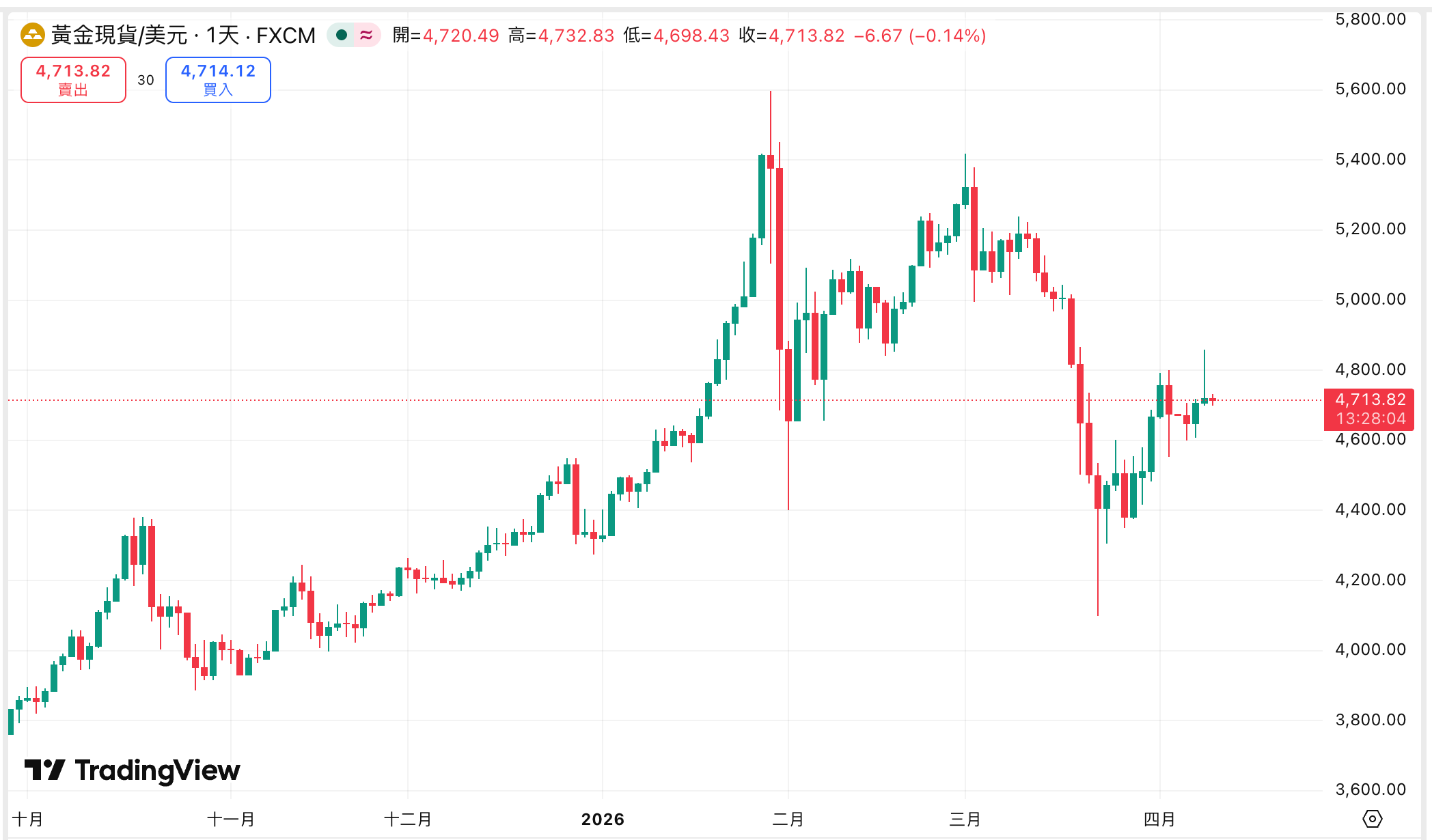
Gold Price Trend Over the Past Six Months
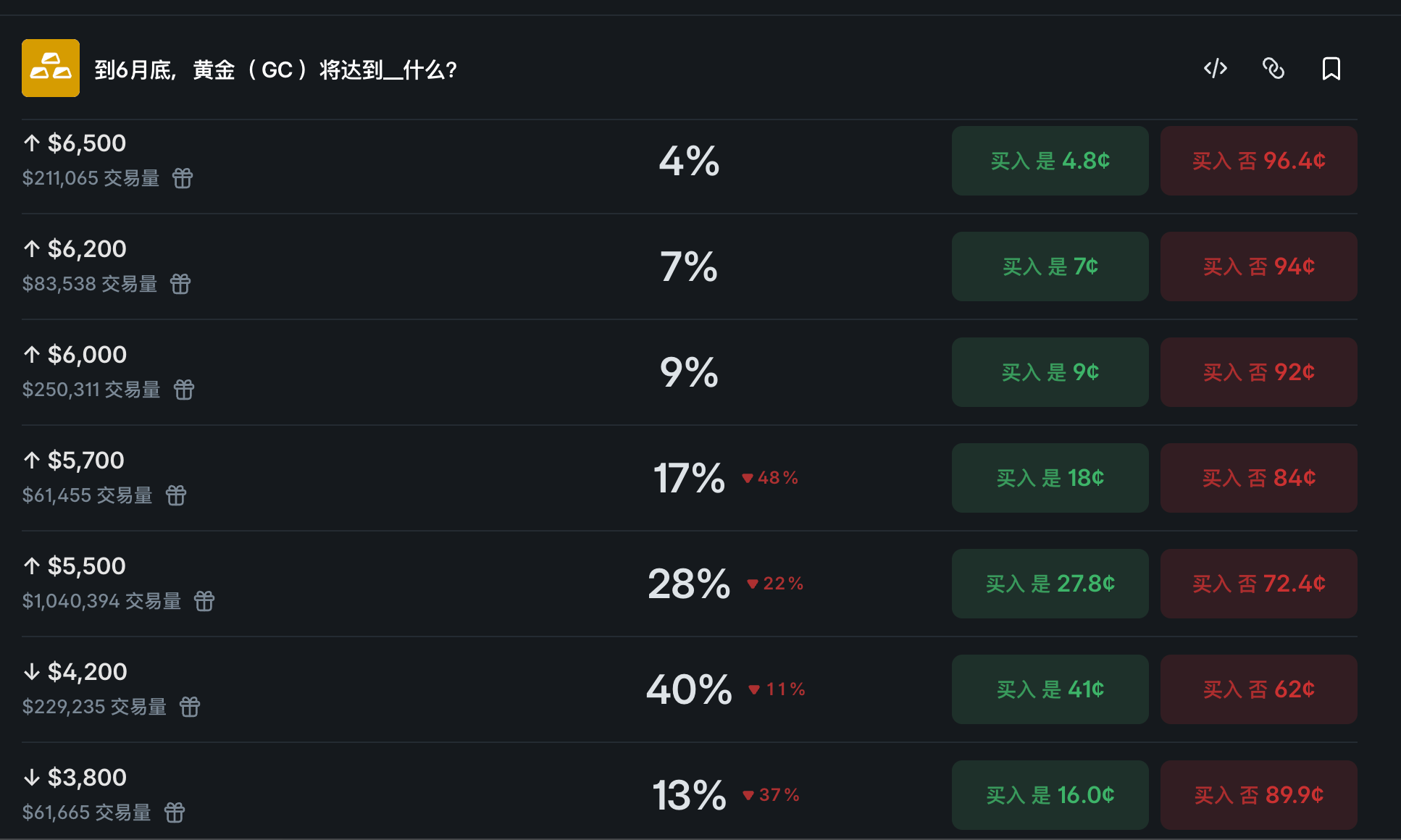
Gold Price Views on Prediction Markets: Price May Be Below $4,200 Before June, Year-End High Could Exceed $6,000
Since the emergence of prediction markets, thanks to factors like real-money betting and "the wisdom of the crowd," they have become an important barometer for predicting asset prices. Currently, the year-end price range for gold on Polymarket is around $3,800-$6,000.
The betting volume for the mid-year gold price prediction on Polymarket currently exceeds $3.5 million, with:
The highest probability being below $4,200, at 40%;
Followed by above $5,500, at 28%;
Then above $5,700 (currently reported at 17%) and below $3,800 (currently reported at 13%).
The betting volume for the year-end gold price prediction on Polymarket is currently only nearly $200,000, with:
The highest probability being above $6,000, reaching 46%;
Followed by above $7,000, reaching 25%;
Then above $8,000, reaching 16%.
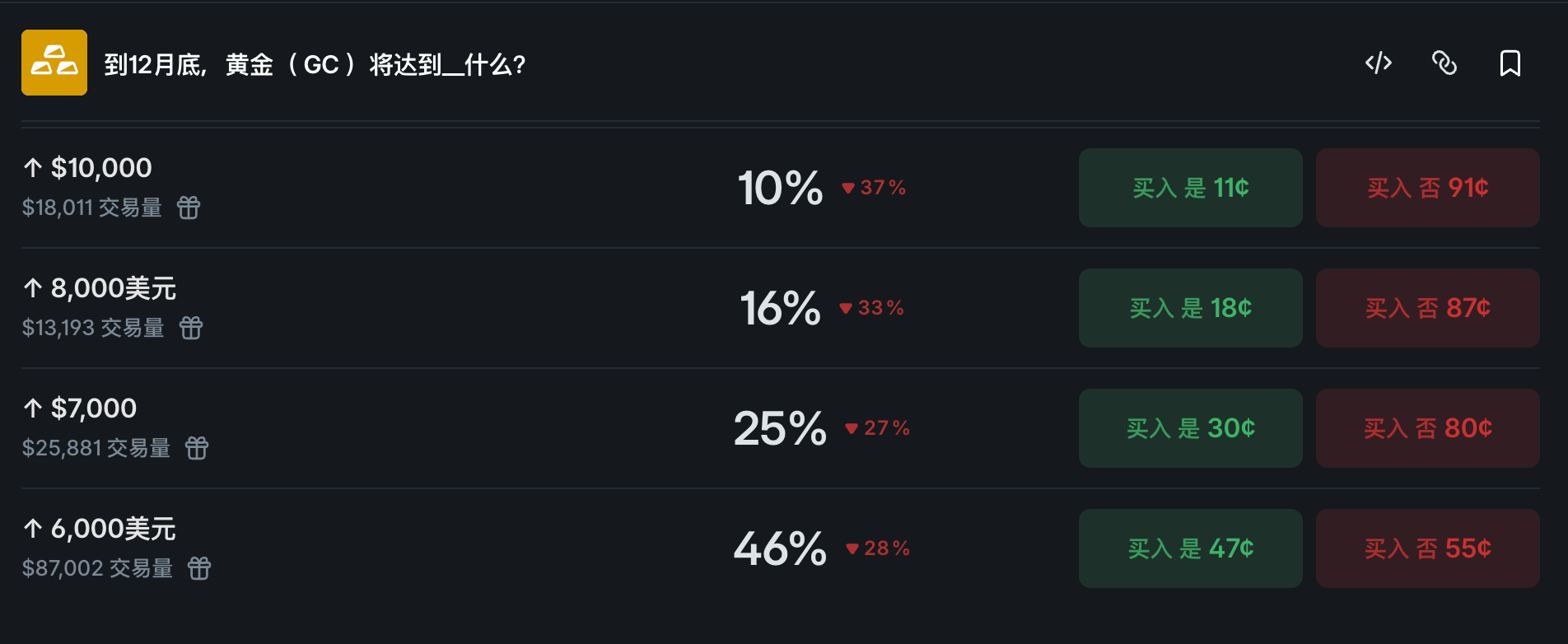
In other words, despite relatively low trading volume, prediction market users still place the year-end price above $6,000, a nearly 20% difference.
It is worth noting that the rules for gold price-related events on Polymarket use the official settlement price of the CME Gold (GC) futures contract active month. Intraday trading, highest/lowest prices, bid/ask prices, or indicative prices are not counted.
Macro Buying: Central Banks Continue to Accumulate, Turkish Central Bank Swaps Gold for Cash
As the world's largest asset class by market capitalization, the primary buyers of gold are naturally the central banks that control fiat currency issuance.
In early April, the World Gold Council released its February Central Bank Gold Purchases Monthly Report. It pointed out that central banks net purchased 19 tons of gold in February 2026. Although this is still below the 2025 monthly average of 26 tons, it represents a recovery compared to the net purchase of 5 tons in January 2026. Furthermore, the report shows that some central banks maintained a continuous net buying streak, accumulating 44 tons of gold purchases from November 2024 to February 2026. The Czech Republic reported its 36th consecutive month of net purchases. China increased its gold holdings for the 16th consecutive month (February data).
Goldman Sachs noted in a late March research report that gold's medium-term outlook remains solid, supported by continued central bank purchases and expectations of two more Fed rate cuts this year, with the price potentially climbing to $5,400/oz by year-end. UBS, also in late March, projected a target price of $5,900/oz for gold by early 2027.
On the 7th of this month, the People's Bank of China announced that China's gold reserves at the end of March stood at 74.38 million ounces (approximately 2,313.48 tons), an increase of 160,000 ounces (approximately 4.98 tons) from the end of February (74.22 million ounces, approximately 2,308.5 tons), marking the 17th consecutive month of gold accumulation.
On the other hand, traditional gold reserve powerhouses have remained largely steady, with holdings almost unchanged—such as the United States (~8,100 tons), Germany (~3,300 tons), Italy (~2,400 tons), and France (~2,400 tons).
As for the news that "the Turkish central bank sold over 120 tons of gold in the past 3 weeks, worth $20 billion," amid pressure on the Middle East's fiat system due to the US-Iran conflict, many only know part of the story. In reality, most of this gold did not flow into the market; it was part of gold-currency swap futures. Simply put, the Turkish central bank merely pledged its gold reserves to obtain US dollar foreign exchange, thereby stabilizing its domestic currency, the lira.
Structurally, the proportion of gold reserves to total reserves in emerging market central banks remains low, at just over 10%, with China's share even in the single digits. This indicates that the accumulation space for global central banks is far from saturated, and the strategic need for "de-dollarization" will provide rigid buying support for gold for years to come.
Crypto Buying: Stablecoin Giant Tether's Gold Reserves Rank Among Global Top 30
In February, Wall Street investment bank Jefferies reported that stablecoin issuer Tether continues to increase its gold holdings. As of January 31, its gold reserve scale had grown to approximately 148 tons, valued at about $23 billion at current prices. Its holdings have surpassed those of many sovereign nations, ranking among the top 30 global gold holders.
The report shows that Tether added about 26 tons of gold in Q4 2025 and continued to add about 6 tons in January this year. Its quarterly gold purchase scale was second only to a few central banks like Poland and Brazil. Its current gold reserve scale exceeds that of countries like Australia, the UAE, Qatar, South Korea, and Greece.
The institution noted that the above gold is primarily used to back the dollar stablecoin USDT and the gold-pegged token XAUT (currently with an FDV market cap exceeding $3.3 billion). As Tether is not a publicly listed company, its disclosed data may represent only the minimum level, and its actual gold holdings could be higher than the published figures. Tether CEO Paolo Ardoino previously stated that the company plans to allocate about 10%–15% of its investment portfolio to physical gold.
Retail Buying: High-Position Bagholding Ensures Holding Stability
In 2026, retail participation in gold investment has significantly increased, with Asian capital becoming a new main force in the gold market.
In January, Asian gold ETFs saw a single-month inflow of up to $10 billion.
Furthermore, Chinese investors purchased a record 432 tons of gold bars and coins throughout 2025. Scenes of queues outside domestic gold stores to purchase accumulation gold and frequent sell-outs of accumulation gold on banking apps reflect ordinary investors' strong recognition of gold's value preservation function.
However, the flip side of retail buying is the intensified two-way volatility in gold prices. In January, news of Kevin Warsh's nomination as Fed Chair triggered a single-day plunge of over 9% in gold prices, marking the largest single-day drop in nearly 40 years. In March, gold prices once plummeted below $4,200/oz, leaving many retail investors trapped at high positions. Combined with the Chinese central bank's massive accumulation, this formed a stark contrast of "retail panic selling, sovereign funds buying the dip."
Consequently, the large volume of retail buying trapped at high positions means that the amount of gold sold within the year will not be excessively large.
Institutional Views: Gold to Still Reach New Highs, Price Around $5,200 by End of June
On the institutional side, UBS, which has long focused on the precious metals market, has frequently expressed views this year.
On January 21, UBS precious metals strategist Joni Teves stated that demand for diversification is the core driver of this round of gold price increases, with institutional investors, retail investors, and central banks all increasing gold holdings to cope with macro uncertainty. It is expected that gold prices still have upward momentum in the first half of the year. If market concerns about Fed independence continue to heat up, gold prices may challenge the $5,000/oz level in the first half. Silver, benefiting from the boost of rising gold prices and its own narrowing supply-demand gap, may challenge $100/oz this year.
Subsequently, both gold and silver surged, with the former once climbing close to $5,600/oz and the latter to $120/oz.
On February 24, UBS Group stated that it expects gold prices to reach $6,200 per ounce in the coming months, as the key factors driving its strong rise over the past year remain in place.
Subsequently, on February 28, the US-Iran conflict officially erupted, with Israel and the US jointly attacking Iran, igniting regional hot war.
On March 5, UBS Group analysts noted in a report that data tracing back to 1900 indicates that economic risks have proven more significant for financial markets than geopolitical risks. They stated that in most cases, investors perform best if they can "see through" the noise of geopolitics.
In late March, UBS projected a target price of $5,900/oz for gold by early 2027.
On April 2, UBS strategist Joni Teves predicted that despite recent gold price volatility, gold prices will hit new highs this year, viewing the recent pullback as a buying opportunity. UBS expects the average gold price for 2026 to be $5,000 per ounce, with $4,800 and $4,250 for 2027 and 2028, respectively.
On April 7, UBS lowered its gold price expectation for the end of June to $5,200/oz, citing cooling investor demand amid increased market volatility.
Additionally, in early February, JPMorgan publicly expressed firm bullishness on gold, believing the year-end target could reach $6,300, representing a 34% increase.
Understanding the Nature of Gold: Safe-Haven Asset and Core of a De-Dollarized Monetary System
Finally, let's briefly discuss the essence of gold investment.
In 1971, the United States dismantled the Bretton Woods system it had established. Subsequently, the gold price soared from $35/oz to nearly $5,000/oz today, a cumulative increase of over 94 times in 55 years. Viewed in 4-5 year investment cycles, it has weathered at least 10 bull-bear cycles.
After the Russia-Ukraine conflict erupted in 2022, the economic process of "de-dollarization" accelerated abruptly. Global central banks thus initiated a new round of gold reserve competition, gradually creating the "super bull run" in gold over the past three years.
Entering 2026, as the US Trump administration, allegedly provoked by Israel's Netanyahu, launched military action in the Middle East (Odaily Note: Rumors suggest Netanyahu personally lobbied before the US-Israel joint strike on Iran), although US political and economic conditions are unlikely to deteriorate instantly due to AI, tech, and onshoring policies, the credibility of the US dollar monetary system is already showing initial signs of weakness.
In January this year, renowned investment bank Morgan Stanley stated that the role of the US dollar in the global system is being persistently and gradually eroded. However, due to the limited availability of credible alternative currencies, in an increasingly multipolar world, gold has become the greatest challenger to the US dollar. According to Morgan Stanley's research, the international influence of the US dollar has declined across multiple metrics, including its share in central bank foreign exchange reserves and its usage share in corporate and emerging market sovereign issuance. Nevertheless, the US dollar still holds the largest share of global reserves, indicating no substantial challenger has emerged yet. However, once gold is factored in, the situation changes. Gold's share in central bank-held assets has risen from about 14% to 25%–28%, and this upward trend "shows no signs of slowing down." Risk premiums and hedging behavior will continue to pressure the US dollar while supporting gold demand.
Although during the Dubai turmoil caused by the US-Iran conflict, gold's "safe-haven asset attribute" was questioned due to portability issues, in the current international context, it remains the only universally recognized hard currency besides the US dollar.
As for Iran charging passage fees in RMB and cryptocurrencies like BTC after closing the Strait of Hormuz, this to some extent exposes the reality of the declining credibility of the US dollar in the global economic system.
Therefore, although Bloomberg Intelligence Senior Market Analyst Mike McGlone warned in his April metals market outlook report that gold and silver may have peaked, and the "once-in-a-generation" high may have passed. Considering Trump's current indecisive, sometimes-winning political attitude, gold is still at a relative low point for the year.
Based on the