




Review of the edgeX Airdrop: From Wash Trading to Harvesting, a Pre-designed "Rug Pull" Scheme


- 核心观点:edgeX项目被指通过虚假交易数据、不透明的空投规则以及大量“老鼠仓”地址,系统性损害早期用户利益,导致社区信任彻底崩塌,揭示了当前加密领域“撸毛”活动的高风险与不对称博弈本质。
- 关键要素:
- 平台数据存疑:TVL仅2亿美元却维持超10亿美元未平仓合约,极端行情下无明显爆仓,且社交媒体热度与宣称的日交易量(超50亿美元)严重不符。
- 空投规则不公:未公布明确分配规则,出现“同分不同权”现象,新钱包获数十万代币而老用户仅获几千枚,分配逻辑无法验证。
- 存在大量“老鼠仓”:链上数据显示超80个关联新地址集中领取约1.8亿枚EDGE,其单积分价值超100美元,远高于普通用户的不足2美元。
- 关联安全事件:被链上侦探发现与攻击Hyperliquid的事件有关,曾导致后者TVL损失约2亿美元。
- 官方压制舆论:面对社区质疑,项目方选择关闭推文评论区,并在Telegram和Discord社群删帖、禁言、踢出表达不满的用户。
Original | Odaily (@OdailyChina)
Author | Asher (@Asher_ 0210)

The crypto winter is also a winter for airdrop farming. In 2026, another project characterized by "severe rug pulls" and "trust collapse" has emerged. Yesterday at noon, edgeX launched its EDGE token airdrop claim page, dealing another heavy blow to the "airdrop farmers." Early users were almost universally "rugged."
The Data Was Off From the Start
The issues with edgeX did not just appear on the airdrop day.
Even earlier, its platform data had already raised questions. KOL Feng Wuxiang noted, "A Perp DEX with a TVL of only about $200 million can sustain an open interest exceeding $1 billion, with an average leverage over 5x. This structure itself is significantly different from similar products."
What's even more suspicious is its performance during extreme market conditions. High-leverage Perp DEXs almost inevitably face cascading liquidations during sharp volatility, yet edgeX showed almost no significant liquidations in similar situations, which is inherently unreasonable. Coupled with frontend delays and slippage issues, the trading experience was noticeably poor, with many users losing money as soon as they placed orders. Simultaneously, there was a stark contrast in its data structure. While social media showed almost no corresponding hype, its daily trading volume consistently remained above $5 billion, second only to Hyperliquid.
Under these circumstances, a market speculation gradually formed: a significant portion of edgeX's platform trading volume was not contributed by real users but was inflated through market-making and wash trading, with ordinary users largely providing continuous fee revenue.
"Same Points, Different Rights": Airdrop Rules Spark Controversy
During its Genesis phase, edgeX publicly stated that 25% to 30% of the tokens would be allocated to the community. However, during yesterday's TGE claim process, no clear distribution rules were announced, making it difficult for users to verify the allocation logic.
Even more controversial is the phenomenon of "same points, different rights." Within the same point bracket, new wallets often received hundreds of thousands of EDGE tokens, while users who participated in and sustained trading over the long term received only a few thousand or even fewer. The project team stated that points from different sources had different weights but did not disclose the specific rules or calculation methods.
KOL Bingwa commented, "Why do we see 'same points, different rights' and arbitrary rule changes? Because a project that, from the very beginning, intended to rely on fake trading to inflate data, hype valuations with narratives, and coordinate with its back-end market-making group for profit transfer, fundamentally cannot respect users or the community." Similar negative sentiments quickly spread within the community, leading to a complete collapse of user trust in edgeX.
"Rat Trading" Confirmed: Multiple Addresses Fit the Pattern of "Created Within 4-10 Days + Gas Funded Directly from CEX Hot Wallets + Massive Airdrop Claims"
According to on-chain data feedback from multiple users including @jeg6322, @muarmemuar, and @btctianze, the edgeX token airdrop contained a large number of "rat trading" addresses, which received far more airdropped tokens than ordinary users.
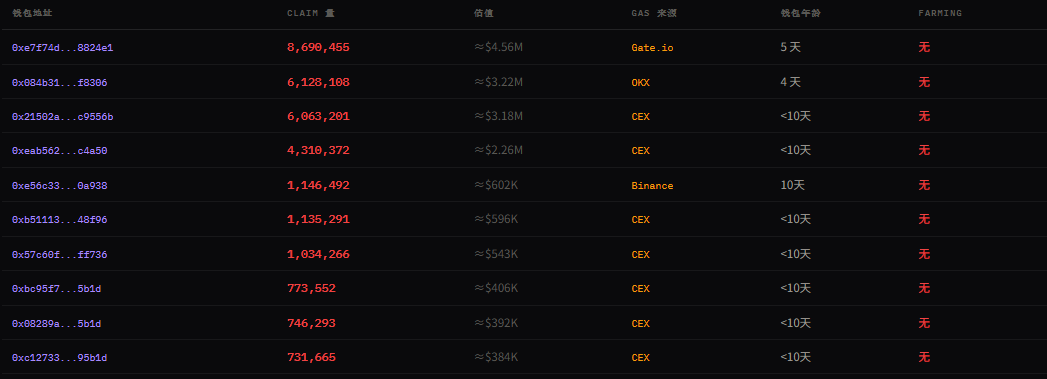
A further analysis reveals that the on-chain behavior of the addresses in the chart is highly consistent: all are newly created EOA accounts (created within the last 4 to 10 days), lacking historical transaction or DEX interaction records. They collectively performed airdrop token claim operations in a short period after the airdrop opened, with Gas funding primarily sourced from exchange hot wallets like Gate.io, OKX, and Binance. This pattern typically aligns with institutional or team fund allocation methods.
Furthermore, on-chain data shows that over 80 newly created and interconnected wallets, including the aforementioned addresses, collectively claimed the airdrop, totaling approximately 180 million EDGE tokens.
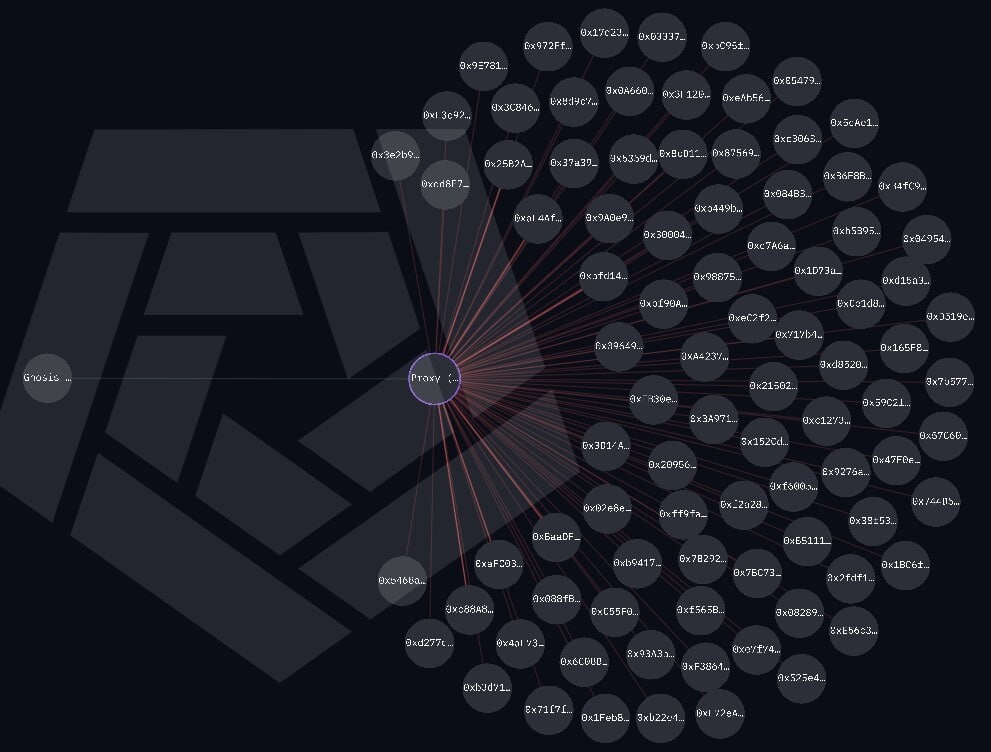
Additionally, there is a significant disparity in allocation weight. The value per point for "rat trading" addresses could exceed $100, while for ordinary users, it was generally below $2. Some early users reported receiving less than 300 tokens for their 940 points, translating to about 0.2 tokens per point, with a corresponding value of approximately $1.3.
Official Response to Community Negativity: Closing X Comment Sections, Deleting Posts and Kicking Users on TG/Discord
After edgeX officially announced the airdrop claim yesterday, faced with community 质疑 regarding the "same points, different rights" issue with the airdropped tokens, the official directly chose to disable comments on subsequent tweets.
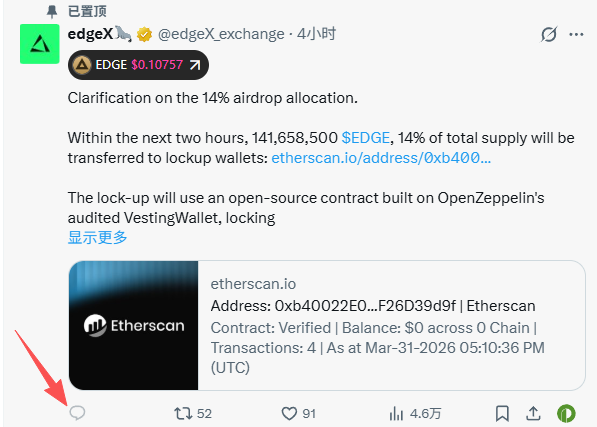
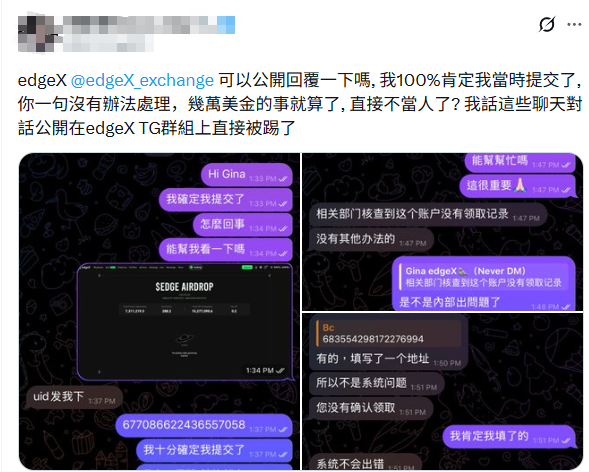
Moreover, similar actions were taken simultaneously in edgeX's official Telegram and Discord communities. The groups enabled a 15-minute slow mode and strengthened entry verification to filter out some users. More directly, administrators quickly deleted posts, muted, or even outright kicked members who publicly questioned, shared chat records, or expressed dissatisfaction in the groups. Some users reported being immediately removed from the Telegram group just for posting their conversation history with the official team, preventing them from further participating in discussions.
Summary
When users invest real money to generate volume but can't even get a clear explanation of the rules, the situation has already soured. What was supposed to be an investment for returns has now become a situation of being completely manipulated.
The near-universal "rug pull" experienced by edgeX users is not just a case of an airdrop falling short of expectations. It represents a complete early-stage harvesting chain for trading-focused projects—attracting traffic through points, amplifying trading volume, monetizing on the fee side, and then, during TGE, cashing out through a large number of "rat trading" addresses dumping on the secondary market.
When "getting rugged" is no longer an isolated incident but gradually becomes a common experience, airdrop farming shifts from a once-certain opportunity to a highly asymmetric game. For users still committed to airdrop farming at this stage, controlling costs and managing expectations may be more crucial than simply chasing potential returns.