






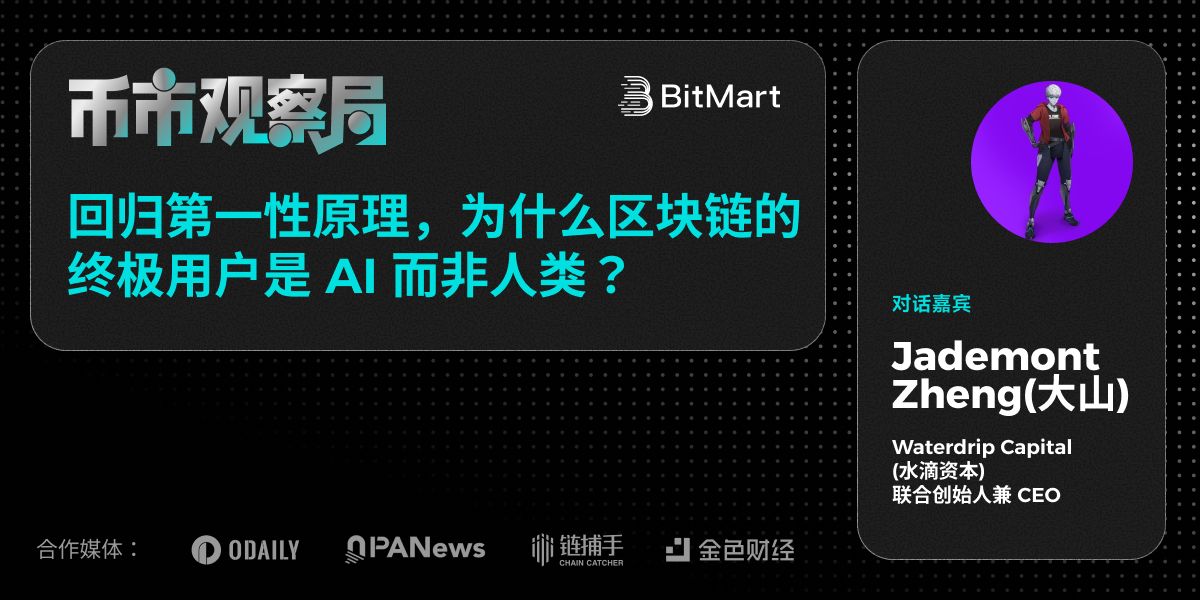
Crypto Market Observation Bureau × Waterdrip Capital Dashan: Returning to First Principles, Why is the Ultimate User of Blockchain AI Rather Than Humans?


- Core Viewpoint: Jademont Zheng (Dashan), founder of Waterdrip Capital, believes that the current structural issues in the blockchain industry hinder its healthy development. The future of the industry does not lie in traditional mass adoption by humans, but in providing trusted infrastructure for AI and Agents, which represents his disruptive judgment of the industry.
- Key Elements:
- Industry Structural Imbalance: The last cycle created an unhealthy industry structure where exchanges occupy the top of the value chain while value-creating project teams are in a weak position, which inhibits the industry's long-term development.
- Bitcoin's Unique Status: Bitcoin is digital gold, fundamentally different from other cryptocurrencies. Its long-term value (e.g., reaching $1 million) is certain, while the "four-year cycle" theory lacks sufficient historical samples and is not an ironclad rule.
- AI is the Future User: The blockchain industry's past pursuit of mass human adoption might have been the wrong direction. Its "inhuman," strict ledger characteristics are more suitable as infrastructure for future autonomous collaboration and transactions among AI Agents.
- Computing Power Facility Transformation: Based on AI's massive demand for electricity, Waterdrip Capital is actively transforming Bitcoin mining's power and computing facilities into "energy supply stations" serving AI training and inference.
- VC's Long-term Advantage: In the crypto industry, the core moat for venture capital firms is not complex methodologies but "presence"—the ability to stay in the industry long-term and thus capture early signals.
In the crypto industry, there are two types of people: those who enter and exit the market with each cycle, and those who remain at the table through the ups and downs.
Jademont Zheng (Dashan), Co-founder and CEO of Waterdrip Capital, clearly belongs to the latter. From his first encounter with Bitcoin in 2013, to resigning from HiSilicon (Huawei) in 2017, co-founding Waterdrip Capital with OGs like Cancer and Peicai, and continuing to invest to this day, he has experienced the ICO frenzy, DeFi Summer, the NFT craze, witnessed the rise and fall of countless institutions, and seen some once-star institutions vanish from the industry within just a few years.
However, in this episode of the "Crypto Market Observation Bureau" dialogue, what is truly compelling about Dashan is not his seniority, but his less mainstream judgments about the industry. In his view, many narratives that are repeatedly discussed—whether it's the "four-year cycle," the Web3 concept, or "mass user adoption of blockchain"—may not hold true. Conversely, the future large-scale users of blockchain might not be humans from the start, but AI and Agents.
Guest for this episode: Jademont Zheng (Dashan), CEO and Co-founder of Waterdrip Capital
Host: yuanyuan, BitMart Marketing VP
From Chip Engineer to Crypto VC
Dashan's path into the crypto industry didn't start from finance like traditional investors.
After completing his Ph.D. in microelectronics in Canada, he returned to China and joined HiSilicon (Huawei) to work on 5G chip R&D. At that stage, Bitcoin was just a technical interest he researched in his spare time. Working on chip R&D during the day and studying blockchain on forums like Bitcointalk at night, communicating with the global early community—this was almost the common trajectory for many early Crypto practitioners.
The real turning point occurred in 2016-2017. As the price of Bitcoin rose, the value of the Bitcoin he had purchased earlier grew rapidly. With financial pressure gone, he began to seriously consider whether to devote all his time to this industry. He ultimately chose to leave Huawei and co-founded Waterdrip Capital with several friends in 2017.
Looking back at that era, Dashan describes the entire industry's VC ecosystem back then as almost entirely "amateur setups." Waterdrip Capital even had only one employee at the time. However, as the environment changed, Waterdrip gradually adjusted its investment approach. Moving from early-stage, wide-ranging small investments to a "co-entrepreneurship" model with fewer projects and larger individual amounts, and participating more deeply in project development, such as joining boards or providing deep support during the post-investment phase. This change was also an active adjustment they made as the industry cycle evolved.
Staying in the Industry Long-Term is an Advantage in Itself
When asked "What is the moat for a Crypto VC?", Dashan's answer was quite restrained.
In his view, Waterdrip Capital's ability to survive from 2017 to today is not because they possess some particularly brilliant method, but simply because they have never left.
Over the past few years, a large number of institutions with traditional backgrounds entered the market at its peak and quickly exited during the downturn. In Dashan's view, this type of "cyclical participant" finds it difficult to develop a genuine understanding of the industry. Taking the Bitcoin ecosystem as an example, because Waterdrip Capital has long been involved in Bitcoin mining and technical communities, they were already researching related technical changes and starting to position themselves before the Ordinals concept truly exploded. This capability doesn't come from some complex methodology, but is more like a sense of "being present"—as long as you are always on the front lines, opportunities often appear in those early signals that are not yet obvious.
Crypto's Biggest Problem is its Industry Structure
If one sentence were to summarize Dashan's assessment of the current situation, it would be: the industry structure is flawed.
In Dashan's view, the structure formed in the last cycle is extremely unhealthy—exchanges stand at the top of the food chain, while the project teams that actually create value are in a weak position. In a healthy tech industry, the top of the value chain is usually occupied by those who create products and technology (like Nvidia or OpenAI), but in the Crypto industry, exchanges control everything through power.
Dashan used an analogy: in a normal industrial structure, platforms should be financial infrastructure; whereas in the current crypto market, some exchanges are more like "casinos," making money but not taking on the responsibility of driving industry development. In the long run, this structure leads to bad money driving out good. He believes the current industry downturn is, to some extent, a result of this structural imbalance.
Bitcoin is in a League of Its Own; The Four-Year Cycle is Just Coincidence
Among all crypto narratives, Dashan's most steadfast point is his attitude towards Bitcoin.
In his view, Bitcoin and "cryptocurrencies" are two completely different things. Bitcoin is digital gold, a global consensus asset; while other tokens are more like a company or a product. Therefore, he believes it's only a matter of time before Bitcoin reaches $1 million. If an investor lacks the ability to find that 1% survivor in the vast asset pool, then holding Bitcoin itself is the safest strategy.
Regarding the "four-year cycle" theory, Dashan is skeptical. He believes the sample size is too small (only four cycles) to derive an ironclad rule. Behind each bull market, there are often macro factors, such as global liquidity or political cycles. Rather than obsessing over cycle length, it's better to focus on a simpler fact: the bottom of each Bitcoin cycle is continuously rising.
From "Hashrate Mining" to "AI Alchemy"
Dashan's logic isn't just talk; Waterdrip Capital has already begun cross-border practices at the physical level.
In Dashan's view, besides algorithms, the most scarce resource in the AI industry currently is electricity. And the Bitcoin industry, over the past decade, has amassed a massive, globally distributed network of power facilities and computing power factories.
"What we are doing is helping Bitcoin computing power factories transform into AI computing power factories," Dashan revealed. Due to Bitcoin price volatility causing some older mining machines to operate below capacity, the ready-made power quotas, cooling facilities, and physical space of these mining farms can seamlessly meet the inference and training demands of AI. By acquiring specialized AI computing power companies for technological empowerment, Waterdrip is upgrading the originally singular "mining" business into an "energy supply station" serving the machine civilization. This transformation is not only a business expansion but also the real-world implementation of his "machine economy" logic.
The AI Era: Blockchain's Real Users Might Not Be Human
The most imaginative viewpoint in this dialogue is Dashan's understanding of the relationship between AI and blockchain.
Dashan believes that the Crypto industry has spent the past decade trying to seek "mass adoption" from human users, and this path might be wrong. For humans, blockchain's efficiency and user experience do not offer clear advantages.
Those who truly need blockchain might instead be AI. If a large number of AI Agents in the future autonomously collaborate and transact within networks, they will need a trusted infrastructure to handle identity, payments, records, and oversight. Blockchain, with its "inhuman" strict ledger,恰恰 possesses these characteristics.
"Blockchain might not have been invented for humans to use, but prepared for AI."
If this judgment holds true, then the Crypto industry's ultimate target user needs to shift from "humans" to "AI."
Dashan believes that the proliferation of AI will make society more fragmented: one part of people will deeply use AI to enhance productivity, while another part will maintain traditional lifestyles. The cognitive gap between these two lifestyles will grow larger and larger, but he also doesn't believe everyone must embrace AI; the two worlds will coexist and gradually diverge.
Conclusion
In this dialogue, Dashan set aside the filter of mainstream narratives. He is not superstitious about the four-year cycle, doesn't care about Web3 or Web4 concepts, but holds a deep conviction about the convergence of Bitcoin and AI Agents.
Looking back at today from ten years in the future, he is actually most concerned with only three questions:
- Has Bitcoin truly reached $1 million?
- Has blockchain become a critical infrastructure for the AI economy?
- Will the stablecoin system ultimately move towards centralization or decentralization?
The answers to these questions may determine the true direction of the crypto industry's next phase.
—------
Recording date for this episode: March 5, 2026
Full content is available on Xiaoyuzhou, Apple Podcast, Spotify. Search for and follow "Crypto Market Observation Bureau."

Also welcome to follow BitMart's TwitterX for more industry insights, market trends, and platform updates.
Risk Disclosure
The opinions or views expressed in this column represent the personal stance of the guest only and do not represent the views of BitMart or its affiliates, nor should they be considered professional financial investment advice.
Cryptocurrency investment is highly speculative and carries significant risk of loss. Past performance, hypothetical scenarios, or simulated results do not guarantee future returns. The value of digital currencies may fluctuate, and buying, holding, or trading digital currencies may involve substantial risks. Before participating in trading or holding digital currencies, please carefully assess their suitability based on your own investment objectives, financial situation, and risk tolerance. BitMart does not provide any investment, legal, or tax advice.


