




Regulatory Boots Land: SEC and CFTC Shake Hands and Make Peace, Is the Crypto Market Entering the "Age of Exploration"?


- Core View: US regulatory agencies are implementing a series of systematic measures to clearly classify and tier the regulation of crypto assets, ending the ambiguous era of "regulation by enforcement." This marks a new stage where crypto assets are accelerating their integration into the mainstream financial system and entering a phase of rule-based differentiation.
- Key Elements:
- The SEC issued guidance clarifying that digital commodities, collectibles, payment-type stablecoins, etc., are not securities. Only tokenized forms of traditional securities, as "digital securities," fall under its purview. For the first time, it has clearly delineated regulatory boundaries with the CFTC.
- The NYSE removed position limits for BTC/ETH ETF options, and the CFTC allowed BTC/ETH and stablecoins to be used as margin. This facilitates traditional financial institutions in allocating crypto assets and accelerates their integration into the traditional financial risk system.
- Regulators intend to position stablecoins as "on-chain dollar interfaces," restricting their ability to pay interest or yield to cut off competition with the traditional banking system. This may reshape the competitive landscape of the stablecoin market.
- The CFTC acknowledges the information aggregation value of prediction markets but simultaneously strengthens oversight, requiring platforms to prohibit insider trading and market manipulation, especially in markets related to highly sensitive events like politics and sports.
- The overall regulatory logic is shifting from a "one-size-fits-all" approach to a structured one, breaking down the crypto ecosystem by asset class and functional scenario and managing them under different existing regulatory frameworks such as securities, commodities, and payment instruments.
Over the past few years, the core controversy in U.S. crypto regulation has always revolved around a fundamental question: Is a token a security?
Now, the answer has finally been settled.
Recently, from the SEC's introduction of the "Token Safe Harbor" framework, to the joint definition of "digital commodities" with the CFTC, and the acceptance of crypto assets by traditional financial infrastructure like the CFTC and the New York Stock Exchange, everything indicates that U.S. regulation is systematically rewriting the rules of the game.
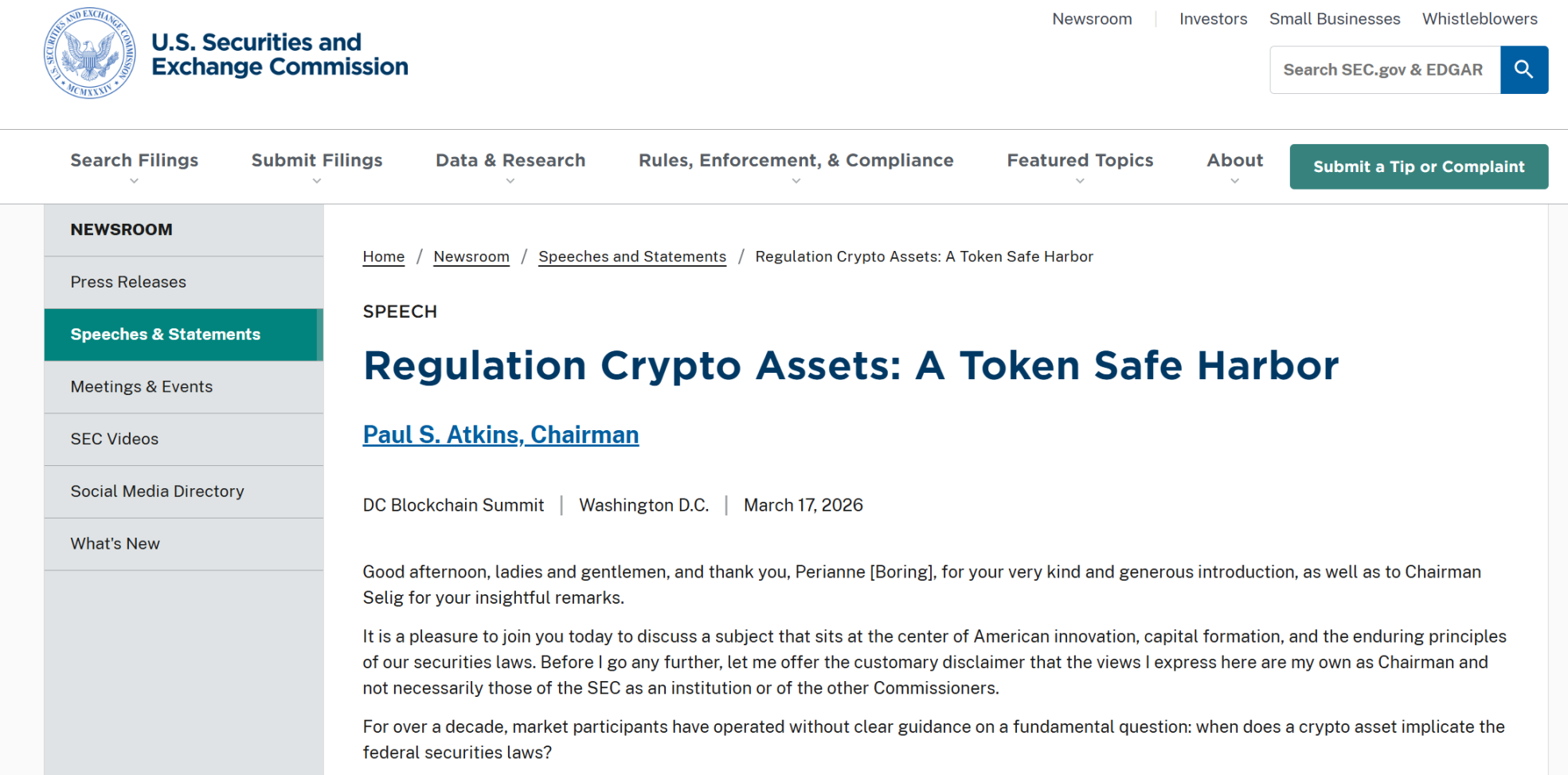
The most significant news among these is undoubtedly the crypto asset guidance issued by the U.S. Securities and Exchange Commission (SEC) on March 17, which clearly stated that digital commodities, digital collectibles, digital tools, and payment stablecoins (as defined by the GENIUS Act) are not securities. Only tokenized forms of traditional securities, as digital securities, will become the sole category explicitly brought under regulation.
This marks the end of the era of "regulation by enforcement" initiated by Gary Gensler, replaced by a clear and definitive institutional framework. It also means that the assets in our hands are accelerating their move from the "gray area" into the mainstream financial system.
1. Clear Identity: Tokens Are No Longer Presumed to Be "Securities" by Default
Objectively speaking, the "Token Safe Harbor" framework released by the SEC this time is highly consistent with the consistent stance of the new Chairman, Paul Atkins, since taking office.
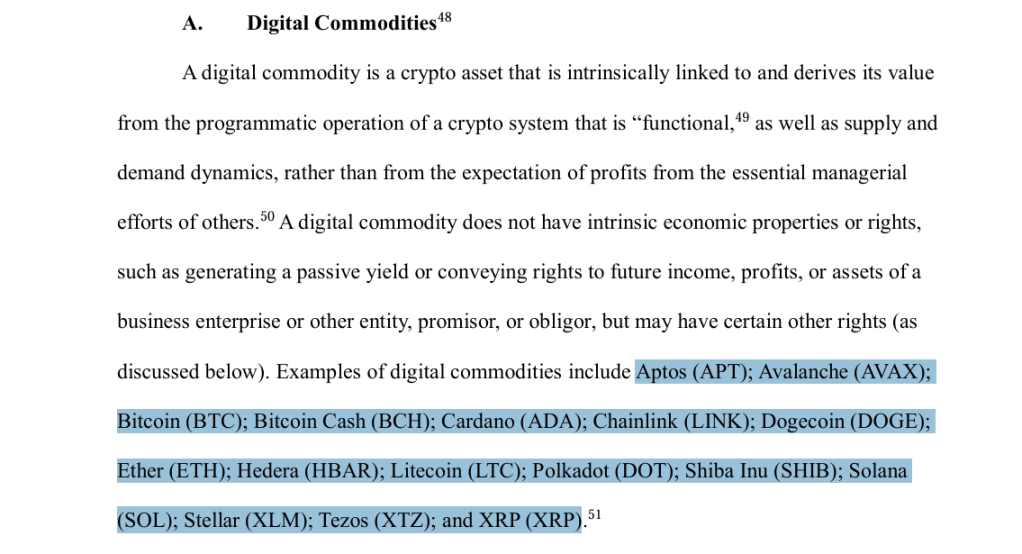
Combined with the SEC and CFTC's clear definition of Bitcoin, Ethereum, Solana, and 13 other mainstream tokens as "digital commodities," this signifies that these assets will primarily fall under CFTC oversight, not securities laws. This also marks the first clear delineation of regulatory jurisdiction between the CFTC and SEC. The question of "whether a token is a security" is no longer stuck in a vague gray area.
In the future, tokens and digital securities will likely diverge into two completely different industry paths—the SEC's regulatory focus will concentrate on "tokenized forms of traditional securities."
This effectively ends the gray area. Determining "whether a token is a security" no longer requires the ambiguous, case-by-case application of the Howey Test. For the first time, regulatory jurisdiction has achieved a clear physical separation.
Simultaneously, the SEC also raised a very interesting point: investment contracts can be terminated. Once a project fulfills its promised core obligations, the token can shed its security attributes. This indicates that "security" is no longer a static label; it can change according to the project's development stage.
In short, a project may transition from a security to a non-security, or vice versa, moving between the regulatory purviews of the SEC and CFTC at different stages.
If identity definition is the confirmation of legal status, then the new initiatives by the NYSE and CFTC represent tangible positive developments for capital flows.
On one hand, the NYSE removed the position limits for BTC/ETH ETF options, eliminating the 25,000-contract holding restriction. On the other hand, the CFTC allowed BTC, ETH, and stablecoins to be used as margin, with BTC/ETH valued at 80% and stablecoins at 98%.
Although this collateralization rate still falls short of exchange standards (e.g., Binance's BTC collateral rate is 0.95, stablecoins are essentially 1:1), it is an important starting point. Traditional financial institutions and institutional players can now use crypto assets as margin for leveraged and portfolio trading, facilitating the further inclusion of crypto assets in their asset allocation tables.
The simultaneous occurrence of these two events also indicates that Crypto is accelerating its integration into the traditional financial risk system, expanding from a single trading asset to include attributes like collateral.
2. Global Stablecoin Regulation Accelerates: Locking in Payment Tools, Cutting Off Yield Attributes
As the attributes of crypto assets become increasingly clear, regulators' stance on stablecoins is also becoming more precise.
Over the past two years, the stablecoin narrative has gained significant traction. A key reason is that they are no longer just a medium of exchange; they increasingly resemble on-chain dollar interfaces, settlement tools, and in some cases, have begun to assume functions akin to savings or yield-bearing accounts. This has rapidly increased the tension between stablecoins and the traditional banking system.
Earlier this month, Reuters reported that discussions in the U.S. surrounding revisions to the CLARITY Act had reached another impasse. A core point of contention was whether to prohibit users from earning yields simply by holding stablecoins. According to disclosed discussion content, the bill text prohibits paying interest to consumers, but some versions still allow rewards or incentives tied to specific activities like payments or loyalty programs.
Precisely because this distinction remains, the banking industry continues to exert pressure, arguing that even "rewards" rather than "interest" could substantively drain deposit funds.
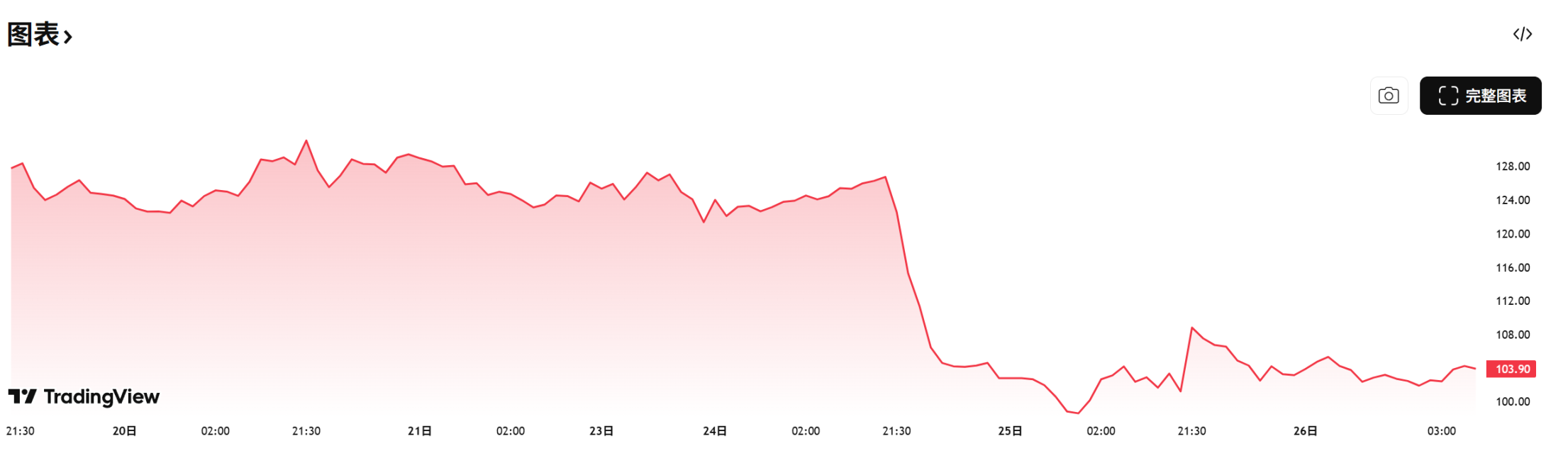
Against this backdrop, Circle's stock plunged nearly 20% intraday on March 24, and Coinbase also fell nearly 10%. From this perspective, the recent market reaction to stablecoin-related company stocks is not difficult to understand.
This is likely also related to USDC's strategy. USDC has expanded rapidly recently, with a key tactic being to compete for distribution channels on exchanges, platforms, and among users through subsidies, profit-sharing, and incentives. Now, if the path of earning yields from static holding is blocked, these yields will likely not disappear but shift into more complex structures, such as activity incentives, DeFi, RWA, or trading scenarios.
This is also why, on the surface, restricting stablecoin yields seems like a tightening. However, from a deeper market structure perspective, it may also be reshaping the direction of the next round of yield distribution. The truly competitive stablecoins in the future may not be the ones offering the highest yields, but rather those with the deepest liquidity, broadest access, strongest use cases, and highest settlement efficiency.
In this sense, such regulatory changes might not inherently be negative for USDT. USDT's long-standing core competitive advantage has not been capturing market share by offering users "deposit-like yields," but by building its dominance through global liquidity, first-mover network effects, and extensive coverage.
Conversely, if the model of "earning yields from static holding" is further compressed, stablecoin strategies that rely more heavily on subsidies and incentives to drive distribution may face greater adjustment pressure. Reuters also mentioned banks' concerns that stablecoins could lead to deposit outflows, with some research estimating that the U.S. banking system could lose hundreds of billions of dollars in deposits by 2028 due to this. This precisely explains why regulators remain highly vigilant towards yield-bearing stablecoins.
Ultimately, what the U.S. now wants from stablecoins is not "high-yield on-chain accounts," but "on-chain dollar interfaces." They can enter payments, clearing, cross-border flows, and financial infrastructure, but regulators do not want them to directly become alternative liability tools that replace the traditional banking system.
3. The Compliance of Prediction Markets: The Cost of Becoming a "Truth Machine"
If token classification and stablecoin regulation address asset attributes, then the changes in prediction markets resemble regulators beginning to redefine the relationship between Crypto and highly sensitive real-world events.
Over the past year, prediction market platforms like Polymarket have frequently gained mainstream attention during U.S. elections, macroeconomic data releases, and geopolitical events. This has made more people realize that prediction markets are not just on-chain entertainment for "guessing outcomes," but potentially a highly market-driven information aggregation mechanism.
CFTC Chairman Michael Selig recently stated in a public speech that he hopes to combine prediction markets with blockchain to make them a force against misinformation, distorted narratives, and financial exclusion. This statement has been summarized by many as prediction markets becoming a "truth machine."
However, the CFTC is, in fact, accelerating its focus on regulating prediction markets and event contracts. After all, once prediction markets become deeply intertwined with highly sensitive real-world events like politics, sports, entertainment, war, and public policy, they are no longer just pure information markets. They quickly encounter issues like manipulation, insider trading, gambling boundaries, and misaligned real-world incentives.
Precisely because of this, recent actions in this area almost all share a common characteristic: while acknowledging their information aggregation value, they simultaneously accelerate the separation from the most problematic scenarios.
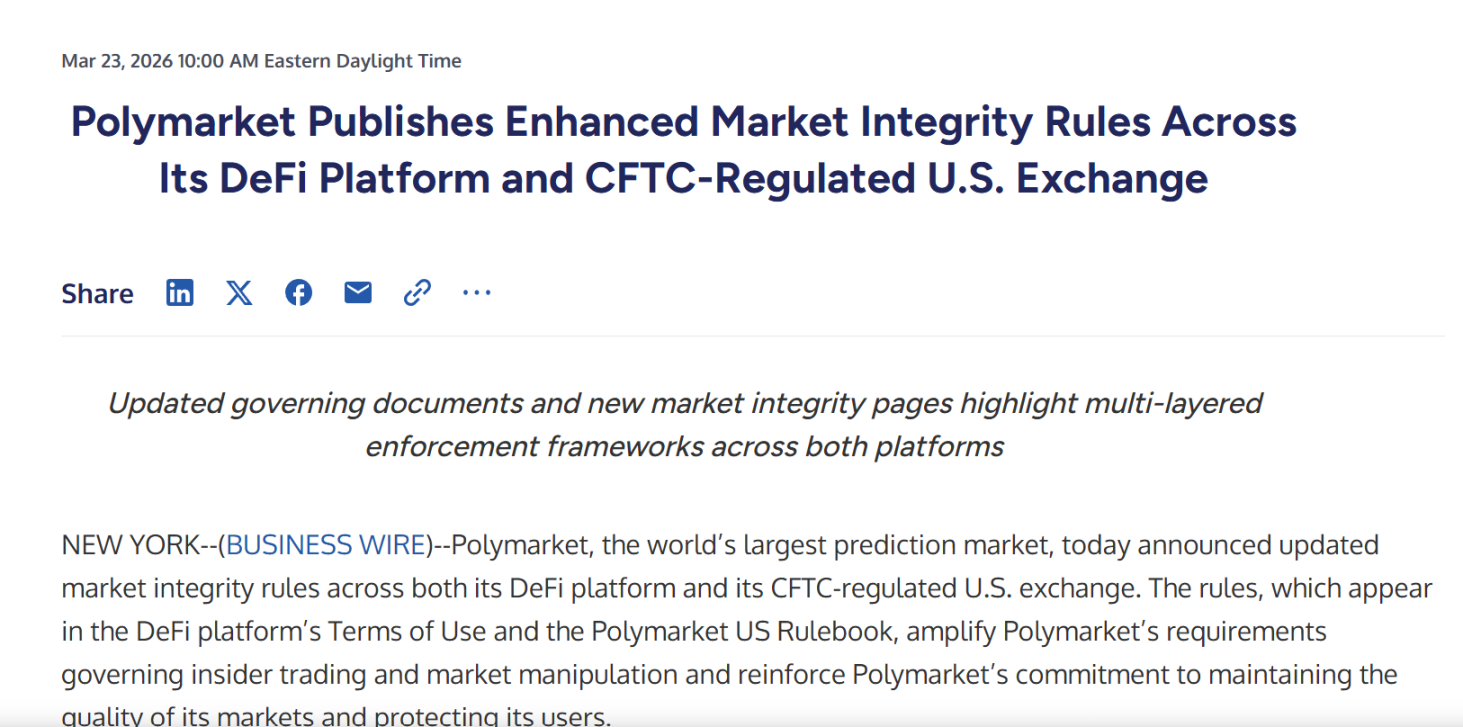
For example, Kalshi has publicly stated it will prohibit political candidates from trading in markets related to their own campaigns and will block athletes, coaches, referees, and related personnel in professional and collegiate sports from participating in trades related to their own events. Polymarket also updated its market integrity rules in March, explicitly prohibiting trading based on stolen information, illegally obtained information, or other improper sources of information, and strengthening constraints against market manipulation and information abuse.
Objectively speaking, the logic behind these actions is becoming increasingly clear. If the market for a particular game, election, or policy outcome is large enough, then theoretically, insiders, related parties, interest groups, and those with informational advantages have a stronger incentive to influence the outcome itself or trade ahead using non-public information.
Sports and entertainment are particularly sensitive precisely because they are high-frequency, mass-market, emotion-driven, and event participants often have a more direct influence on outcomes. Therefore, they are极易 (highly susceptible) to being viewed by regulators as "disguised gambling" rather than serious information markets.
Overall, the recent changes in the U.S. regulatory landscape are no longer simple suppression or laissez-faire, but a more systematic, layered, and structured rule reshaping:
- The SEC no longer presumes tokens are securities by default;
- The CFTC and SEC are moving towards clearer division of labor and coordination;
- BTC, ETH, and stablecoins are gradually being incorporated into options, margin, and risk management systems;
- Stablecoins and prediction markets are being pushed towards the distinct paths of "payment tools" and "restricted information markets," respectively.
In other words, Crypto is no longer treated as a vague whole but is beginning to be broken down into different asset classes, functional interfaces, and real-world scenarios, each being incorporated into its corresponding institutional framework.
For users, this means a more predictable environment is forming. For the industry, it means the next round of competition will no longer just be about who tells the best story, but increasingly about who better adapts to the new institutional boundaries and who can more effectively connect on-chain innovation to the real-world financial system.
2026 may not be the year Crypto completely escapes regulation, but it is likely to be the year it truly enters a phase of rule differentiation, value reassessment, and institutional realignment.