




edgeX Analysis: How the High-Performance Perpetual DEX Operates and the Role of the EDGE Token


- Core View: EDGE is the native token of the high-performance on-chain perpetual contract protocol edgeX. Its value is not dependent on mandatory use cases but is tied to platform trading activity and incentive mechanisms, aiming to align the incentives of ecosystem participants.
- Key Elements:
- Protocol Positioning: edgeX employs an order book model, focusing on execution speed and trading experience, aiming to bridge the performance gap between centralized and decentralized exchanges.
- Token Function: EDGE is primarily used to incentivize trading, liquidity provision, and ecosystem participation, rather than being a necessary asset for paying fees or accessing the protocol, lacking rigid consumption scenarios.
- Economic Model: The total token supply is 1 billion. Allocation focuses on early user incentives, employing a multi-year linear vesting mechanism with no inflation design.
- Competitive Landscape: Faces competition from perpetual protocols like Hyperliquid and dYdX Chain that also focus on high-performance execution. Its differentiation lies in its "execution layer first" architecture.
- Main Risks: Token value is highly dependent on sustained trading volume and user retention; as tokens unlock, sell-side pressure may emerge if demand is insufficient; complex technical architecture presents stability challenges.
Quick Takeaways
- What it is: EDGE is the native token of edgeX, serving an order book-based perpetual contract trading protocol.
- Core Utility: Used to align trading incentives, liquidity participation, and ecosystem reward distribution.
- Differentiation: edgeX employs an order book and high execution speed design, rather than a traditional AMM perpetual model.
- How Users Participate: Users engage by trading perpetual contracts, providing liquidity, and participating in incentive mechanisms.
- Key Risks: Token value depends on sustained trading activity and competitive positioning within the perpetuals landscape.
What is edgeX (EDGE)
edgeX is an on-chain perpetual contract trading protocol whose core utilizes an order book execution model, rather than an automated market maker (AMM) mechanism. EDGE is its native token, used to coordinate incentive relationships among traders, liquidity providers, and ecosystem participants.
Unlike tokens required for accessing a protocol or executing trades, EDGE is not a mandatory asset for using the exchange. It exists more as an incentive layer, reflecting actual activity and participation within the platform.
What Problem Does a High-Performance Perpetual DEX Solve?
As on-chain trading evolves, the gap between decentralized exchanges and centralized exchanges remains a core market concern. Although DeFi offers transparency and self-custody advantages, many platforms still exhibit significant shortcomings in execution speed, liquidity depth, and trading stability.
Consequently, the market has begun focusing on protocols designed with "performance-first" as their core. These systems no longer emphasize just composability or yield structures but attempt to replicate a trading experience on-chain that is close to that of centralized exchanges, while retaining on-chain settlement and asset security.
edgeX emerges in this context. Its positioning focuses on execution efficiency, order book trading, and infrastructure specifically designed for derivatives markets. When evaluating EDGE, it's necessary to distinguish between the performance narrative and actual adoption, and to judge whether its demand stems from genuine trading activity or is primarily driven by incentive mechanisms.
How Does edgeX (EDGE) Work?
EDGE is a homogeneous token related to the edgeX perpetual contract trading ecosystem. It is not a required asset for paying trading fees or accessing the platform's core functionalities.
Users primarily interact with EDGE through trading behavior and liquidity participation. Specific methods include opening perpetual contract positions, providing funds to liquidity pools, or participating in mechanisms like strategy vaults.
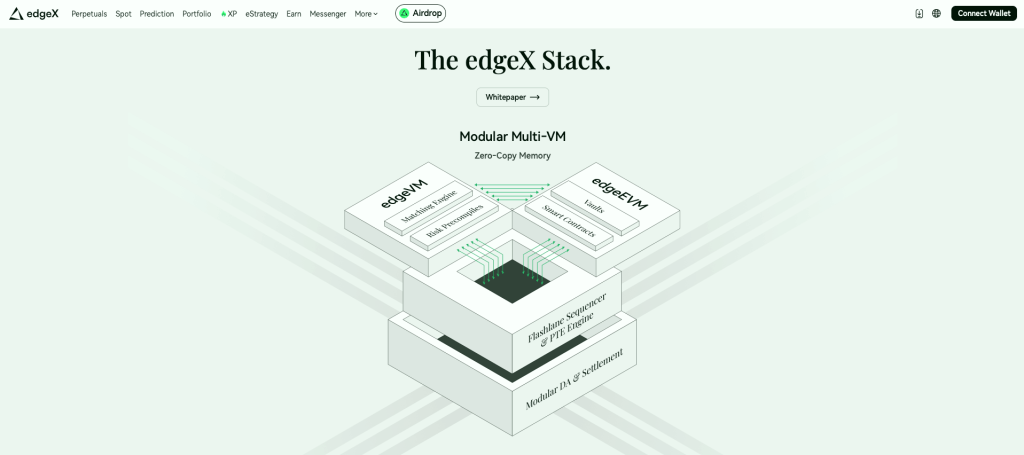 Image Source: Pro.edgeX.exchange
EDGE's market demand is closely tied to platform usage. Increases in trading volume, open interest, and liquidity participation levels all influence how incentives are distributed among users.
From a technical perspective, edgeX separates trade execution from asset settlement. Trading is completed through a high-performance matching system, while asset custody remains based on Ethereum-related infrastructure.
Therefore, EDGE functions more as a coordination mechanism rather than a necessary asset in the trading process. Its value and relevance depend on the protocol's ability to consistently attract and retain trading activity.
EDGE Tokenomics
Core Token Mechanism
EDGE employs a fixed total supply model, with a maximum supply of 1 billion tokens. Its allocation covers multiple categories including early users, core contributors, ecosystem development, liquidity support, and future reserves.
A significant portion is allocated to early participants and distributed through behavior-based incentive mechanisms. This ties the initial distribution more closely to platform usage rather than relying entirely on private funding.
Both the core contributor and future reserve portions are subject to lock-up periods and multi-year linear vesting schedules. This design slows the rate at which tokens enter the market but also means supply will continue to be released over the long term.
The token does not have mandatory utility within the protocol. EDGE is not required for trading fees, staking, or access permissions, nor is it designed with a mandatory burn mechanism or usage dependency.
Allocation Structure
Category Percentage Explanation Early Users 30% Distributed via behavior incentives and pre-TGE activities Core Contributors 25% Released linearly over multiple years after lock-up Future Reserves 30% For long-term ecosystem and strategic development Ecosystem & Community 5% For partnerships, growth, and incentives Foundation 5% Supports operations and development Liquidity 5% For market making and trading depth support
Token Data Overview
Metric Value Explanation Blockchain Ethereum-related infrastructure Settlement based on Ethereum-compatible architecture Token Standard ERC-compatible standard Homogeneous token logic Total Supply 1,000,000,000 EDGE Fixed cap, no additional minting Max Supply 1,000,000,000 EDGE No inflation mechanism Initial Circulating Supply Not fully disclosed (depends on TGE) Related to user rewards and early unlocks Emission Mechanism No minting (fixed supply) Released via incentives and unlocks Unlock Structure Multi-year (includes lock-up & linear vesting) Contributors and reserves released gradually
Why the Token Mechanism Matters
EDGE's token design is closer to a "behavior-based incentive" model rather than a value system reliant on fee capture or governance. Due to the lack of mandatory use cases, its value depends more on trading activity and liquidity depth. In the short term, a lower circulating supply may aid price discovery; however, in the long term, as unlocks progress, the continuous release of supply requires protocol growth to absorb it, otherwise it may create dilution pressure.
Ecosystem and Core Applications
How Users Interact with EDGE
Users connect with EDGE through a "trade + participate" loop. They enter the platform, open perpetual contract positions, and engage in liquidity or strategy systems. Acquiring EDGE is typically a result of these actions, not a prerequisite for using the platform.
During periods of rising trading volume or increased market volatility, user activity typically increases. When trading demand declines, participation related to the token may also decrease due to reduced incentive distribution.
Core Applications and Use Cases
Supporting Perpetual Trading Activity
EDGE is used to align incentives between traders and the protocol. Rewards are distributed based on trading behavior, linking token acquisition to actual trade execution activity.
Supporting Liquidity Participation
EDGE enables users to participate in liquidity systems, such as funding pools or strategy vaults. Funds provided by users support trading activity and may generate returns based on fees or market movements.
For Strategic Capital Allocation
The protocol allows users to participate in structured products (e.g., strategy vaults). These systems deploy capital into the market through preset mechanisms, operating strategically.
As an Ecosystem Coordination Mechanism
EDGE exists as a coordination tool for ecosystem growth. It distributes incentives based on user participation and contribution levels, serving to connect users, developers, and partners, rather than functioning as a mandatory utility token.
How to Buy, Use, and Participate in EDGE
EDGE can be acquired on secondary markets, including pre-market trading environments and exchanges that have listed its trading pairs. Currently, XT.com has listed the EDGE/USDT pre-market OTC trading pair, providing an early participation channel for price discovery before the official TGE.
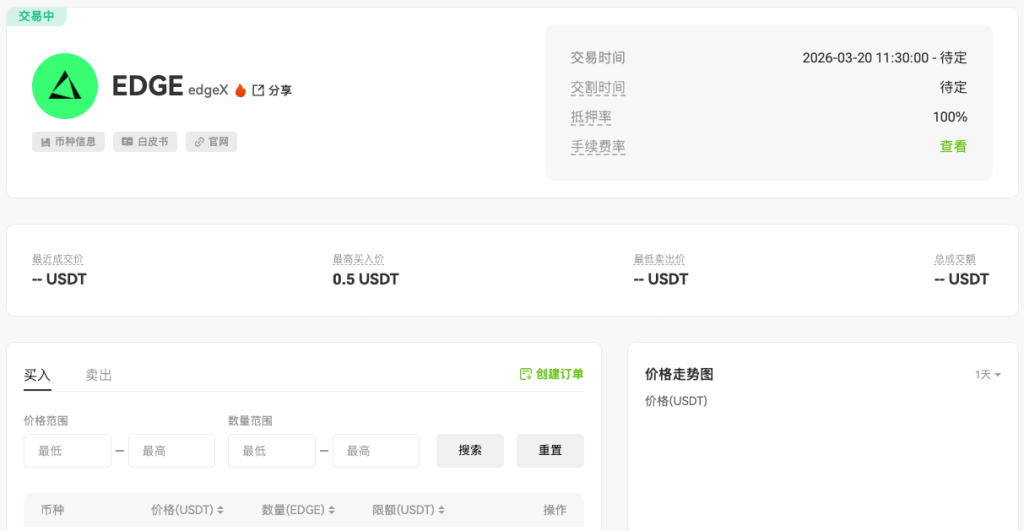 The EDGE/USDT pre-market OTC trading pair is now live on XT.com.
Holding EDGE does not automatically grant access to protocol functionalities or governance rights. Ownership represents more of an exposure to the ecosystem rather than functional usage within the platform.
Users typically participate in the ecosystem by trading perpetual contracts, providing liquidity, or engaging with strategy vaults. Following the TGE, XT.com will also open EDGE/USDT spot trading, further expanding its trading and circulation scenarios.
The participation process does not require additional specialized tools; users only need a standard exchange account or a compatible wallet to complete operations.
EDGE Competitive Landscape
edgeX operates in the competitive arena of high-performance perpetual trading protocols, projects dedicated to replicating the execution experience of centralized exchanges as closely as possible while maintaining on-chain settlement. Its main competitors include Hyperliquid, dYdX Chain, Vertex Protocol, Aevo, and Drift Protocol. Competition among these platforms focuses primarily on execution quality, liquidity depth, and capital efficiency, rather than composability or yield design.
edgeX's differentiation lies in its "execution-layer-first" design philosophy, focusing on order book trading, parallel processing, and infrastructure built specifically for derivatives markets. This contrasts with protocols reliant on