




What is Perle (PRL)? Core Logic Analysis of the AI Human Data Layer


- Core Viewpoint: Perle (PRL) is a Solana-based token designed to coordinate human data contribution and evaluation processes for AI training through crypto-economic incentives. Its core value lies in whether the token can be deeply embedded into and drive a scalable, high-quality off-chain data workflow.
- Key Elements:
- The project positions itself as a "human-driven AI data layer," focusing on incentivizing and coordinating contributors in areas like data labeling, review, and verification, distinguishing it from narratives centered on computing power or agents.
- The token has a fixed total supply of 10 billion, with allocation emphasizing community and ecosystem incentives. However, as the core business operates primarily off-chain, the token's value capture capability is a key risk.
- Users can trade PRL on exchanges or participate in its data contribution system to earn rewards. Token demand depends on ecosystem participation rather than fundamental network functionality.
- It faces competition from centralized data service providers and other decentralized AI projects. Its advantage hinges on proving that a tokenized coordination mechanism is superior to traditional models.
- Key metrics for future observation include the scale of active contributors, task throughput, and whether the token becomes a necessary tool for platform access or governance.
Quick Takeaways
- What it is: PRL is a Solana-based token associated with Perle's human-driven AI data and evaluation network.
- Core Use: Used to coordinate contributor rewards, data attribution, and participation mechanisms within AI training and validation workflows.
- Differentiation: Focuses on the human data layer, rather than compute markets or pure AI agent narratives.
- How Users Can Participate: Interact by trading PRL or participating in task-based data contribution systems.
- Main Risk: If core operations remain largely off-chain, the token's value capture ability may be weak.

What is Perle (PRL)
Perle is a cryptocurrency token built on Solana, centered around a human-centric AI data infrastructure model. Its positioning is not as a general-purpose payment or network settlement tool, but rather as a means to coordinate data contribution, model evaluation, and reputation-based participation mechanisms.
In practice, PRL is linked to a system of human-involved data production and validation. Contributors help improve the training quality of AI models by participating in data labeling, review, and optimization. This token is not merely attached to an AI concept narrative; it is more concretely embedded in the "workflow layer"—the stage where expert input, quality control, and distributed collaboration occur.
Why AI is Increasingly Dependent on the "Human Data Layer"
As AI systems advance, their bottlenecks are gradually shifting from model scale to data quality. Improvements in model outputs increasingly rely on high-quality data, stricter evaluation systems, and more reliable human feedback. This is particularly evident in scenarios requiring contextual understanding, professional judgment, and error identification.
This shift has given rise to a new direction in AI data infrastructure. Unlike projects focusing solely on model hosting, inference, or compute power, these initiatives are starting to concentrate on "how data is collected, validated, and optimized." Perle emerges in this context, building a data collaboration system by integrating human contribution processes with crypto-economic incentives. When evaluating PRL, it is necessary to distinguish the feasibility of its underlying data logic from the token's actual role within the system. This article will analyze PRL's operational model, user participation pathways, potential sources of demand, and structural constraints.
How Perle (PRL) Works
PRL is a fungible token deployed on Solana, associated with Perle's AI data infrastructure system. This system is centered on human participation, revolving around data contribution, review, and evaluation processes to enhance model quality.
The token's primary role is to coordinate participation within this system. Contributors can engage in tasks such as data labeling, result auditing, or output validation, while reputation and attribution mechanisms distinguish high-quality work from low-value activity. In this structure, PRL is closer to a "coordination asset" circulating around contributions and incentives, rather than a foundational network token.
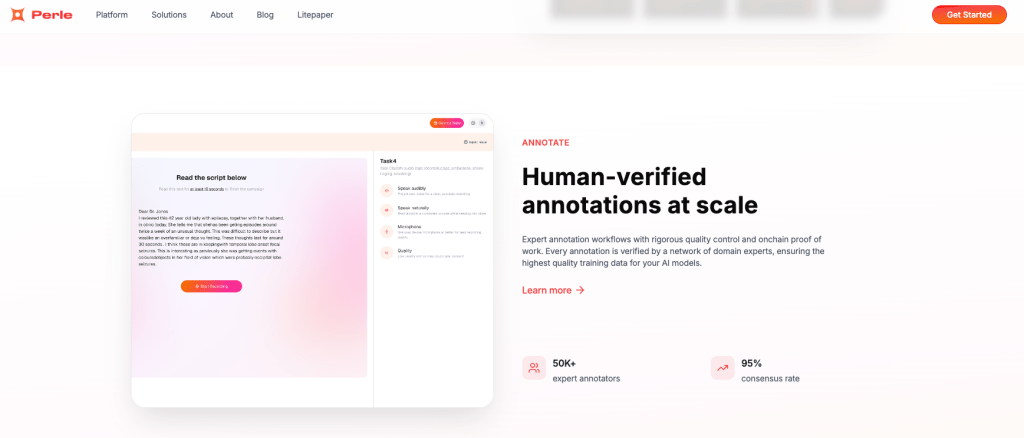 Image Source: Perle.xyz
Demand for PRL primarily stems from ecosystem participation, not fundamental blockchain functions. Its value depends on whether users, contributors, and platform participants need the token to access tasks, claim rewards, or participate in reputation-based systems. This gives it a certain functional attribute compared to purely narrative-driven tokens, yet it remains distinct from infrastructure tokens used for compute or network fees.
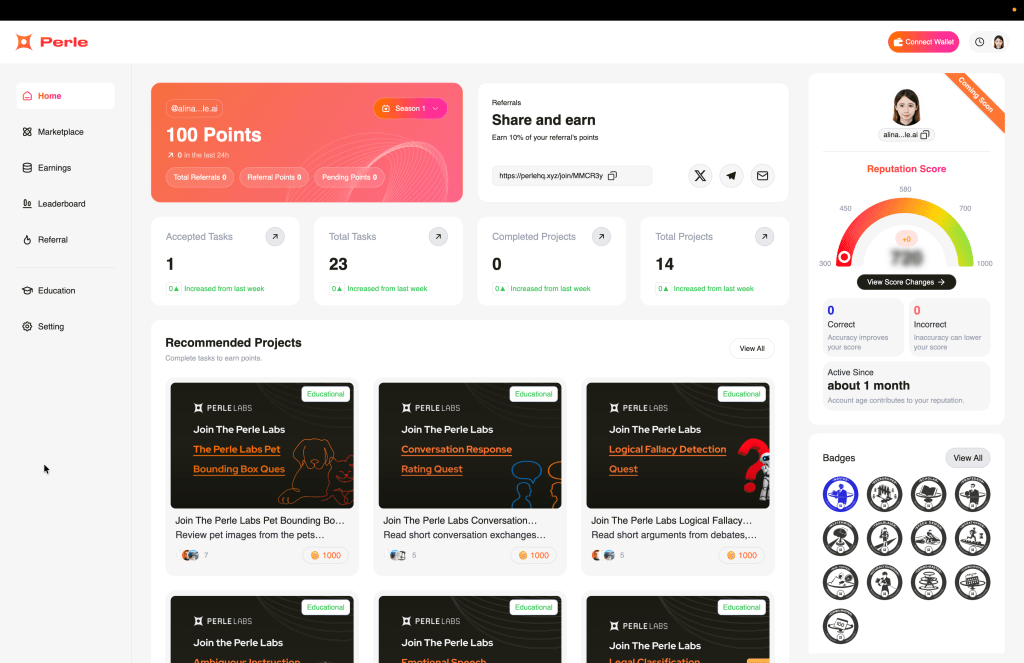 Image Source: Perle.xyz
From a technical architecture perspective, Perle employs a hybrid model. Core operations, including data processing and enterprise services, primarily occur off-chain, while the blockchain layer is used to record attribution, distribute rewards, and potentially support governance or participation mechanisms. On the trading front, PRL also exists as a tradable asset, representing market pricing and expectations for the AI data collaboration narrative in pre-market environments, including on platforms like XT.
PRL Tokenomics
Core Token Model
PRL adopts a fixed total supply model, with a total supply of 10 billion tokens. Its allocation primarily covers community incentives, ecosystem development, investors, and the team, among other categories.
A significant proportion of tokens is allocated for community and ecosystem purposes. Structurally, this indicates the token is more focused on supporting user participation, contributor incentives, and network expansion, rather than concentrating a large share with internal holders. This design aids early ecosystem growth but also means circulating supply may gradually increase as incentives are released.
Investor and team allocations typically feature lock-up and linear vesting mechanisms. This can mitigate selling pressure in the initial stages but does not eliminate long-term dilution risk. Over time, the market still needs to absorb new circulating supply from these portions.
PRL's value does not originate from mining, validator issuance, or network gas consumption. Its issuance logic leans more towards ecosystem expansion and participation incentives. Since the core business corresponding to PRL mainly occurs off-chain, its tokenomics function more as a coordination tool between users, contributors, and incentives, rather than a traditional protocol security layer.
Allocation Structure
CategoryPercentageUnlock / Release MechanismCommunity37.50%7.5% unlocked at TGE, remaining vested linearly over ~36 monthsEcosystem17.84%10% unlocked at TGE, remaining vested linearly over ~48 monthsInvestors27.66%12-month lock-up, then vested linearly over ~36 monthsTeam17.00%12-month lock-up, then vested linearly over ~36 months
Tokenomics Overview
MetricValueBasisBlockchainSolanaProject / Market DisclosureToken StandardSPLOn-chain Info / Chain TypeTotal Supply10,000,000,000 PRLOfficial DisclosureSupply ModelFixed Total SupplyIssuance MechanismEcosystem-Driven AllocationTokenomics ExplanationBurn MechanismNot explicitly disclosed in public materialsStaking DemandNot yet defined as a core function
Why Tokenomics Matters
For PRL, tokenomics influence participation incentives more than network security. If the token is primarily used for reward distribution but lacks sustained demand support, it could lead to long-term selling pressure. Its sustainability depends on whether PRL becomes a necessary tool for access, coordination, or governance, rather than merely an incentive asset attached to off-chain operations.
Ecosystem and Core Applications
How Users Interact with PRL
Users interact with PRL through a "contribution-coordination" cycle. They may encounter the token in discussions related to AI infrastructure, acquire PRL through exchanges, or further engage with task-based data workflows linked to the ecosystem. Contributors complete tasks, accumulate reputation, and receive rewards, while other market participants may choose to hold or trade the token based on its positioning within the AI data layer.
Therefore, compared to pure Meme or AI persona tokens, PRL's interaction has a more practical foundation, but its activity level still depends on whether the underlying workflows can scale and operate sustainably. If platform engagement increases, token usage depth may follow; if the contribution system remains limited in scale, user behavior may primarily concentrate on trading.
Core Applications and Use Cases
Coordinating AI Data Contributions
PRL is used to coordinate participation in workflows such as data labeling, auditing, and validation. Unlike tokens used for compute payments, it primarily corresponds to the critical "human input" phase in AI training processes.
Supporting Reputation-Based Task Participation Mechanisms
The system allows users to establish verifiable contribution records, thereby reflecting quality differences in task allocation. This helps assign higher-value tasks to more reliable participants and forms a structured quality control mechanism.
Distributing Human Evaluation Incentives
PRL can be used to distribute rewards related to data labeling, result auditing, and edge-case validation. This gives it a practical role in contributor incentives and collaboration, even if core operations still primarily run off-chain.
As Market Exposure to AI Data Infrastructure
From a market perspective, PRL also represents the assetization of the AI data infrastructure narrative. For traders, its value stems not only from potential use cases but also from its positioning and expectations within this sector.
How to Buy, Use, and Participate in PRL
PRL can be acquired through supported trading platforms, including early market environments. Currently, XT.com has launched the PRL/USDT pre-market OTC trading, providing users with a channel for early participation before full liquidity is established. Following TGE, the PRL/USDT spot market is also expected to open, enabling standard secondary market trading.