






What is Instaclaw? Analysis of the Hosted AI Agent Platform and Dual-Layer Token Structure


- Core Viewpoint: Instaclaw is a hybrid project that combines a hosted personal AI agent SaaS service with an independent crypto token layer. Its core product operates on a subscription model, while the token (INSTACLAW) is mainly used for optional market mechanisms such as staking and agent priority. The necessity of the token and its long-term value capture remain uncertain.
- Key Elements:
- The core product is a hosted AI agent service. Users can deploy agents on dedicated virtual machines via subscription (e.g., $29/month), connect them to communication apps like Telegram to handle tasks, and use the service without needing tokens.
- The INSTACLAW token is deployed on the Base chain with a maximum supply of 1 billion tokens, of which approximately 280 million are currently in circulation. Its utility is described as being related to staking, agent priority, and market participation, forming an optional incentive layer on top of the core product.
- The main risks facing the project are insufficient disclosure of the token economic model and the weak binding between token demand and product usage. Its long-term value depends on the effectiveness of its market mechanisms and the sustained adoption of the AI agent narrative.
- Unlike projects like Fetch.ai where tokens are directly embedded into protocol operations, Instaclaw adopts a "SaaS + Token" hybrid model. This lowers the barrier to entry for users but also diminishes the token's necessity.
- Going forward, it is crucial to monitor the sustained growth in actual product usage and whether the official team provides clearer first-hand documentation regarding token allocation, staking mechanisms, etc., to verify the real economic activity of its market mechanisms.
Quick Takeaways
- What it is: INSTACLAW is a Base-based token associated with a hosted personal AI agent platform.
- Core Utility: Primarily designed around staking, agent priority, and market participation, rather than basic feature access.
- Differentiation: Instaclaw combines a SaaS-style agent hosting service with an independent token incentive mechanism.
- How Users Participate: Users deploy agents, connect communication apps, and can choose to participate in token-related mechanisms.
- Key Risks: The product usage path is clear, but the token's necessity is weak, with uncertainty regarding long-term value capture.
What is Instaclaw
Instaclaw is a cryptocurrency token built on Base, associated with a hosted personal AI agent platform that allows users to deploy always-on AI agents through messaging applications like Telegram, Discord, Slack, and WhatsApp. The token is mentioned in the project's FAQ and external market pages as part of the platform's Web3 layer, while its core product focuses on agent hosting, persistent memory, and task execution capabilities.
Why Hosted AI Agents Are Gaining Attention and Where Instaclaw Fits In
As the AI agent narrative matures, market focus has shifted beyond model capabilities themselves to deployment methods, continuous operation, and practical usability. The key question is no longer just whether an agent can generate text, but whether it can stay online persistently, remember context, connect to real tools, and perform repetitive tasks within the channels users use daily. This shift creates space for platforms specializing in agent hosting and orchestration, not just underlying model development.
Instaclaw is positioned within this emerging space. Its official product positioning emphasizes dedicated machines, persistent memory, built-in skills, and interaction via messaging apps, while also introducing a token layer through separate entries for $INSTACLAW and $CLAWLANCER in its FAQ. This structure makes INSTACLAW noteworthy as it combines a relatively concrete SaaS product with a more uncertain crypto asset. This article will analyze the token's current operation, potential sources of demand, and its limitations within the overall structure.
How Instaclaw (INSTACLAW) Works
INSTACLAW is a fungible token deployed on Base, part of the Instaclaw ecosystem. The official product website primarily focuses on the hosted AI agent itself rather than token mechanisms, so the token's role is more evident in ecosystem descriptions and market materials than in core product documentation.
 Source: Instaclaw.io
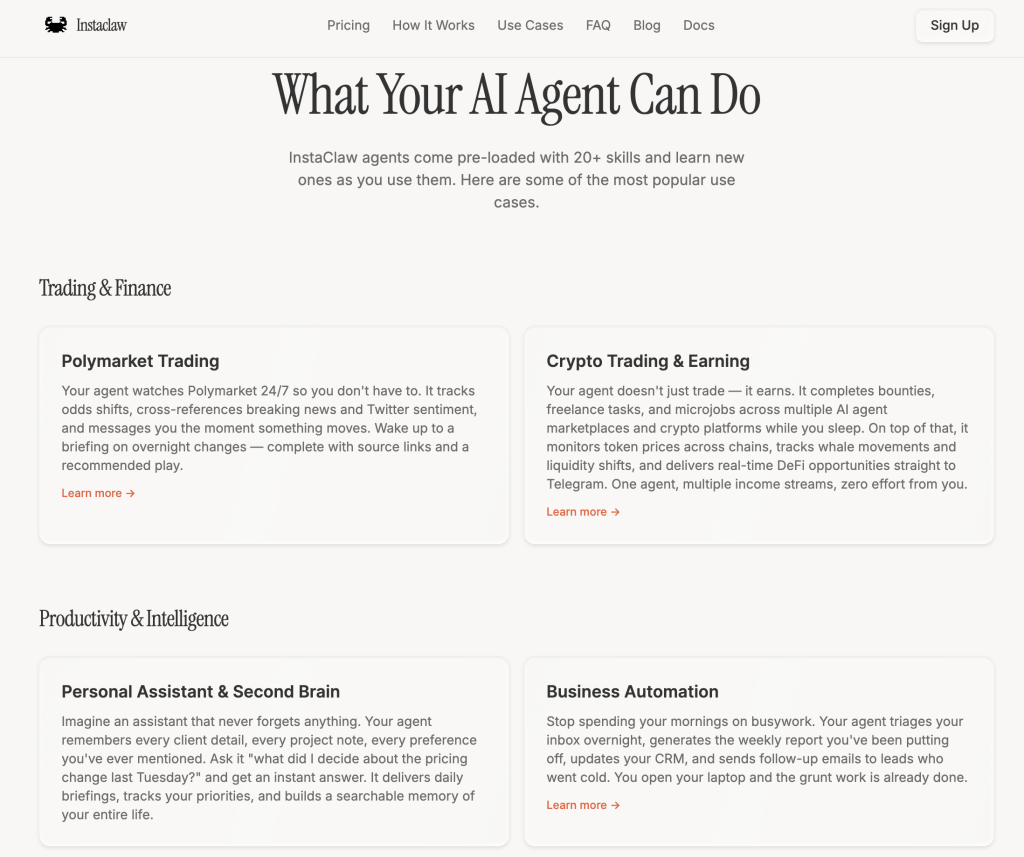
The platform allows users to launch personal AI agents on dedicated virtual machines and connect them to Telegram, Discord, Slack, or WhatsApp for handling emails, managing schedules, organizing files, performing web searches, and executing multi-step task workflows. Basic usage is provided via a subscription model, including a $29/month Starter plan and a 3-day free trial as shown on the website. Additionally, the blog mentions a BYOK plan priced at $14/month for users who bring their own Anthropic API Key.
This point is crucial because the product itself can function normally without relying on the token. Based on available information, INSTACLAW appears more like a layer added on top of the core service rather than being embedded within it. External market descriptions often link the token to staking and agent priority mechanisms, meaning token demand stems more from competitive resource allocation than from basic feature access.
Structurally, Instaclaw consists of two layers. One is the subscription-based product layer responsible for deployment and operation; the other is a token layer that may influence priority, exposure, or opportunity allocation, provided its market mechanisms can create real effects. On centralized exchanges, user participation is more about gaining trading exposure to this overall ecosystem narrative rather than direct dependence on a specific protocol.
INSTACLAW Tokenomics
CoinGecko shows that INSTACLAW has a maximum supply of 1 billion tokens, with approximately 280 million currently circulating. Its Fully Diluted Valuation (FDV) is calculated based on the assumption that the entire future supply enters circulation. On the surface, this provides a framework with a fixed cap, but CoinGecko also notes that the actual realization of FDV depends on subsequent issuance mechanism design.
Current first-hand documentation remains limited. The official FAQ confirms that $INSTACLAW and $CLAWLANCER belong to the project's token layer, but existing public content does not provide a complete allocation structure, including team share, vesting schedules, ecosystem incentives, or issuance plans. Therefore, transparency regarding token distribution is relatively weaker compared to the product itself.
At the market level, INSTACLAW's liquidity is primarily concentrated on exchanges rather than a protocol interface with full documentation support. CoinGecko shows the token is listed on both decentralized and centralized exchanges, including Uniswap V2 on Base and LBank, with INSTACLAW/VIRTUAL being one of its more active trading pairs.
Tokenomics Overview
MetricValueBlockchainBaseToken TypeEcosystem / Utility TokenMax Supply1,000,000,000 INSTACLAWCirculating Supply (Est.)~280,000,000Core Product AccessSubscription-basedOther Ecosystem TokenMentions $CLAWLANCERAllocation StructureNot explicitly disclosedStaking / Priority MechanismExternally mentioned, lacks first-hand details
Why Tokenomics Matters
For INSTACLAW, the importance of tokenomics lies not in the issuance mechanism itself, but in its "necessity." If staking mechanisms can substantially affect agent performance or rewards, token demand may have structural support. Conversely, if the token remains optional while core value is provided by the subscription product, long-term token demand may struggle to grow in sync with product usage.
Ecosystem and Core Applications
How Users Interact with INSTACLAW
A user's first step into the Instaclaw ecosystem is the product itself, not the token. After registering, they connect a messaging app, choose a subscription plan, and deploy a personal AI agent on a dedicated machine. This agent then operates through daily communication channels and can handle various task-oriented workflows.
Token-related interactions typically occur on top of this foundation. According to existing market descriptions, users can stake INSTACLAW to enhance their agent's priority or gain more opportunities in similar market mechanisms. This creates an interaction loop: product usage comes first, and token usage depends on whether users find this incentive layer sufficiently valuable.