



OSAK Explained: From Meme Narrative to a New Attempt at Cross-Chain Liquidity


- Core Viewpoint: OSAK is a Meme token characterized by fair launch and cross-chain liquidity. Its value is primarily driven by market sentiment and trading activity, rather than protocol functionality or application demand.
- Key Elements:
- The project is positioned as a cross-chain Meme asset. Its core lies in decentralized distribution and cross-chain accessibility, not relying on mandatory protocol usage or application-layer functions.
- It adopts a fixed supply (1 quadrillion tokens) with a burn mechanism, featuring no additional issuance and no staking. The token economic model aims to shape a perception of scarcity.
- Utilizes LayerZero's OFT model to achieve omnichain transfers, maintaining a unified supply across multiple EVM chains such as Ethereum, Base, and Arbitrum.
- User participation primarily involves secondary market trading, cross-chain transfers, and liquidity mining. Demand stems from market attention cycles rather than functional consumption.
- Main risks include reliance on market narratives, lack of intrinsic value support, and technical risks associated with external infrastructure like cross-chain bridges.
Quick Takeaways
- What it is: OSAK is a cross-chain Meme token built around fair launch and community distribution.
- Core Use: Primarily exists as a tradable asset, not reliant on mandatory use within a protocol or application.
- Differentiating Factor: Combines a deflationary token model with LayerZero's omnichain transfer infrastructure.
- How Users Participate: Interact through trading, cross-chain bridging, and liquidity provision.
- Main Risks: Relies on market attention for momentum, lacks intrinsic value or protocol-level demand support.
What is Osaka Protocol (OSAK)
Osaka Protocol (OSAK) is a cryptocurrency token that originated on Ethereum and has expanded to multiple EVM-compatible chains. It is structurally positioned as a Meme asset, focusing on decentralized distribution and cross-chain accessibility rather than application-layer functionality or protocol integration.
Unlike tokens used to support the operation of a specific protocol, OSAK is not a necessary asset for accessing on-chain services. Its role is more evident in its circulation within markets and networks, rather than in demonstrating value through mandatory use within a product ecosystem.
Why Fair Launch × Cross-Chain Design is Becoming a New Trend in the Meme Space
As the crypto market continuously cycles through new narratives, distribution mechanisms have once again become a key focus. The rise of early Meme tokens largely depended on "fairness" and community consensus, while subsequent projects gradually introduced higher proportions of insider holdings and structured incentive mechanisms.
Recently, market attention has begun shifting towards assets that combine early distribution logic with new infrastructure. In this context, OSAK attempts to reintroduce the concept of fair launch in a multi-chain environment.
Its market positioning is precisely built upon this combination. On one hand, it continues the distribution-centric Meme narrative; on the other hand, it adapts to the flow of liquidity between different ecosystems through its cross-chain structure. Evaluating OSAK requires separating its structural design from the market attention cycle.
How Does OSAK Work
OSAK is a fungible token initially deployed on Ethereum and extended to multiple blockchains via LayerZero's Omnichain Fungible Token (OFT) model. It is not a required asset for accessing a protocol, executing transactions, or interacting with on-chain applications.
User participation with OSAK primarily occurs in the secondary market. Users typically interact through decentralized exchanges and, where supported, through centralized trading platforms. Their participation process does not rely on an application or product that mandates the use of this token.
The omnichain structure allows OSAK to be transferred between multiple networks like Base, Arbitrum, and BNB Chain while maintaining a unified total supply. Cross-chain transfers are typically achieved by locking or burning tokens on the source chain and minting or releasing a corresponding amount on the destination chain.
Market attention on OSAK is primarily influenced by Meme narratives, liquidity conditions, and cross-chain activity. Its demand stems from trading behavior and attention cycles, rather than functional dependencies within a protocol.
From a technical perspective, OSAK is based on a standard token mechanism, combined with cross-chain transfer infrastructure to achieve its functionality. Holding this token does not confer governance rights, access permissions, or any form of functional guarantee.
OSAK Tokenomics
OSAK employs a high total supply, fixed-structure token model, with an initial total supply of one quadrillion (1,000,000,000,000,000) tokens. Through a burn mechanism, a significant portion of tokens has been permanently removed, including early liquidity burns and distribution-related burns.
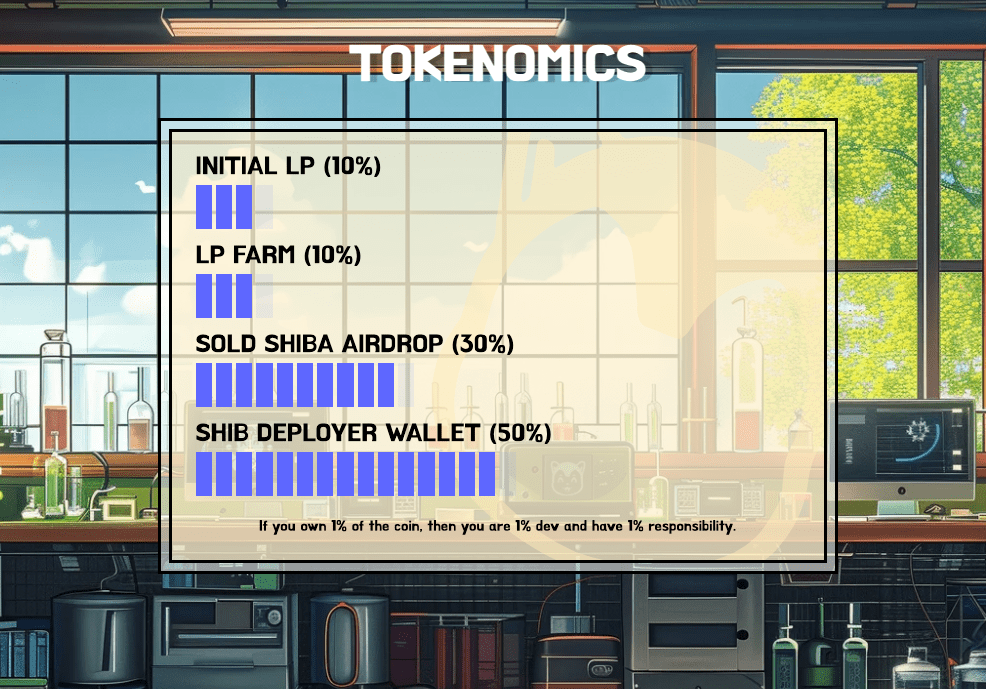 Source: Osaka.win
The token has no dedicated developer allocation. Its distribution was primarily completed through liquidity provision and airdrop mechanisms, with unclaimed airdrop portions subsequently burned. Therefore, the current circulating supply is lower than the original nominal total.
OSAK has no ongoing issuance mechanism, staking requirements, or inflationary minting. Apart from burn actions, its total supply remains stable. Cross-chain transfers do not increase the total supply but maintain overall consistency through mapping between different chains.
The token's liquidity and circulation are primarily driven by market behavior, rather than in-protocol incentive mechanisms. This design is closer to a fixed-supply Meme token than a functional token reliant on issuance or reward mechanisms.
Tokenomics Snapshot
Metric Value Verification Basis Blockchain Ethereum + EVM-compatible chains Project Documentation Token Standard ERC-20 / OFT Contract Design Total Supply 1,000,000,000,000,000 OSAK Official Documentation Circulating Supply Approximately 750T–760T OSAK Market Data Platforms Issuance Mechanism None No minting functionality Burn Mechanism Yes Initial and ongoing burns Staking Mechanism None No mandatory lock-up
Why Tokenomics Matter
In the absence of an issuance mechanism and functional consumption scenarios, OSAK's tokenomics primarily influence scarcity perception and liquidity behavior. Due to the lack of structured incentives, its demand relies more on trading activity and market attention cycles than on protocol-level usage drivers.
Ecosystem and Core Applications
How Users Interact with OSAK
User interaction with OSAK primarily unfolds through a market-driven cycle, including trading, cross-chain transfers, and liquidity mining. Typically, users first learn about the token through Meme narratives or cross-chain discussions, then acquire it through trading platforms.
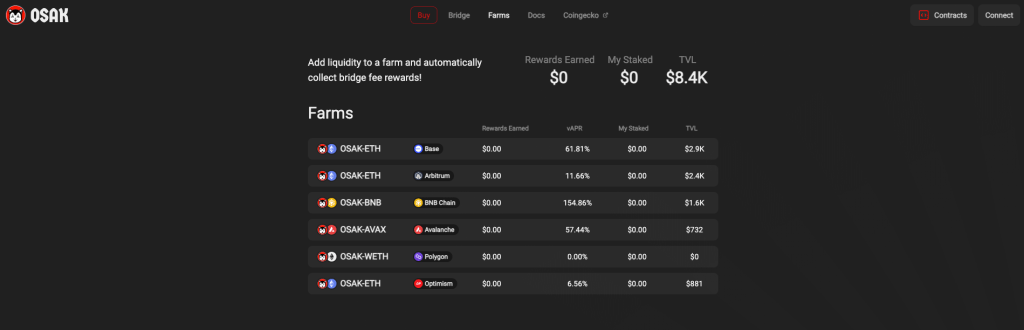 Source: Osaka.win
After acquiring OSAK, users can choose to hold, trade, or transfer it between supported chains. The cross-chain functionality allows liquidity to migrate to ecosystems with lower fees or more active trading, thereby influencing the distribution of trading volume.
Besides trading, users can also participate in mining mechanisms by providing funds to designated liquidity pools. This introduces a certain yield attribute to the token, but this participation method is optional and not a prerequisite for using the token.
Overall, interaction with OSAK remains primarily driven by market behavior and liquidity conditions, with mining mechanisms serving more as auxiliary incentives rather than core dependencies.
Key Applications and Use Cases
For Enabling Cross-Chain Asset Flow
OSAK allows users to transfer assets between multiple blockchains without exiting the token, maintaining continuous asset exposure across different ecosystems.
For Speculative Allocation in Meme Market Trends
This token enables traders to participate in the rotation of the Meme market. Its price changes reflect shifts in attention and sentiment more than actual protocol-level usage.
Supporting Cross-Chain Liquidity Participation
OSAK allows liquidity providers to participate in trading pairs within decentralized pools on different networks. Related activities are primarily driven by market demand, not by yields from underlying services.
As a Distribution-Oriented Meme Asset
This token embodies a distribution model centered on fair launch. User participation is based more on agreement with the distribution logic than on functional usage needs.
How to Buy, Use, and Participate in OSAK
OSAK can be acquired via decentralized exchanges on Ethereum and other supported chains, or traded on centralized platforms where it is listed. Specific trading pairs are typically against ETH or stablecoins, depending on the support of different platforms.
After acquiring OSAK, users can store it in self-custody wallets or transfer it between different networks via supported cross-chain bridges. This allows users to enter different ecosystems and access diverse liquidity environments.
Participation in OSAK is primarily market-behavior oriented. Users typically participate through spot trading, providing liquidity, or engaging in cross-chain asset allocation. On XT.com, users can trade via the OSAK/USDT