



What is ROBOTMONEY? The AI Agent Fund Management Track is Taking Shape


- Core View: ROBOTMONEY is a governance token on the Base network, aiming to provide a centralized fund management (vault) solution for the AI agent economy. Its current value is primarily driven by narrative and expectations for future infrastructure, rather than established, rigid use-case demand.
- Key Elements:
- The project has a unique positioning, focusing on managing funds generated by AI agents, rather than traditional DeFi users or AI agent development itself.
- The token's core function is governance, used to participate in decisions regarding future vault fund allocation strategies. It does not represent direct ownership or profit rights to the underlying assets.
- The total supply is 100 billion tokens. The value logic relies on future buyback-and-burn mechanisms driven by vault profits, with the contract retaining some flexibility in supply management.
- Main risks include the project being in its early stages, unproven demand, and token value being highly dependent on the popularity of the AI narrative and the actual performance of future vaults.
- Current user participation is mainly through secondary market trading on Base chain DEXs or XT.com to gain market exposure to the AI agent fund management narrative.
Quick Takeaways
- What it is: ROBOTMONEY is a governance token built on Base, centered around an AI agent treasury (Vault) model.
- Core Use: Used to coordinate capital allocation decisions across various strategies such as yield generation, trading, and liquid assets.
- Differentiation: Targets the capital management needs of AI agents, not traditional DeFi users.
- How Users Participate: Primarily through trading and governance expectations, forming a link with treasury strategy decisions.
- Main Risks: The project is still in its early stages, demand is unproven, and there is some flexibility at the contract level.

What is ROBOT MONEY (ROBOTMONEY)
Robot Money (ROBOTMONEY) is a cryptocurrency token deployed on the Base network, built around a treasury-based capital management model designed for AI agents. It emerged from discussions about the "Agent Economy," a framework where automated systems are gaining the ability to generate revenue, hold assets, and interact on-chain, thus creating new demands for structured capital allocation.
Unlike functional tokens that are mandatory for protocol use, ROBOTMONEY currently represents governance rights over a "proposed capital management system" more than direct participation in a live product. Therefore, market attention is primarily driven by narrative and expectations for the future implementation of on-chain capital management infrastructure.
Why the AI Agent Economy is Creating New Capital Allocation Challenges
As AI agents gain a stronger presence in the crypto market, their role is evolving from simple automation tools to entities with economic participation capabilities. An increasing number of AI agents are being viewed as "economic units" capable of generating revenue, holding assets, and operating within decentralized systems. This shift brings a new core problem: how to efficiently manage the capital controlled by these agents.
ROBOTMONEY is a proposed solution within this context, attempting to address current issues of capital fragmentation and idleness. Instead of having each agent or user connect to multiple DeFi protocols separately, this model achieves centralized allocation through a unified treasury (Vault) structure. Understanding ROBOTMONEY requires distinguishing between the macro-narrative of the "Agent Economy" and the project's current implementation stage. This article will analyze its operational model, user participation pathways, and its structural positioning.
How ROBOTMONEY Works
ROBOTMONEY is a fungible token deployed on the Base blockchain, built around a treasury (Vault)-based capital allocation model. The system aims to aggregate dispersed capital into a structured portfolio and allocate it according to predefined strategy categories.
In its design, the treasury divides capital into three main parts. One portion is used to generate stable yields via lending protocols; another is allocated to trading AI agent-related tokens; and the third portion is deployed into liquid crypto assets that generate on-chain yields.
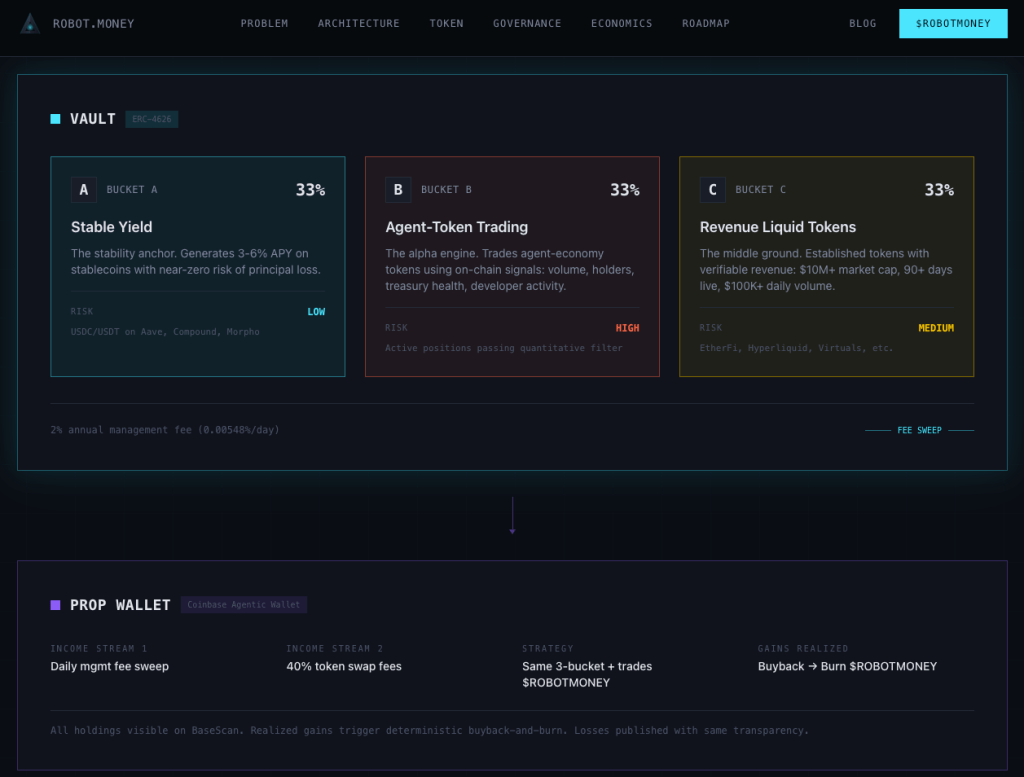 Source: Robotmoney.net
The token itself does not represent direct ownership of the treasury assets. Its core function is as a governance layer tool, enabling holders to participate in adjusting capital allocation strategies and system parameters. Holding ROBOTMONEY does not provide fixed returns, nor is it a prerequisite for using any application.
Currently, participation in ROBOTMONEY primarily occurs in the secondary market. Users can trade it on decentralized exchanges on Base or via the ROBOTMONEY/USDT spot market provided by XT.com. This type of participation is more about market positioning than direct use of a live capital management system.
Demand for ROBOTMONEY stems mainly from two aspects: interest in the AI agent economy narrative and expectations for the future implementation of on-chain capital management infrastructure. Therefore, its market role is defined more by trading behavior and market perception than by rigid usage demand within the current protocol.
ROBOTMONEY Tokenomics
Core Token Mechanism
ROBOTMONEY employs a high total supply model, with a total supply of 100 billion tokens deployed on the Base network. According to public information, the token had no presale and no explicit team allocation, positioning it overall as a fairly launched asset within the ecosystem.
Narratively, ROBOTMONEY is described as a non-inflationary token. However, from a contract structure perspective, it retains some flexibility in minting parameters and administrative permissions, indicating a discrepancy between the "fixed supply" claim and the underlying technical capabilities.
The token does not directly distribute earnings to holders, nor are there mandatory staking or lock-up mechanisms. Its value accrual logic primarily relies on a buyback and burn mechanism, funded by the profits generated from the protocol's managed capital. Therefore, this mechanism depends more on future treasury performance than on a predetermined issuance or fee distribution model.
Liquidity is primarily concentrated on decentralized exchanges on the Base network. At this stage, a large portion of tokens is distributed across liquidity pools and related contract addresses, reflecting early-stage market structure characteristics rather than a mature, long-term distribution pattern.
Metric Value Blockchain Base Token Standard ERC-20 Total Supply 100,000,000,000 ROBOTMONEY Max Supply 100,000,000,000 ROBOTMONEY Circulating Supply ~100,000,000,000 (Market Estimate) Market Cap ~$1.8 Million (As of March 2026) 24h Trading Volume ~$800k–$900k Primary Liquidity Source Uniswap v4 (Base) Main Pool Liquidity ~$500k–$600k Number of Holders ~3,000–3,300 Contract Type Verified ERC-20 (BaseScan)
Why the Token Mechanism Matters
In the absence of mandatory use cases or direct profit distribution, ROBOTMONEY's token mechanism influences market behavior more than actual usage demand. Its value performance depends primarily on governance relevance, narrative traction, and the actual operational effectiveness of the future capital management system.
Ecosystem and Core Applications
How Users Interact with ROBOTMONEY
Users typically interact with ROBOTMONEY via a "narrative-driven" path. They encounter the token in discussions about AI agents and capital management, purchase it through exchanges, and hold or trade it based on their assessment of its market relevance.
This interaction is not triggered by mandatory application-layer requirements but stems more from expectations for future treasury implementation, the potential influence of governance participation, and overall market interest in the agent economy.
When narratives around AI gain traction, ROBOTMONEY's trading activity typically increases in sync; conversely, when market attention shifts, its participation tends to decline.
Main Applications and Use Cases
To Express Exposure to Capital Governance Participation.
ROBOTMONEY can be used to represent participation in a capital allocation governance model. Holding the token implies potential exposure to influence over how treasury strategies are formulated and adjusted.
To Provide Indirect Exposure to Treasury Performance.
The token allows users to indirectly participate in the potential outcomes of capital allocation strategies. This exposure is not contractually guaranteed but depends on the system's future actual operation and management effectiveness.
To Coordinate Capital Allocation Decisions.
ROBOTMONEY allows governance participants to influence how capital is allocated between yield generation, trading, and liquid assets, creating a coordination mechanism between token holders and protocol design.
As a Narrative Vehicle for the AI Agent Economy.
In the actual market, the token functions more as a proxy for the narrative of AI agent capital management, with its market performance closely tied to the popularity of this theme in overall discussions.
How to Buy, Use, and Participate in ROBOTMONEY
ROBOTMONEY