






Space Review | The Rise of the "Agent Economy" Driven by AI Agents and the Financial Infrastructure Layout of Bank of AI


- Core Viewpoint: AI Agents are evolving from information processing tools into "digital labor" capable of autonomously executing on-chain tasks. This marks the arrival of the Agent Economy era and is reshaping on-chain business paradigms. Bank of AI, as an on-chain financial operating system designed specifically for AI Agents, aims to accelerate this process by simplifying the underlying infrastructure.
- Key Elements:
- The core breakthrough of AI Agents lies in their upgrade from "information analysis" to "active execution," enabling them to automate programmable tasks such as on-chain interactions and asset management, thereby addressing the shortcomings of smart contracts.
- AI Agents are seen as key to the Web4 "Agent Network" and possess the potential to become "investable assets" themselves. Through tokenization, holders can share in their operational profits.
- Future commercial opportunities include the development of vertical domain-specific AI Agents, AI Agent marketplaces similar to app stores, and AI Agent capability and credit scoring systems based on historical data.
- The high-frequency interaction nature of AI Agents will increase demand for the performance of underlying public chains. High-performance public chains like TRON and Solana are likely to be core beneficiaries.
- By integrating core components such as payment protocols, identity authentication, and MCP Servers, Bank of AI provides AI Agents with independent on-chain payment, identity verification, and contract interaction capabilities, aiming to lower the development barrier.
As the "lobster storm" ignited by OpenClaw swept through communities, AI Agents are completing the crucial leap from "chat tools" to "digital labor." With various applications intensifying their deployments, AI Agents have firmly established their core position as the next-generation infrastructure. They are not only completely颠覆ing human-computer interaction paradigms but are also driving the industry's transition from Web3 to Web4, reshaping the production relationships and value flows of the entire on-chain world.
In this evolution towards Web4, Bank of AI has consistently stood at the intersection of technology and users. As an on-chain financial operating system specifically built for AI Agents, Bank of AI is dedicated to paving the "last mile" for the agent economy. By simplifying the underlying infrastructure, it enables developers to build vertical AI Agents with extremely low barriers to entry.
This Space roundtable brought together active practitioners and seasoned observers from the industry's front lines, directly addressing the most critical proposition of commercial monetization under the agent wave. As AI Agents become capable of fully automating on-chain operations, where will the imminent new wave of commercial红利 flow? In this in-depth dialogue focusing on "Human-Machine Collaboration and Value Reconstruction," we will thoroughly deconstruct this core issue, outlining a clear path to participation and an action guide for every builder and explorer riding the Web4 wave.
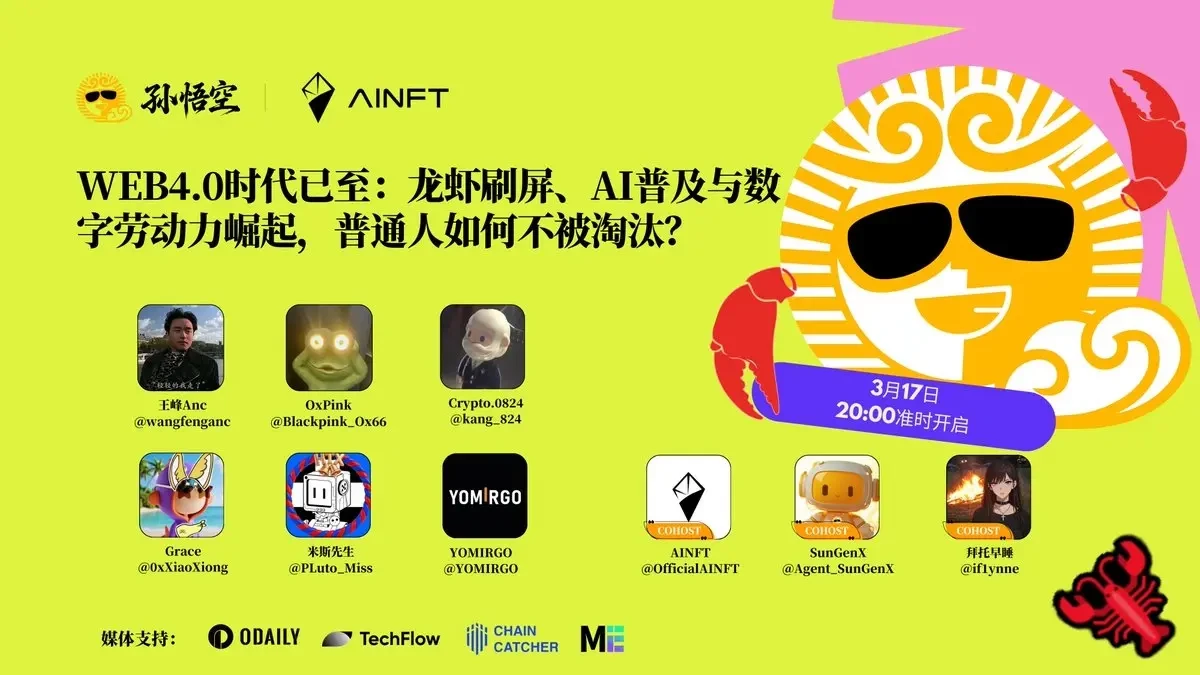
Behind the "Shrimp Farming" Frenzy: The Rise of the "Agent Economy" Driven by AI Agents
Recently, with the explosive popularity of OpenClaw, the "全民养虾潮" (全民养虾潮) quickly刷屏ed the internet. This hardcore upgrade of AI Agents precisely complements the most critical piece of the "active execution" puzzle in the Web4 architecture, officially heralding the comprehensive arrival of the agent economy era. In this Space roundtable discussion, several资深嘉宾 deconstructed the industry inevitability behind this trend from different dimensions.
Crypto.0824 was the first to clarify the core logic of this evolution: AI is upgrading from an information processing tool to a task execution主体. "Previously, we asked AI to help write or analyze things, solving the problem of information preprocessing. But AI Agents are different; they can directly help us execute tasks." In his view, a series of standardized, programmable operations such as on-chain interactions, asset management, reward claiming, and strategy execution are naturally suited for AI Agents to complete. He described this shift with a vivid analogy: "It's like moving from manual driving to assisted driving; users only need to set the goal, and the rest is handled by AI."
Following the脉络 of technological evolution, YOMIRGO analyzed it from the macro perspective of internet iteration. He emphasized that Web2 built the information network, Web3 reshaped the value network, and today's Web4 is nurturing a highly autonomous "agent network." For a long time in the Web3 era, AI始终 could not independently control funds and resources. The introduction of AI Agents breaks this historical limitation, granting AI the right to调度 and manage funds for the first time, fundamentally弥补ing the shortcoming of smart contracts lacking active execution capabilities.
He further前瞻性地 proposed that AI Agents themselves possess the potential to become "investable assets." For example, an AI Agent could autonomously operate fan communities on social platforms and achieve commercial monetization, ultimately distributing profits precisely to its holders through tokenomics. Regarding this颠覆性的 ecological reconstruction, OxPink highly评价ed it as "the moment of the iPhone's birth." He believes that the deep integration of AI Agents with the underlying value network is precisely the historical turning point triggering the industry's transition from Web3 to Web4.
Finally, Grace补充ed from the practical角度 of user experience and industry scalability. She剖析ed: "Web3 is essentially a highly programmable economic system, but currently, the vast majority of operations still极度 rely on manual intervention, which constitutes a huge bottleneck hindering the ecosystem's规模化 growth." She emphasized that the emergence of AI Agents正好 fills this systemic gap, rapidly rising as the core middleware layer connecting users to the on-chain world. Under the new Web4 architecture, users only need to "express intent," and the Agent will automatically take over and complete complex execution logic on-chain. This is not only a significant leap in user experience but also a key breakthrough driving the agent economy towards mass adoption.
When AI Agents Move Towards Autonomous Execution: The Reconstruction and Opportunities of On-Chain Business Paradigms
As AI Agents move from "information analysis" to "autonomous execution," the operating logic of the on-chain world is being rewritten. In this transformation, Bank of AI, as the on-chain financial infrastructure specifically built for AI Agents, is paving the last mile for the agent economy. In the second round of this Bank of AI roundtable discussion, guests展开ed an in-depth exploration around the topic: "When AI Agents can automatically execute on-chain operations, where will new business opportunities emerge?"
Mr. Mi Si pointed out that while AI Agents automate repetitive labor previously dependent on human effort, their true commercial爆发点 lies in the moment they can "connect to the chain and execute transactions." He预言ed, with the continuous differentiation of application scenarios, a batch of AI Agent development teams深耕ing vertical fields will inevitably emerge in the future, each细分赛道 harboring巨大的 market potential. Furthermore, he envisioned an AI Agent marketplace similar to an "app store," where users wouldn't need to build architectures from scratch but could conveniently调用 mature strategies by paying on-demand.
Following the thread of the "app marketplace," YOMIRGO further defined the future AI Agent market as the ecosystem's "commercial hub." He noted that this hub would not only match supply and demand but would also沉淀出 AI Agent capability rankings and credit scoring systems based on historical execution data. More颠覆性ly, AI Agents themselves would evolve into investable assets: "Through tokenization, users can either hire AI Agents on-demand for services or purchase shares to collectively share profits." Simultaneously, he提醒ed, the high-frequency interaction特性 of AI Agents will极大推升 demand for underlying infrastructure, with high-performance public chains like TRON and Solana potentially becoming core beneficiaries of this ecological红利.
From developing vertical AI Agents to building AI Agent marketplaces, from on-demand strategy调用 to hiring AI Agents for task execution, a new commercial landscape driven by intelligent agents is gradually becoming清晰 in the roundtable discussion. However, the true落地 of these business opportunities离不开 a set of underlying financial infrastructure that allows AI Agents to independently "live" on-chain. Bank of AI was born precisely for this purpose.
As an on-chain financial operating system specifically built for AI Agents, Bank of AI provides complete落地支撑 for the aforementioned commercial蓝图 through the deep integration of five core components: the x402 payment protocol, the 8004 identity authentication protocol, MCP Server, Skills, and the OpenClaw extension plugin.
First, addressing the aforementioned scenarios of "on-demand hiring and profit sharing," the x402 payment protocol endows AI Agents with lightweight, low-cost on-chain payment capabilities, supporting automated settlement for high-frequency micro-payments. This means that when a user hires a swing trading AI Agent, it can independently pay Gas fees and complete profit distribution. Second,呼应ing the "credit scoring system" proposed by the嘉宾, the 8004 on-chain identity protocol issues a verifiable digital identity for each AI Agent. Under this system, users can confidently select AI Agents based on historical success rates, and AI Agents can participate in DeFi protocols as credible independent entities, fundamentally establishing the trust cornerstone of the trading marketplace.
In terms of lowering development barriers, MCP Server, as a standardized bridge between AI large models and blockchain services,彻底打通s the connection between the two. Developers no longer need to write complex链 interaction code from scratch; they can drive AI Agents to call smart contracts and read on-chain data through standard interfaces. Simultaneously, the Skills module pre-installs reusable skill packages like DeFi operations and asset management, while the OpenClaw extension plugin achieves ultimate "plug-and-play," ensuring that any AI Agent接入ed based on this framework can instantly activate the aforementioned全套 on-chain financial operational capabilities.
The颠覆性 significance of this system lies in its极大释放 of productivity. When developers conceive a vertical AI Agent, they are彻底解放ed from the burdensome underlying architecture of payment logic, identity verification, Gas management, etc. With simple standardized configuration, an AI Agent can possess its own dedicated on-chain wallet, verifiable identity, and the financial operational capability to autonomously receive/pay assets and interact with protocols. It can be said that Bank of AI is simplifying complexity, turning the commercial蓝图 of "developing vertical Agents, building Agent marketplaces, hiring Agents for collaboration" from concept into reality.


