




RWA Weekly Report|Representative Assets Drop Nearly 14%; Dollar Stablecoin Market Cap Reclaims $300 Billion (Mar.4 - Mar.10)


- Core View: This week, the RWA (Real-World Asset) market showed a consolidation trend at high levels. The growth rate of total on-chain value slowed, with capital rotating moderately among assets of different risk grades such as U.S. Treasuries and corporate bonds. Meanwhile, the stablecoin market and user participation showed signs of recovery.
- Key Elements:
- The total on-chain RWA value increased slightly by 0.8% to $26.43 billion, but the growth slope slowed; the total value of representative assets saw a significant pullback of 13.9%.
- The user side resumed growth, with the total number of asset holders increasing by 1.18%. The total stablecoin market cap rebounded by 0.85% to $301.04 billion.
- Asset structure indicates continued capital preference for U.S. Treasuries (increased to $11 billion), while also spreading to medium-risk sectors like corporate bonds and institutional alternative funds.
- Regulatory activity was high: Florida, USA, passed a stablecoin regulatory framework; South Korea plans to ban corporate investment in stablecoins; Russia plans to introduce a stablecoin bill.
- Deepening linkage between traditional finance and crypto markets: BlackRock's private credit fund restricting redemptions raised concerns about risk spillover into DeFi and Bitcoin.
- Infrastructure and product innovation continued to advance, such as Ondo Finance's tokenized stocks being used as collateral in Ethereum DeFi for the first time.
Original | Odaily (@OdailyChina)
Author | Ethan (@ethanzhang_web3)
RWA Sector Market Performance
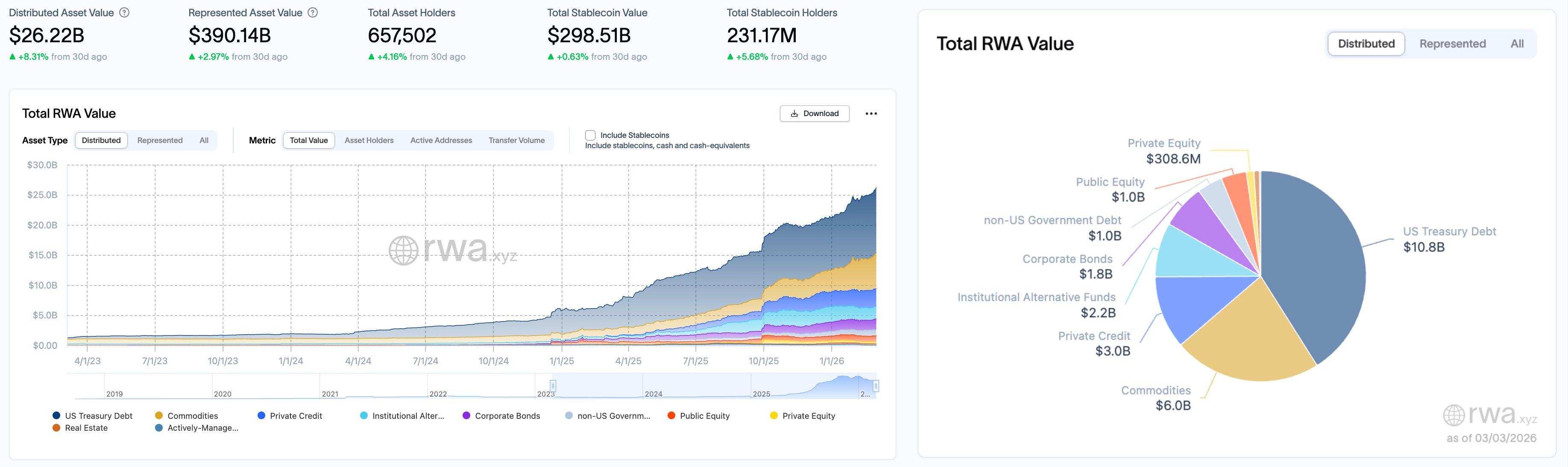
According to the rwa.xyz data dashboard, as of March 10, 2026, the total on-chain value of RWAs increased slightly from $262.2 billion on March 3 to $264.3 billion, a weekly increase of approximately $2.1 billion, representing a gain of about 0.8%. Compared to the accelerated growth in previous weeks, the total on-chain asset value continued to reach new highs this week, but the growth rate has noticeably slowed. In contrast, the total value of representative assets fell from $390.14 billion to $336.08 billion, a decrease of approximately $54.06 billion, or about 13.9%.
User-side recovery shows moderate growth: The total number of asset holders increased from 657,500 to 665,300, adding about 7,760 new holders in a week, a growth of about 1.18%, ending the previous consecutive decline and weak consolidation phase. Regarding stablecoins, the total market cap rebounded from $298.51 billion to $301.04 billion, an increase of about $2.53 billion, or about 0.85%, reclaiming the $300 billion threshold. The number of stablecoin holders also rose from 231.17 million to 233.94 million, adding about 2.77 million people, an increase of about 1.2%.
In terms of asset structure, U.S. Treasury bonds continue to firmly hold their position as the core anchor for on-chain RWAs, with their scale growing from $10.8 billion to $11 billion, a weekly increase of about $200 million. Commodity assets fell from $6 billion to $5.7 billion, a decrease of about $300 million, ending their previous strong upward trend. Private credit slightly declined from $3 billion to $2.8 billion, possibly due to some profit-taking after the previous rebound. In contrast, institutional alternative funds recovered from $2.2 billion to $2.4 billion, showing some repair; corporate bonds increased from $1.8 billion to $1.9 billion, continuing a moderate expansion trend.
Trend Analysis (Compared toLast Week)
Compared to last week, this week did not see a concentrated surge in any particular type of risk asset. Instead, it was characterized more by a mild rotation among mainstream assets: U.S. Treasuries continued to attract capital, institutional alternative funds and corporate bonds showed marginal strength, while commodities and private credit experienced some consolidation at high levels.
Overall, the total value of on-chain RWA distributed assets continued to rise this cycle, but the growth rate slowed, while the total value of representative assets saw a significant pullback. The simultaneous improvement in user numbers and total stablecoin market capitalization indicates that market participation is still recovering. Structurally, as mentioned earlier, capital continues to favor high-certainty assets like U.S. Treasuries, while also beginning to spread to medium-risk sectors such as corporate bonds and institutional alternative funds, suggesting a slight overall increase in risk appetite.
Market Keywords: High-level consolidation, structural rotation, liquidity repair.
Key Event Review
Data: Dollar Stablecoin Market Cap Reclaims $300 Billion
According to RWA.xyz data, the total market capitalization of dollar-denominated stablecoins has reached $301.04 billion. Among them, USDT's market cap is approximately $195.147 billion, and USDC's is about $79.647 billion, maintaining their positions as the top two stablecoins.
The discussion around the U.S. CLARITY Act has sparked a public debate between the banking industry and White House crypto policy officials. Christopher Williston VI, President of the Independent Bankers Association of Texas, publicly stated on platform X that compromising on this bill would harm local lending and economic production capacity, and that they would not back down on liquidity issues supporting the local economy. In response, Patrick Witt, Executive Director of the White House Digital Asset Advisory Committee, argued that making no compromise on the CLARITY Act would mean not imposing limits on stablecoin rewards for intermediaries. According to the banking industry's "deposit outflow" argument, this situation could have catastrophic consequences, a logic he likened to "watching an arsonist threaten to burn down their own house."
Coinbase stated that the IRS's new digital asset tax reporting Form 1099-DA rules are overly cumbersome and could impose unnecessary administrative burdens on a large number of cryptocurrency holders. Lawrence Zlatkin, Coinbase's Vice President of Tax, pointed out that the new rules require reporting stablecoin transactions and small-amount transactions like network gas fees. Given that stablecoin prices are essentially stable and gas fees are typically just a few dollars or less, reporting such information could lead to system "over-reporting," making the tax system more complex.
It is reported that Coinbase is currently sending 1099-DA forms to millions of U.S. users. This system requires trading platforms to report users' digital asset transactions to the IRS and provide users with copies for their own profit/loss reporting. However, for this year's filing, Coinbase will only report the gross proceeds from digital asset sales to the IRS, not the cost basis. Users must calculate their actual taxable gains themselves, which may cause confusion for some investors. Coinbase plans to calculate the cost basis for users starting from the next tax year to simplify the filing process.
NYSE Parent Company ICE Invests in OKX at $25 Billion Valuation
Intercontinental Exchange (ICE), the parent company of the New York Stock Exchange, has invested in cryptocurrency exchange OKX at a $25 billion valuation. ICE declined to disclose the specific investment amount or terms but emphasized the shared vision of the two companies for the future. It is reported that OKX will provide ICE with real-time cryptocurrency price data and plans to offer its users access to trade on-chain stocks and derivatives listed on the NYSE starting in the second half of 2026. ICE had previously announced plans to build its own blockchain-based tokenized securities trading infrastructure and invested in prediction market platform Polymarket. (Recommended reading: 《NYSE Parent's $25 Billion Valuation Investment in OKX Marks Formal Arrival of Stock Tokenization》)
Data: DeFi Stablecoin Interest Rates Hit Lowest Level Since June 2023
Blockworks posted on platform X, stating that stablecoin interest rates in DeFi have dropped to their lowest level since June 2023.
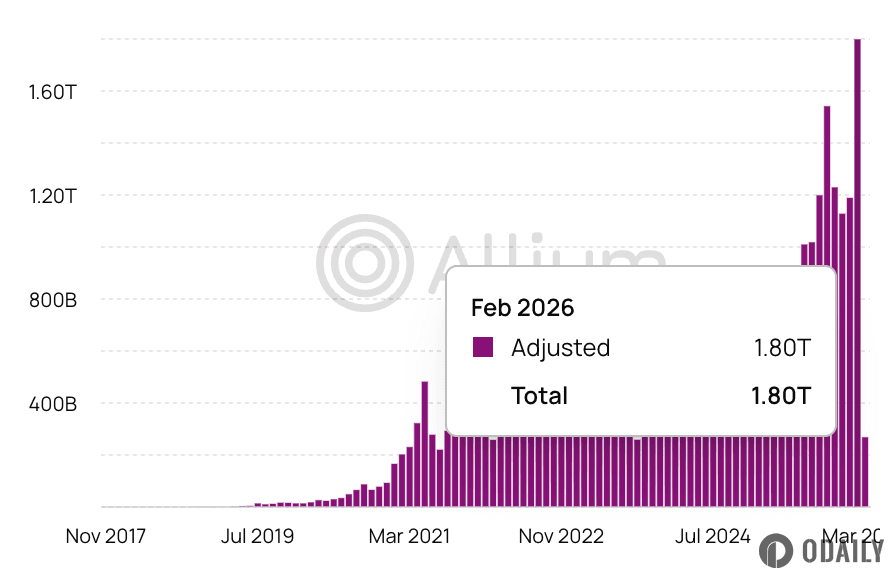
According to data from the Allium website, stablecoin transaction volume reached 1.8 trillion in February, setting a new monthly record. Among them, USDC transactions accounted for about 70% of the total market data, approximately 1.26 trillion transactions, roughly double the transaction count of USDT, which was about 514 billion.
The Florida Senate passed Senate Bill 314 on Thursday with a vote of 37 in favor and 0 against, paving the way for establishing a regulatory framework for issuing payment stablecoins in the state. This bill, along with the companion House Bill 175, will be submitted to Governor Ron DeSantis for signature within the next 30 days. The bill prohibits payment stablecoin issuers from paying any form of interest to holders, provided that "federal law prohibits such payments." The companion bill CS/CS/SB 1440 was also passed on the same day, expanding confidentiality protections for information related to virtual currency businesses, qualified payment stablecoin issuers, and other institutions to protect trade secrets and non-public information.
Julia Leung, CEO of the Hong Kong Securities and Futures Commission (SFC), delivered a keynote speech at the 2026 ASIFMA EU-Asia Financial Services Dialogue event. She stated that Hong Kong must thoroughly upgrade its market infrastructure, particularly in the fractionalization, clearing, and settlement of financial products. Distributed Ledger Technology (DLT) and tokenization developments offer a way forward. The real value of tokenization lies in its programmable nature, which can support a wide range of investment products, including bonds, funds, and even gold. As the tokenization ecosystem continues to grow, it is essential to effectively integrate related innovation projects, seamlessly combining market confidence in traditional finance with the efficiency of decentralized finance to further unlock liquidity. Leung revealed that the Hong Kong SFC, together with the Australian Securities and Investments Commission (ASIC), is co-leading a working group under the Asia-Pacific Regional Committee to combat online scams and is collaborating with global peers to exchange intelligence and participate in standard-setting and coordination work in areas such as digital assets.
South Korean Financial Authorities Plan to Prohibit Corporate Investment in Stablecoins
In the "Corporate Virtual Currency Trading Guidelines" being formulated by South Korea's Financial Services Commission, the permitted investment scope will not include stablecoins. These guidelines aim to allow listed corporations and registered professional investment corporations to trade digital assets for investment or financial purposes. To prevent disorderly investment in the early market stages, authorities have decided to exclude dollar-pegged stablecoins like USDT and USDC from the permitted scope.
One reason for excluding stablecoins is that South Korea's current Foreign Exchange Transactions Act does not recognize stablecoins as a means of external payment. Including stablecoins in the permitted investment scope would conflict with the existing legal system, effectively allowing companies to use stablecoins for commercial purposes like trade. Currently, the National Assembly is reviewing an amendment to the Foreign Exchange Transactions Act that would recognize stablecoins as a payment method; this bill was proposed last October.
It is reported that some listed companies with a high proportion of trade had requested the inclusion of stablecoins in the permitted scope to facilitate foreign exchange hedging using stablecoins. Even if excluded from the guidelines, companies could still trade stablecoins through personal wallets or overseas exchanges. Industry insiders revealed that the relevant working group has completed its tasks, but the release timing of the guidelines is linked to the legislative progress of the Digital Asset Basic Act.
Russian Ministry of Finance Plans to Introduce Stablecoin Bill, Citing "Huge Potential"
Officials from the Russian Ministry of Finance stated they are considering introducing a separate stablecoin bill, rather than incorporating stablecoins into the upcoming cryptocurrency exchange regulations. Alexey Yakovlev, Director of the Financial Policy Department at the Ministry of Finance, said stablecoins have "huge, even enormous potential."
Russia has already viewed stablecoins as a potential tool to circumvent sanctions. Yakovlev stated that after the State Duma passes a bill prohibiting citizens from trading crypto assets on platforms without operating licenses, they will proceed with stablecoin regulation. This crypto bill is expected to be submitted to the State Duma during the spring session and could take effect as early as July.
Currently, stablecoins have no legal status in Russian law, and the Ministry of Finance expressed a desire to resolve this issue promptly. Yakovlev said the government wants to ensure stablecoins "serve economic interests, especially domestic ones." Previously, the Russian central bank established a "foreign digital rights" category, with the first approved stablecoin being the ruble-pegged A7A5 stablecoin, permitted for use in overseas trade last October. According to DefiLlama data, the total value of issued stablecoins has risen over 51% since the beginning of 2025, reaching $311 billion.
BlackRock, the asset management giant, has begun limiting withdrawals from one of its private credit funds, valued at approximately $26 billion, due to rising redemption requests, sparking concerns about spillover effects from stress in the global private credit market. Analysts warn that risks could also be transmitted directly on-chain. Data shows the current on-chain private credit scale is close to $5 billion, primarily entering DeFi in the form of RWA tokenization. If the underlying credit assets experience impairment or default, the net value fluctuations of related tokens could trigger liquidations or liquidity tightening, thereby transmitting traditional credit stress to the DeFi ecosystem. Furthermore, tensions in this sector could spread to the crypto market through two channels: macro deleveraging and tokenized credit products. If private credit funds are forced to deleverage or liquidate assets, it could trigger a chain reaction across broader risk assets and impact crypto assets, including Bitcoin.
Stablecoin Payments Company KAST Raises $80 Million at ~$600 Million Valuation
Stablecoin payments company KAST has completed an $80 million funding round co-led by QED Investors and Left Lane Capital. The funds will be used for expansion in North America, Latin America, and the Middle East, as well as for hiring, license applications, and product development. The new round values the company at approximately $600 million. Insiders said the terms of this funding round were finalized in October, and the company's annualized revenue is expected to rise to $100 million this year.
Bloomberg Analyst: Equity Tokenization Won't Replace ETFs, But Will Democratize Access for Investors
Eric Balchunas, Senior ETF Analyst at Bloomberg, posted on platform X, stating that Nasdaq's launch of an equity tokenization framework aims to allow stocks like Nvidia and Tesla to be traded both as traditional stocks and as blockchain-based tokens. This move will build a bridge between traditional stock market investors and blockchain investors, diversifying stock trading methods. Equity tokenization will not replace ETFs but will distribute them on-chain, providing participation opportunities for global investors, especially in less developed regions and countries. Bringing the world's most popular ETFs and stocks on-chain is a positive development for the market.
Hot Project Updates
Ondo Finance (ONDO)

One-Sentence Introduction:
Ondo Finance is a decentralized finance protocol focused on structured financial products and the tokenization of real-world assets. Its goal is to provide users with fixed-income products, such as tokenized U.S. Treasury bonds or other financial instruments, through blockchain technology. Ondo Finance allows users to invest in low-risk, high-liquidity assets while maintaining decentralized transparency and security. Its token, ONDO, is used for protocol governance and incentive mechanisms