



Bombs Fall, Crypto Assets Become Iran's Primary Channel for Capital Flight



- Core Viewpoint: By analyzing the case of surging capital outflows from cryptocurrency exchanges in Iran following an airstrike, the article reveals that crypto assets have become a key tool for capital flight and circumventing financial blockades in sanctioned countries during geopolitical crises, exhibiting systematic and normalized characteristics.
- Key Elements:
- Within minutes of the US-Israel airstrike on Iran, capital outflows from Iran's largest exchange, Nobitex, surged by 700%, indicating crypto assets are the first reaction for capital flight during a crisis.
- Iran has long been excluded from the SWIFT system. Citizens convert rials into stablecoins like USDT for on-chain transfers to bypass traditional banking sanctions.
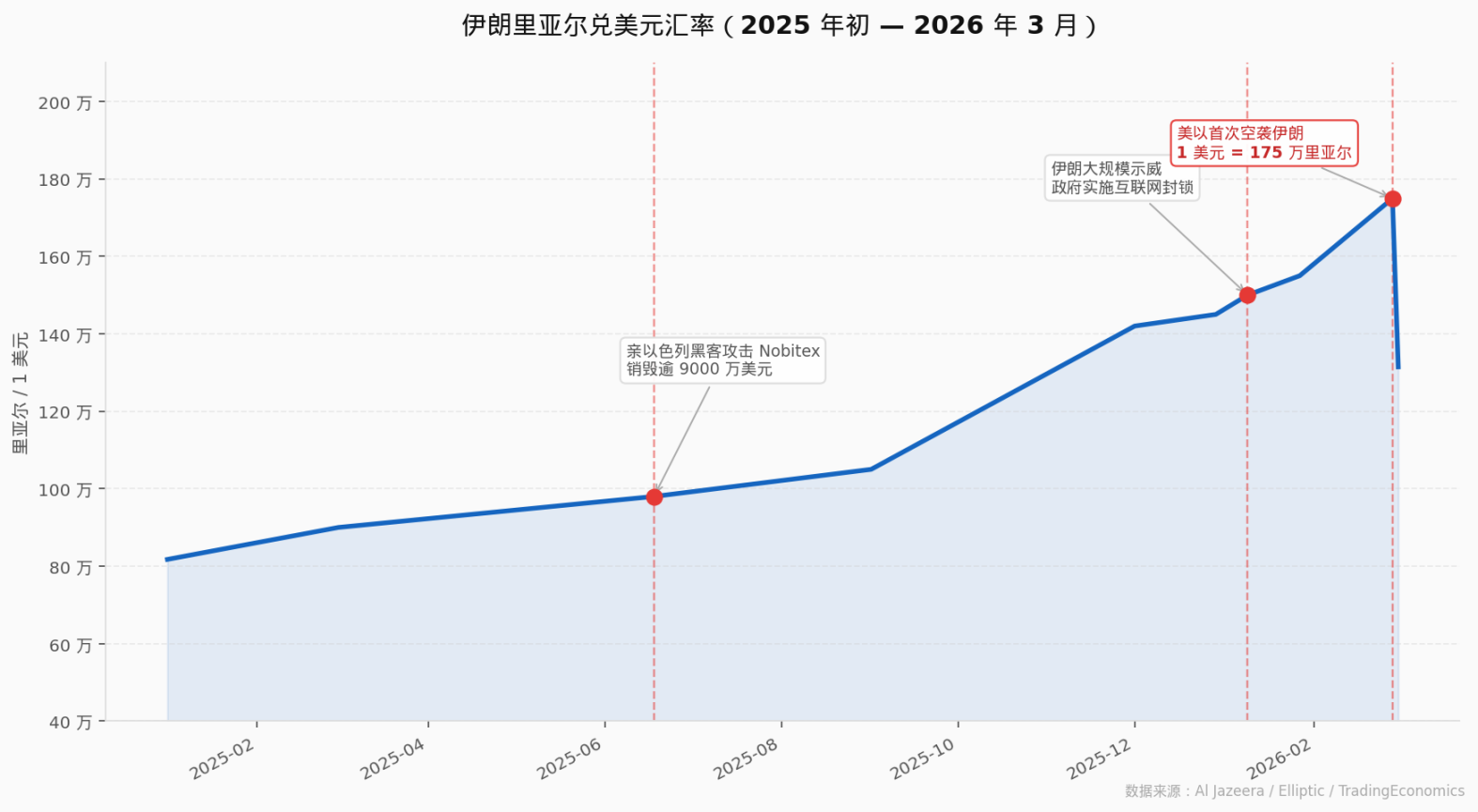
- The sharp depreciation of the Iranian rial (from approximately 817,500 to 1.75 million per USD from early 2025 to post-airstrike) and high inflation (42.5%) are the core economic drivers of capital flight.
- Iran's central bank itself was also reported to hold at least $500 million in USDT as reserves through Nobitex, highlighting the contradictory yet crucial role of crypto in sanctioned economies.
- Historical patterns show peaks in crypto asset outflows during sanctions against Russia and the regime change in Afghanistan, but the Iranian case has formed a systematic, normalized capital escape channel.
Original author: angelilu, Foresight News
On February 28, 2026, the United States and Israel jointly launched their first airstrike on Iran. Within minutes of the news breaking, assets on Iran's largest cryptocurrency exchange, Nobitex, began flowing out at an abnormal rate. Meanwhile, at the other end of the Middle East, days into the ongoing war, the Tel Aviv Stock Exchange in Israel closed at a record high on March 2.
The same war, two starkly different financial signals: capital celebrating on one side, wealth fleeing on the other. This scene might be the best lens through which to understand the true role of crypto assets in geopolitical conflicts.
Nobitex Outflows Surge 700%
Nobitex is Iran's largest cryptocurrency exchange, with over 11 million registered users. In 2025, it processed $7.2 billion in crypto asset transactions, making it a core piece of infrastructure for Iran's crypto ecosystem.
According to on-chain monitoring data from blockchain compliance firm Elliptic, crypto asset outflows from Nobitex surged by 700% within minutes of the US-Israeli airstrike. The flow of funds indicates these assets were being transferred abroad, primarily to overseas crypto exchanges that have historically received significant Iranian funds.
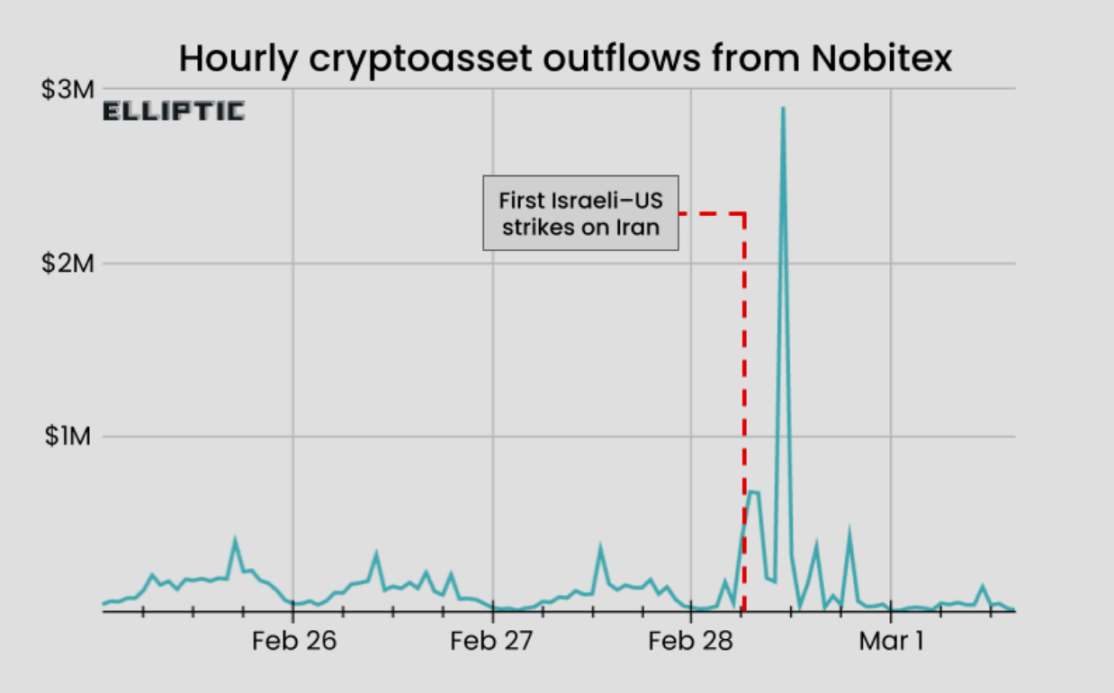
Subsequently, shortly after the US announced sanctions on Iran, there were two smaller spikes in crypto asset activity, suggesting crypto assets may have been used in attempts to circumvent these sanctions.
A closer analysis of the chart data reveals that the normal baseline for Nobitex outflows before the airstrike was roughly $300,000-$400,000 per hour. The peak outflow reached about $2.8 million per hour in cryptocurrency. While the absolute amount is not enormous, it reflects a behavioral signal: upon hearing the news, people's first reaction was to move their assets. Furthermore, Elliptic only monitors the on-chain, traceable portion. A significant volume of crypto trading in Iran occurs through over-the-counter (OTC) and P2P channels, which are completely invisible in this data. The actual scale of outflows is undoubtedly larger.
This is not an isolated incident. Elliptic's tracking shows that since January 2026, Nobitex has experienced multiple outflow peaks: On January 9, large-scale demonstrations erupted within Iran, and the government subsequently imposed an internet blackout. Outflows that day hit a record high for the year, with some assets continuing to flow out even during the internet shutdown, indicating some individuals were able to bypass the blockade. Later, when the US Treasury sanctioned two UK-registered exchanges linked to Iran (Zedcex and Zedxion), Nobitex outflows briefly spiked again.
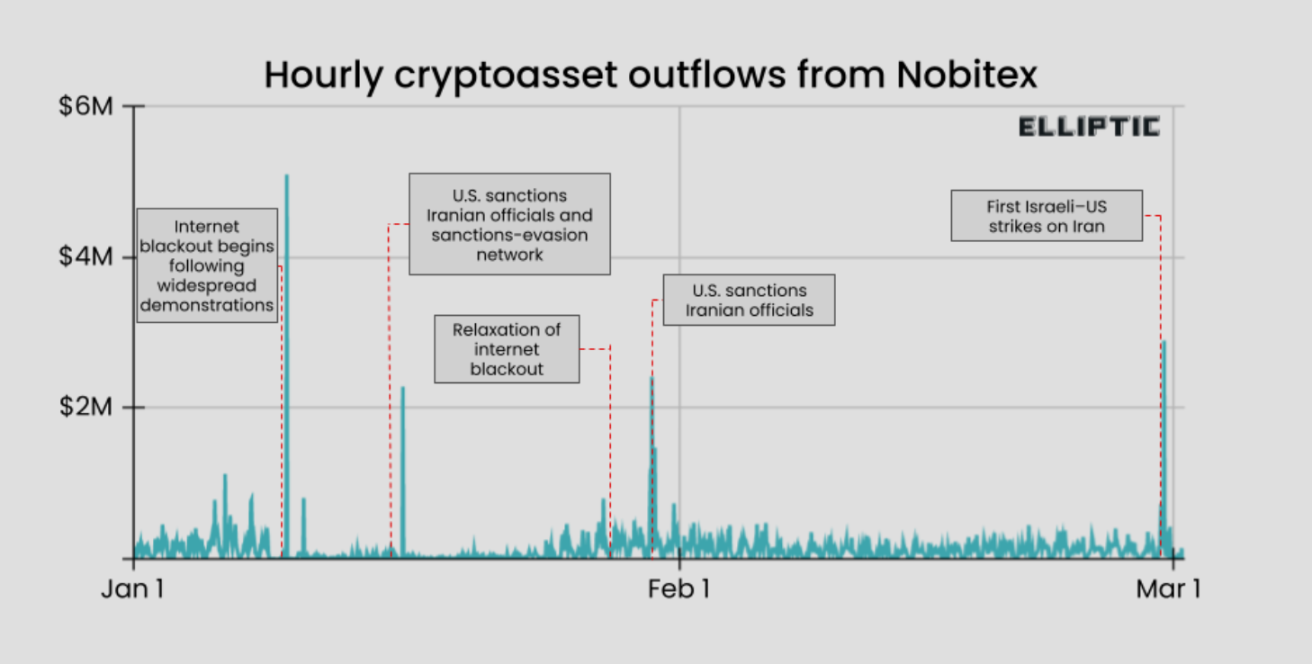
Three peaks, three triggers—sanctions, internet blackout, airstrike—together outline a pattern: whenever Iran's political or military risk escalates, crypto assets become the first choice for capital flight.
Why Crypto, Not Banks?
The answer to this question lies in Iran's decades-long history of sanctions.
Since the 1979 Islamic Revolution, Iran has been under severe sanctions from the US and Western nations, cut off from the SWIFT international settlement system. Its residents have almost no means to transfer wealth abroad through traditional banking channels. Crypto assets provide a workaround: converting the rial (Iran's currency) into stablecoins like USDT, then transferring them via on-chain transactions to overseas wallets, ultimately landing in foreign exchanges. This entire process bypasses any traditional bank, making it difficult for sanctions to intercept.
The collapse of the rial provides the most direct motivation for flight. In early 2025, 1 US dollar exchanged for approximately 817,500 rials. By January 2026, the exchange rate had fallen to 1.5 million rials. Following the airstrike, the rial hit a historic low in a single day, dropping to 1.75 million rials per US dollar.
Against the backdrop of prolonged international sanctions and geopolitical conflict, food prices in Iran have risen over 72% year-on-year, with national inflation reaching 42.5%. Back during the 1979 Islamic Revolution, 1 US dollar could only buy about 70 rials. This means that over more than forty years, the purchasing power of the rial has shrunk by more than twenty-five thousand times. The wealth of ordinary people has been ground to dust under the wheels of history.
Previously, US Treasury Secretary Bessent publicly acknowledged in a congressional hearing that the US actively created a dollar shortage within Iran, accelerating the rial's collapse, and characterized this as part of the strategy against Iran.
More notably, this pathway is not only used by ordinary citizens. Elliptic's research indicates that the Central Bank of Iran itself holds at least $500 million in USDT through Nobitex as a reserve tool to support the rial's exchange rate and circumvent sanctions. The government regulates crypto on one hand and relies on it on the other—this contradiction itself illustrates the irreplaceable function crypto assets have already attained in sanctioned economies.
The Historical Pattern of War and Crypto Outflows
Iran's case is not an isolated one but a pattern that has repeated in multiple countries.
In February 2022, Russia invaded Ukraine, and the West imposed the harshest financial sanctions in history on Russia, including kicking its major banks out of the SWIFT system. The ruble plummeted, and trading volumes for Bitcoin and USDT within Russia surged rapidly. However, Russia's situation differs from Iran's: constrained by the liquidity ceiling of the crypto market, large-scale, state-level sanction evasion is difficult to achieve, resulting in relatively limited actual outflows.
In August 2021, when the Taliban seized power in Afghanistan, the peak monthly outflow of crypto assets reached approximately $150 million, primarily from capital flight by Kabul's elite. Subsequently, the Taliban announced a ban on cryptocurrency, and the market quickly collapsed to zero.
Looking at the pattern holistically, it's clear: war or crisis triggers a surge in crypto asset outflows. What makes Iran different is that here, the outflow has formed a systematic rhythm—it's not a sporadic reaction but a normalized capital escape route.