



What's Left for Optimism After Base Takes Everything?


- Core View: By adopting the extremely permissive MIT open-source license, Optimism successfully made OP Stack the default standard for Ethereum L2 scaling. However, this strategy also prevented it from effectively capturing the value it created. Ultimately, after its major partner Base went independent, its token economics and ecosystem vision suffered a severe blow.
- Key Elements:
- OP Stack's adoption of the MIT license, allowing anyone to use and commercialize it for free, led to its widest adoption, processing nearly 70% of L2 transaction fees.
- The core value proposition of Superchain—native interoperability features—failed to launch as scheduled, causing member chains to pay revenue shares without receiving the expected returns.
- The Base chain contributed over 96% of the gas fee revenue to the Optimism Collective. After it announced independence and integrated its codebase, the OP token price plummeted nearly 30% in the short term.
- Base's departure was driven by both technical autonomy considerations and clearing the path for its future issuance of a token with value-capture capabilities. This reflects that value flows to entities controlling users and distribution, not those setting standards.
- The competitive landscape of the L2 market has shifted from a technology race to a competition over structural advantages, such as the user base of exchange chains or the liquidity depth of DeFi chains, which are moats difficult to fork.
Original author: Thejaswini M A
Original compilation: Luffy, Foresight News
There could have been a triumphant version of the Optimism story.
In that version, the OP Stack becomes the default infrastructure for Ethereum scaling, dozens of well-funded chains join the Superchain, revenue flows back to the Collective, interoperability features launch smoothly, and the entire ecosystem compounds, looking from afar like a new form of the internet: it belongs to no one, is governed by all, and is self-sustaining.
This version was not a fantasy. For a time, it genuinely seemed like it was about to happen. The problem is: everything Optimism did to achieve this vision also made protecting it impossible.
The OP Stack was released under the MIT open-source license. The importance of this decision arguably surpasses any other choice Optimism made, so it's necessary to clarify its meaning: MIT is currently the most permissive general-purpose open-source license. Anyone can take the code, develop it further, modify it, commercialize it, or even fork it entirely. No royalties, no revenue sharing, no obligations whatsoever—you don't even have to say thank you.
Optimism made this choice deliberately. The logic was simple: if you want to become the default framework, you must eliminate every reason not to adopt you. Reduce the adoption cost to zero, make the protocol uncontroversial, and allow any team, company, or exchange with a development budget to launch an OP Stack chain with one click, without permission or signing any documents.
It succeeded. By mid-2025, the OP Stack processed 69.9% of L2 transaction fees, with 34 chains live on mainnet. Coinbase, Uniswap, Kraken, Sony, and Worldcoin were all using it. When people talked about Ethereum scaling, they were usually talking about something built on Optimism's code.
Optimism won the standards war.
Then, the largest chain it helped build announced it no longer needed the relationship.
On February 18, 2026, Coinbase published a blog post with a carefully worded, amicable title—a typical corporate tone for announcing major news without sounding harsh. The Base chain would consolidate its codebase, accelerate its development cycle, and reduce coordination costs. The post expressed gratitude and praised the collaboration.
Upon the news, the OP token plummeted 28% within 48 hours, with sell volume surging 157%. Within days, the token was down 89.8% from a year prior, trading at just $0.12 at the time of writing, compared to its March 2024 high of $4.85. OP Labs CEO Jing Wang wrote on X: "This is a hit to short-term on-chain revenue."
To understand why, you must grasp what the Superchain was truly selling.
The OP Stack is free. The license makes this permanent and irrevocable. So, why would any chain willingly share revenue with the Optimism Collective? Optimism's answer was: interoperability. Join the Superchain, and your chain isn't just a chain; it's part of a unified network—liquidity and users can flow freely between all member chains, building on one chain is equivalent to building on all, achieving a 1+1>2 effect.
That was its value proposition: pay 2.5% of gross revenue or 15% of net profit, and in return, you get something no single chain could build alone.
But interoperability never launched.
Optimism originally planned to launch native interoperability on mainnet in early 2025, but it never arrived. A long-time governance delegate stated: "Despite years of technical development, unfortunately, this did not materialize."
Members were paying "taxes," while the product that was supposed to be funded by that money remained theoretical. What the Superchain actually offered was a shared brand, shared governance costs, and a revenue obligation. The thing meant to make that obligation worthwhile was perpetually "just around the corner." Meanwhile, Base kept growing.
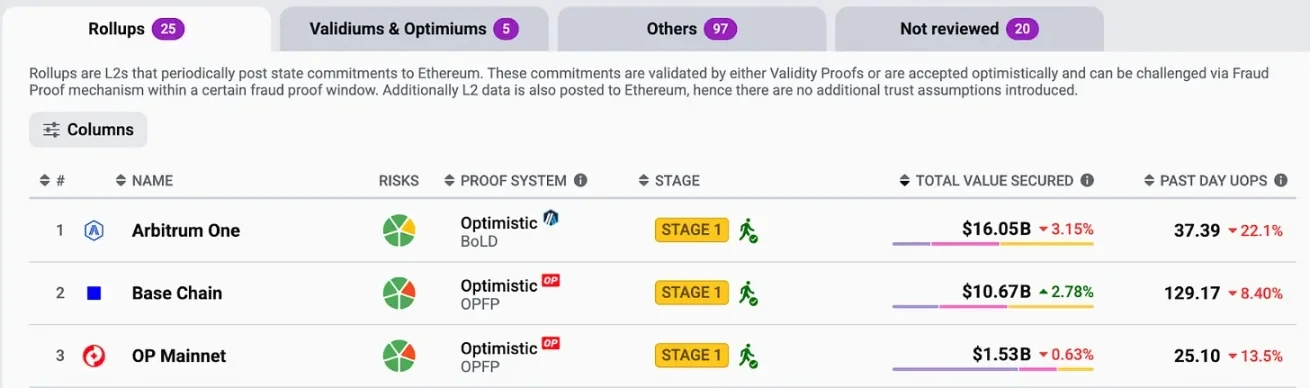
By January 2026, Base contributed 96.5% of all Gas fees flowing into the Optimism Collective—almost the entirety. Base's transaction volume was about 4 times that of OP Mainnet, its DEX volume about 144 times, and its Gas fee generation 80 times. During their partnership, the Collective received a total of approximately 14,000 ETH over its lifetime, with Base contributing 8,387 ETH, and its monthly share of revenue steadily approached 100%.
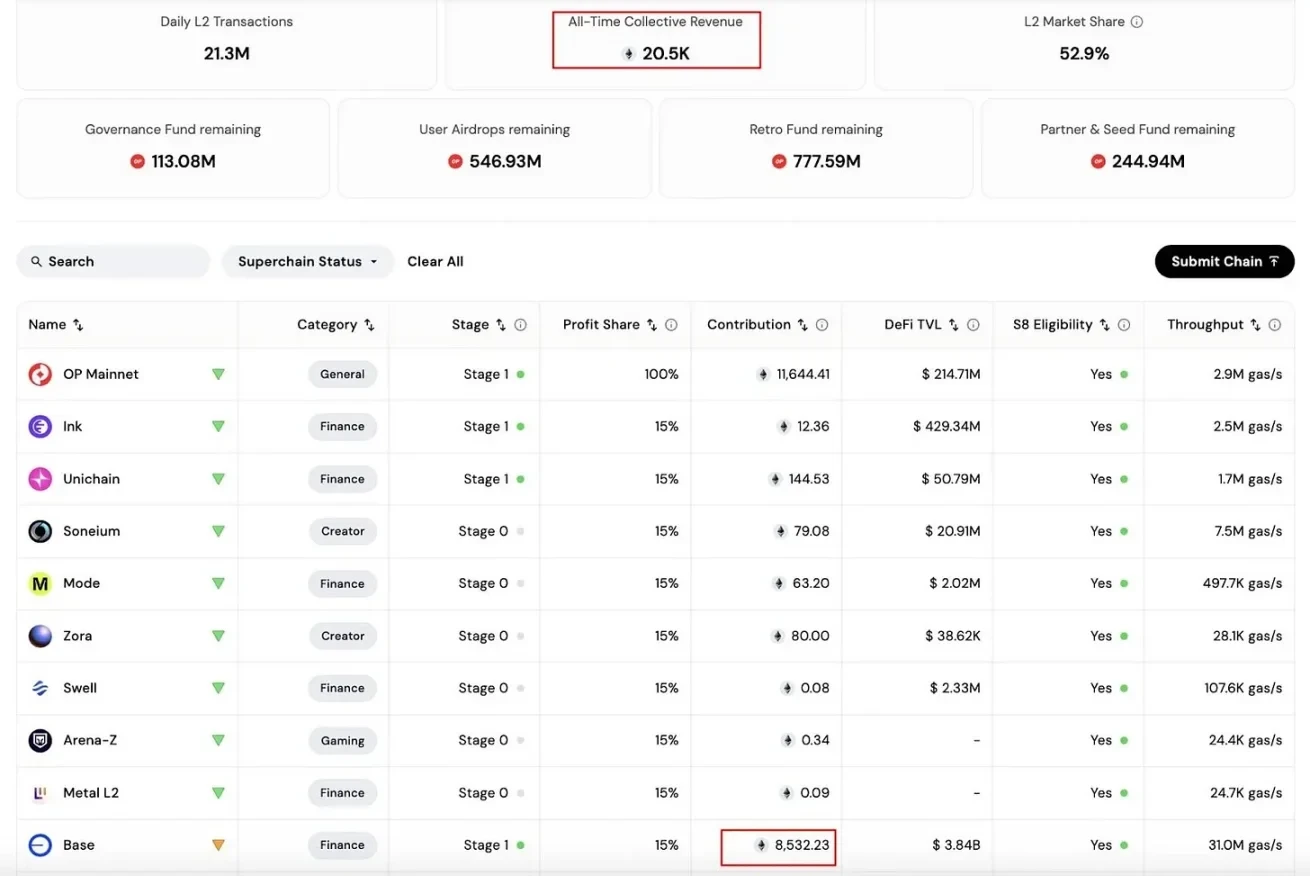
The other 33 Superchain members were on the list but economically insignificant. In the first half of 2025, the second most active member, World Chain, accounted for only 11.5% of Superchain compute, OP Mainnet itself for 11.4%, and Ink, Soneium, and Unichain combined for less than 13%.
Beyond its name, the Superchain had effectively become a one-chain ecosystem. The alliance was real on paper, but economically, it was entirely Base.
In any alliance, a point comes where the strongest participant asks the obvious question: What am I actually getting from this?
Nearly every successful open-source story follows the same logic. MongoDB built a widely used database, released it open-source, then watched as AWS built a profitable managed service on top of it without paying a dime. AWS controlled traffic distribution, MongoDB set the standard, and value flowed to the entity controlling users, not the one writing the code. MongoDB eventually changed its license, and AWS forked it into OpenSearch.
Elastic and Redis went through the same cycle. The details differ, but the structure is identical: the infrastructure setter establishes a standard, a giant with distribution power adopts it, the giant harvests the value, and eventually, the giant internalizes the tech stack and leaves.
Optimism is the crypto version of this story.
Arbitrum saw this logic and made a different choice. Its Orbit chains, the counterpart to Superchain, use the Business Source License, with revenue sharing based on contractual obligations, not voluntarism. When your largest partner can leave without legal consequence, the alliance's survival depends entirely on its willingness to stay. Arbitrum didn't want to build an ecosystem on that assumption.
Base's official reason for leaving was technical: a unified codebase meant faster development, aiming for 6 major upgrades per year instead of 3; independent control of the security council meant no external body could delay or block network decisions; reducing dependencies meant Base could keep pace with Ethereum's own upgrades without waiting for governance processes it didn't control.
Coordinating across multiple codebases is indeed slower than controlling your own tech stack.
But there was another reason, left unstated. Morgan Stanley estimated that a Base token could add about $34 billion in equity value to Coinbase and raised its price target to $404. As long as Base was paying 15% of its net profit to an external protocol's Collective, designing a Base token with reliable value capture was structurally extremely difficult. Leaving the Superchain was a prerequisite, not a side effect. Both motives pointed in the same direction, and Base acted accordingly.
What remains for Optimism is not nothing, but one must honestly confront what has changed.
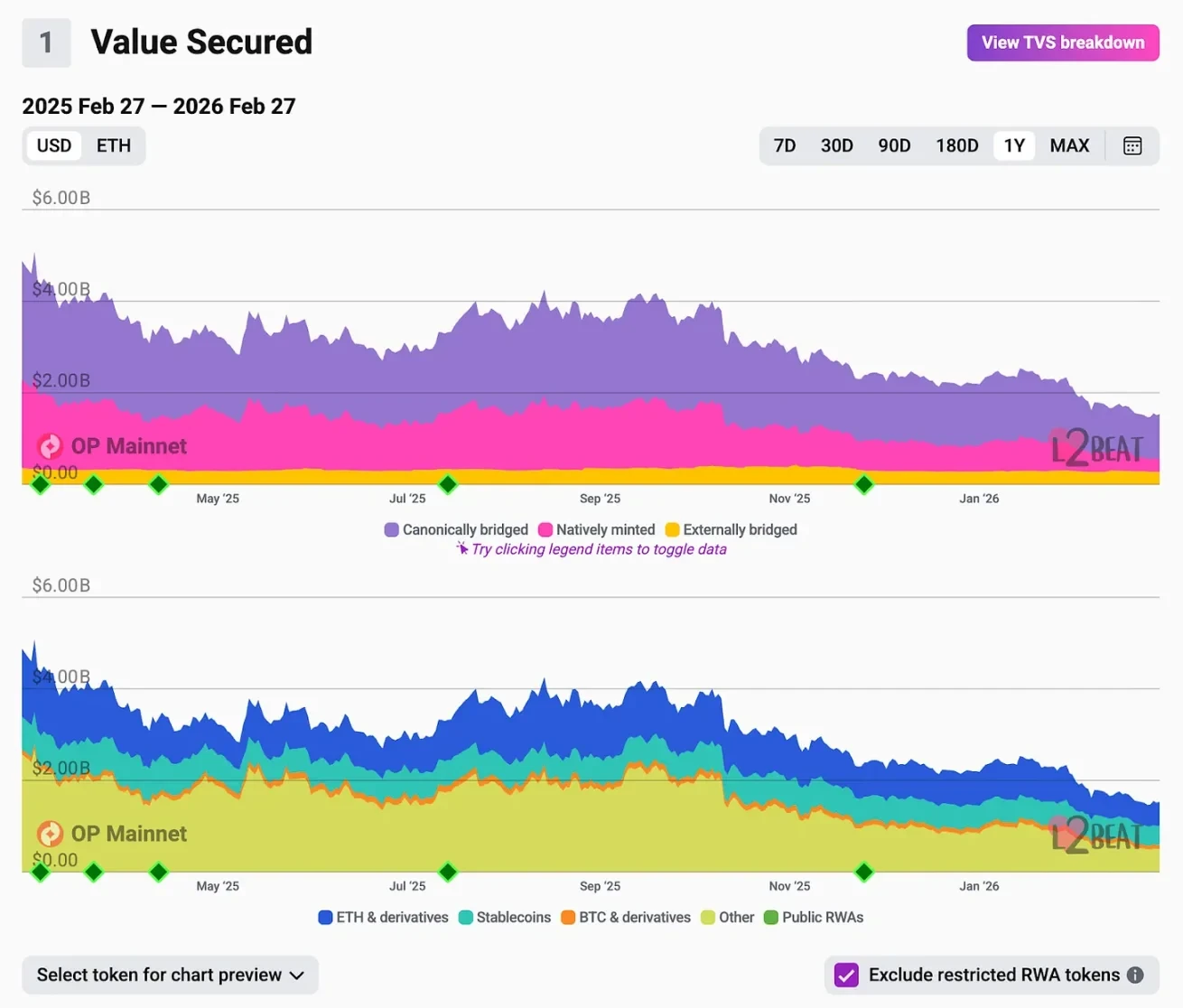
OP Mainnet still holds $1.5 billion in TVL. On the same day Base announced its departure, ether.fi stated it would migrate its on-chain credit card product to OP Mainnet, bringing 70,000 active cards, 300,000 accounts, and over $160 million in TVL. Just weeks earlier, the Collective had passed a buyback plan, using 50% of sequencer revenue for monthly OP buybacks.
The ether.fi partnership gives OP Mainnet a clearer use case in consumer payments. However, ether.fi's annualized fee contribution is only about $13 million, while Base's profit in 2025 alone was $55 million. The revenue base underpinning the buyback plan no longer exists. Token unlocks for investors and contributors continue at a rate of about $32 million per month.
Pivoting to enterprise services might be the right step. OP Labs has raised over $175 million, possesses top engineering talent, and there is genuine institutional demand for managed OP Stack deployments—institutions that want to launch a chain but don't want to build their own maintenance capabilities. Jing Wang positions it as "the Databricks of blockchain infrastructure," a reasonable analogy. It's a services business, and it could work.
But a services business is entirely different from a network generating compound protocol revenue through an alliance. The OP token's valuation was priced for the latter. The market understood this less than 12 hours after the blog post.
Zooming out, what happened on February 18th is, in essence, not just about Optimism.
For most of 2024, over 50 L2 networks competed for users and liquidity. By the end of 2025, Base, Arbitrum, and Optimism processed nearly 90% of L2 transactions, with Base alone exceeding 60%. Small Rollups saw activity decline by 61% since June. The Dencun upgrade brought a 90% fee reduction, compressing industry-wide profit margins. Base was the only L2 to be profitable in 2025.
The chains that survive, and the ones that will define this layer in the coming years, are not necessarily the most technically proficient. They are the chains with a structural reason for user retention. Exchange-backed chains (Base, Ink, Mantle) leverage the distribution power of their parent company's existing user base; every Coinbase user wanting to get on-chain is just one click away from Base. DeFi-native chains like Arbitrum and Hyperliquid hold their ground with liquidity depth that is difficult to rebuild elsewhere.
Technology can be forked. The OP Stack proves this better than anything. What cannot be forked is Coinbase's relationship with its 100 million users, or Arbitrum's tens of billions in open interest. Enduring value lies here, almost regardless of which license you choose for your codebase.
Optimism's decision to release the OP Stack under a permissive open-source license was the correct choice. It led to the widest adoption among L2 frameworks, making Optimism the infrastructure standard for an entire generation of Ethereum scaling. Without that decision, Base might have been built on other technology, or might not have existed at all.
But the decision that made all this possible also made exit costless. When Base grew large enough, with its own users, its own token roadmap, and its own reasons for pursuing full infrastructure sovereignty, there was nothing in the license to constrain it, and the promise of interoperability wasn't enough to give it a reason to stay.
Optimism won the standards war. It's just that this standard didn't come with a mechanism to capture the value it created. The $0.12 token price is the market's final valuation of all that value.