




A Century-Long Journey of an Egg: From Wall Street to Polymarket



- Core Insight: Through the case study of egg futures migrating from traditional markets (CME) to emerging crypto markets (Polymarket), this article reveals that the crypto derivatives market is gradually taking over the price discovery and risk management functions of traditional financial markets. Especially during traditional market closures, its 24/7 trading advantage makes it a crucial venue for pricing geopolitical events.
- Key Elements:
- Historical Case: Egg futures were once a core product of the CME's predecessor but were delisted due to industry maturation and stabilized price volatility. They were later revived on China's Dalian Commodity Exchange due to demand from a fragmented industry, and trading has now migrated to crypto platforms like Polymarket.
- Market Validation: During the escalation of the US-Iran conflict last weekend, traditional markets were closed. A large number of traders flooded into Hyperliquid to trade crude oil and gold perpetual contracts to hedge risks, validating the crypto market's pricing function during non-trading hours.
- Core Advantage: Platforms represented by Polymarket and Hyperliquid offer 24/7 trading, filling the pricing gap left by traditional futures and forex markets during nights and weekends.
- Asset Expansion: Tradable assets have expanded from cryptocurrencies to a wide range of traditional assets including crude oil, gold, forex, housing data, and even egg prices. The platforms' positioning now surpasses that of mere cryptocurrency exchanges.
- Tokenization Logic: The on-chain tokenization of assets like gold enables their continuous pricing in decentralized markets, acting as a "shadow pre-market" for traditional markets and facilitating early price discovery.
- Essence of Power: The core of this shift is the struggle for "pricing power," which follows the same logic as when Chicago merchants established exchanges a century ago to discover prices and transfer risks.
"We went from eggs to yen," this financial reminiscence from CME legend Leo Melamed bears witness to a time when eggs were once among the world's most active futures products.
In the first half of the 20th century, egg futures were one of the hottest trading instruments in Chicago. Trading volume in some years was second only to grain varieties, and there were even periods where futures trading volume far exceeded the physical circulation of eggs.
The predecessor of the Chicago Mercantile Exchange (CME), the world's largest derivatives market, was called the "Chicago Butter and Egg Board." This was the foundation of the entire later derivatives empire, and as the name suggests, this exchange initially traded only two things: butter and eggs.
After the 1970s, the US egg-laying industry rapidly industrialized, cold chain logistics matured, and price volatility was gradually "smoothed out." As uncertainty began to disappear, the noise in the trading pits also grew quieter. In 1982, egg futures officially ceased trading on the Chicago Mercantile Exchange. It didn't collapse with a bang; it was more like the lights were quietly turned off by the era.
In 2013, the Dalian Commodity Exchange in mainland China reignited this product. At that time, China's egg-laying industry was still highly fragmented, with sharp price fluctuations, creating a real and urgent need for hedging.
Egg futures trading did not disappear; it merely migrated. And today, this migration has taken another step forward. The venue for trading egg prices has shifted to Polymarket.
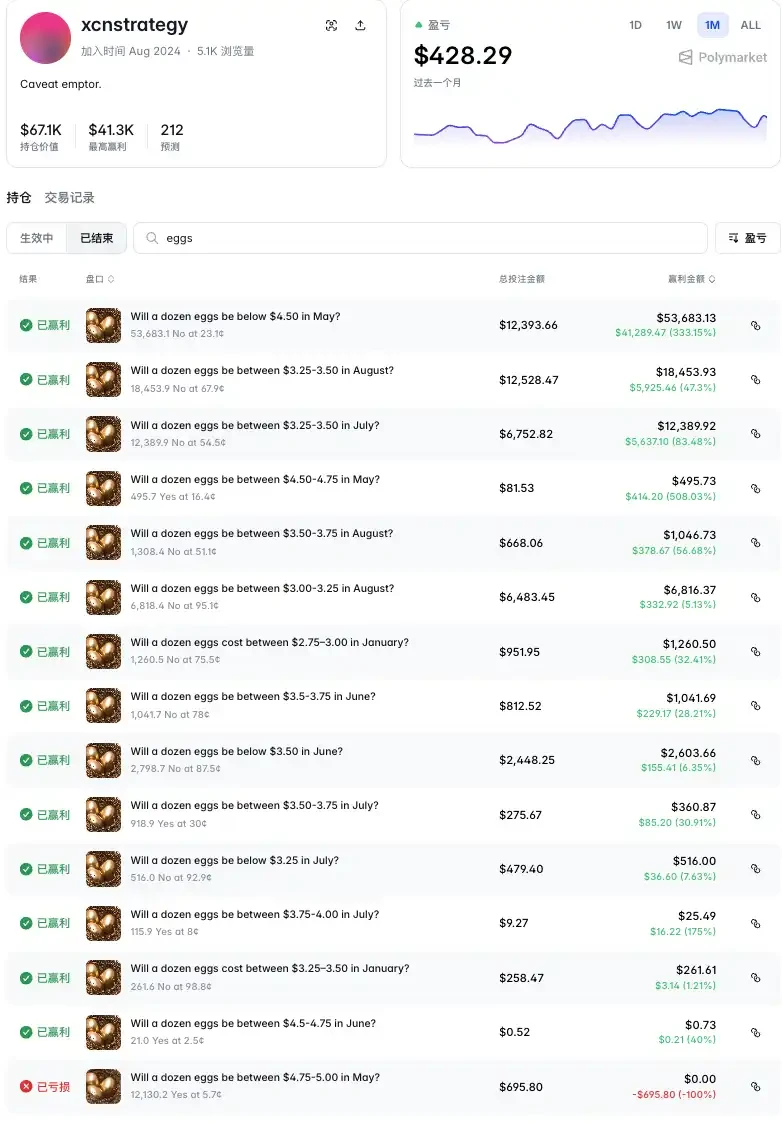
A trader with the ID "xcnstrategy" established positions across multiple expiration months (January, May, June, July, August) for egg price predictions. The vast majority of these trades were shorting the "Yes" on a specific price range, essentially betting that eggs would not reach a certain price point. The total wagered amount was $44,800, with profits nearing $100,000. Out of 15 trades, all but the first one were profitable.
The most recent trade was also the most profitable one. An investment of $12,393 was placed on "No" for "a dozen eggs in May below $4.50," resulting in a profit of $41,289 (+333%).
Regarding speculation about xcnstrategy's real identity, beyond possibly being an "egg enthusiast," many believe this person likely has a background in commodity markets or agricultural data research, having analyzed that the egg price surge triggered by the US avian flu starting in 2025 was a short-term phenomenon and that the market overestimated the probability of sustained high prices. Others think they might be an industry participant in the egg supply chain, hedging against the inherent volatility of the sector.
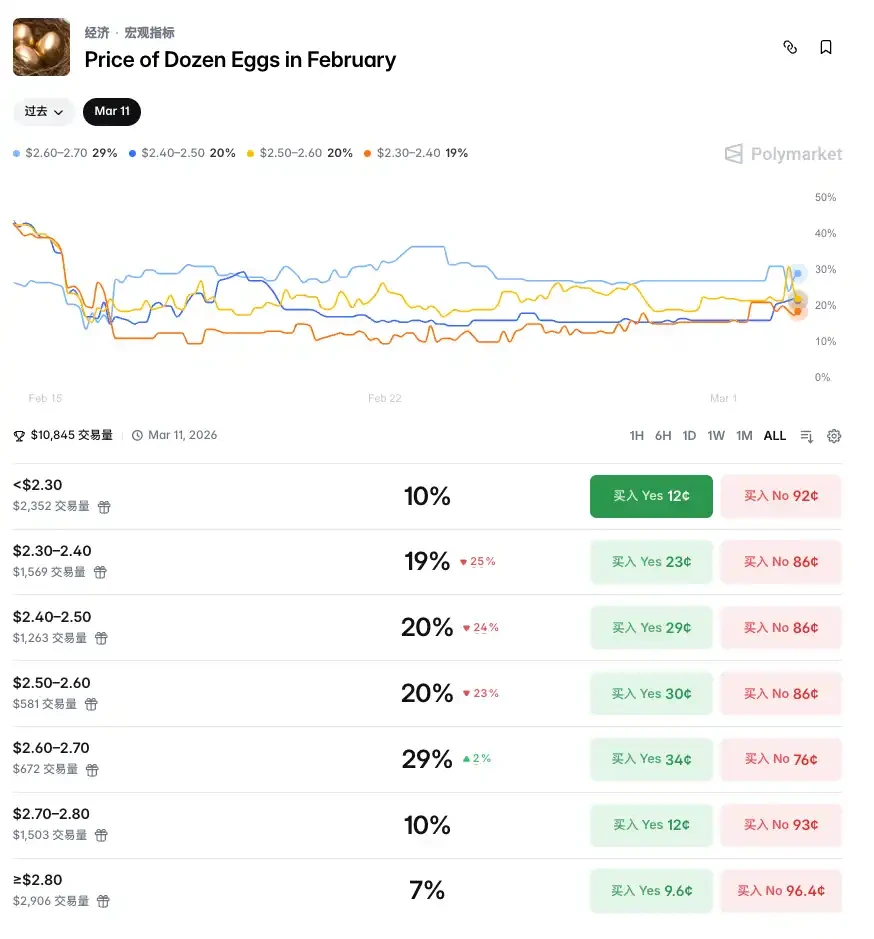
Eggs are just one example. The range of traditional asset instruments tradable on Polymarket is far broader than one might imagine: from commodities like crude oil (CL), gold (GC), and silver (SI), to various forex prices, and even housing data—all can find markets on Polymarket.
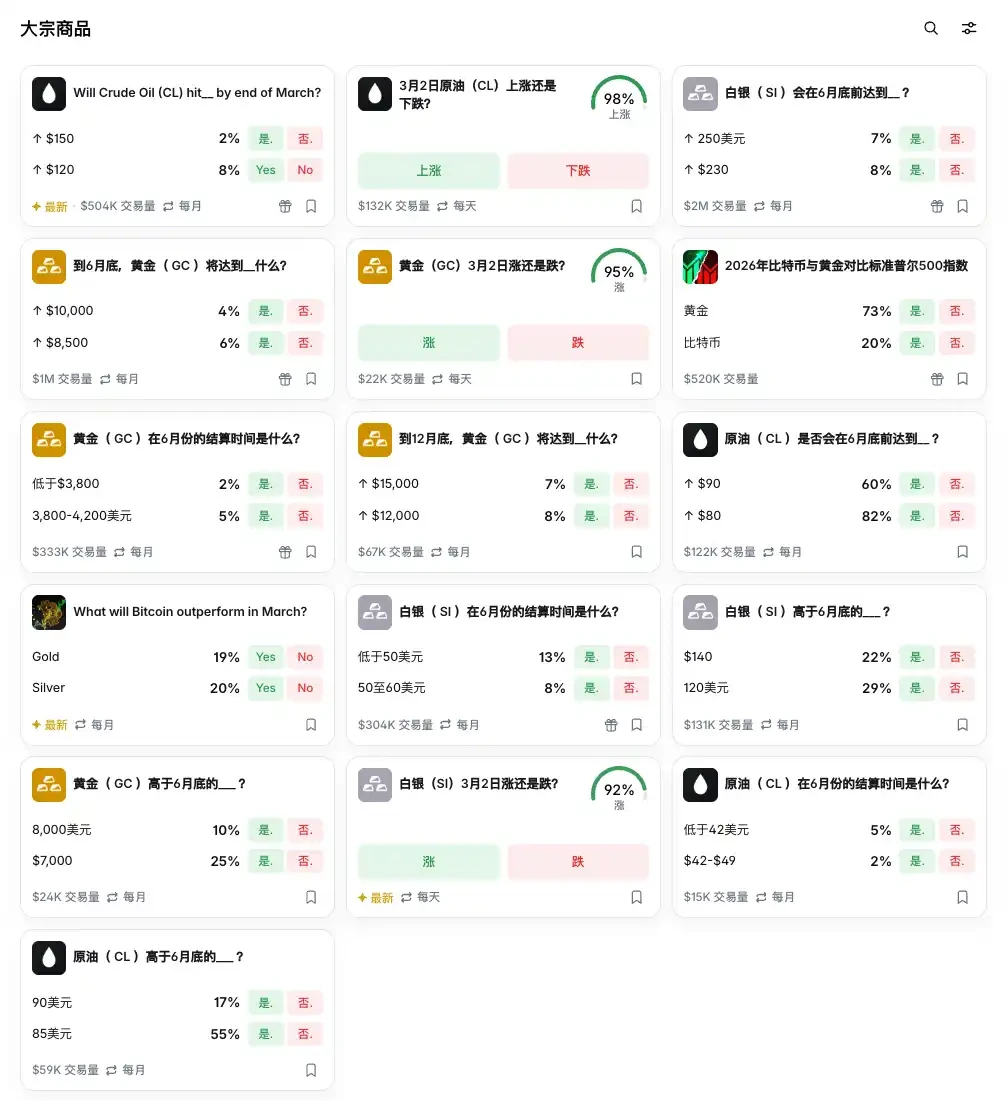
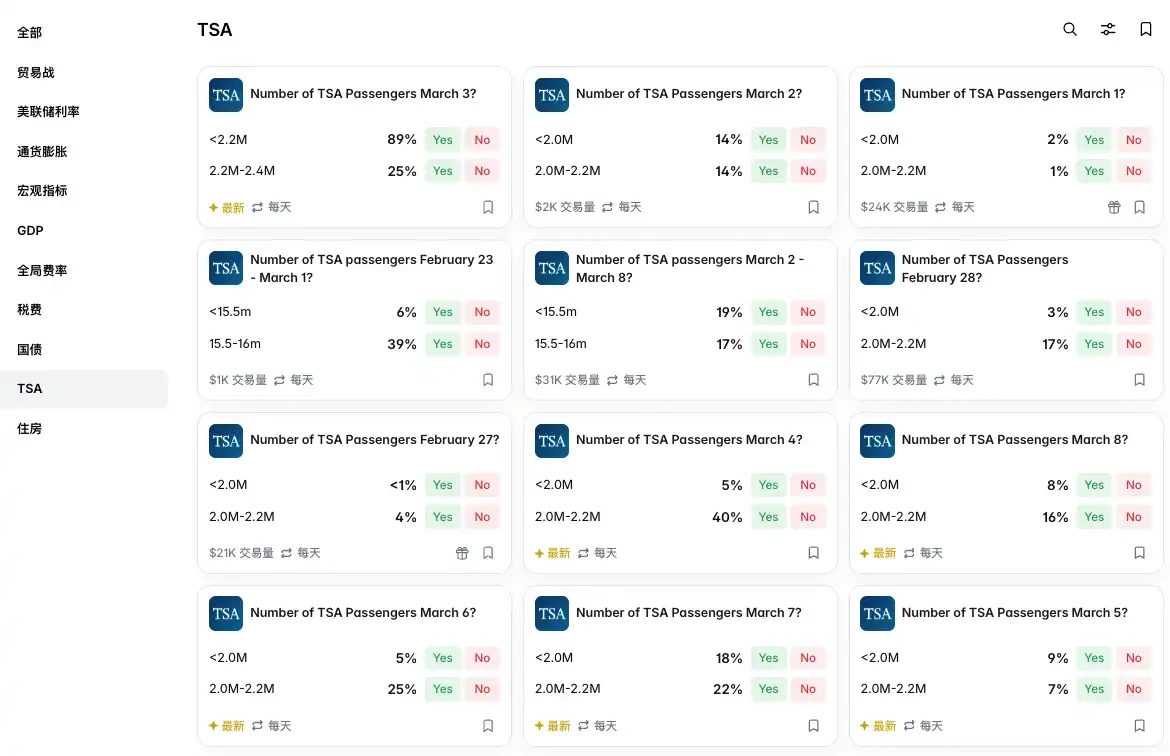
Operating 24/7 without market closures is one of the biggest advantages of trading such markets on Polymarket. This advantage becomes very apparent during traditional financial market holidays, with last weekend's escalation in US-Iran tensions being a prime example.
In this regard, Hyperliquid shares the same advantage. The perpetual contracts on Hyperliquid linked to crude oil and gold have no expiration dates and operate continuously, 24/7.
This points to an increasingly hard-to-ignore phenomenon: the crypto market is quietly taking on the price discovery function of traditional financial markets, especially when the latter are closed.
Traditional futures markets have fixed trading hours. CME's crude oil and gold contracts are closed on weekends, and forex markets see liquidity dry up late at night. This means that when geopolitical shocks erupt suddenly after Friday's market close, traditional market participants can only wait in the dark—unable to hedge, unable to express views, unable to price.
Last weekend's escalation in US-Iran tensions served as the latest validation. According to Bloomberg, around the time the conflict erupted, a large number of traders flooded into Hyperliquid to trade perpetual contracts linked to crude oil and gold in response to the geopolitical shock—at a time when traditional markets were shut tight, the crypto derivatives market was the only place with its lights on. Investment firm executive Avi Felman had previously predicted that "Hyperliquid will become indispensable for fund managers because it's open 24/7." This judgment found concrete validation during this recent conflict.
Meanwhile, gold tokenization is accelerating another line of logic: when gold exists in the form of on-chain tokens and is continuously priced in decentralized markets, it no longer needs to wait for the London Metal Exchange or CME to open. To some extent, the tokenized gold market is acting as a "shadow pre-market" for the traditional gold market, pricing gold ahead of time on weekends, allowing price discovery to occur before traditional markets open.
In 2020, FTX, then the world's second-largest trading platform, launched tokenized stocks, allowing platform users to trade stocks like Tesla and Nvidia using stablecoins. The idea was to capture pricing power. When US stock markets were closed, Tesla tokens on FTX could fill the market gap, allowing users to trade Tesla stock when the company announced a new model on a Saturday, thereby influencing Nasdaq's Monday opening.
Unfortunately, due to liquidity issues, the price discovery effect ultimately wasn't achieved. Six years later, tokenization has circled back to this vision. Today, the positioning of Polymarket and Hyperliquid is certainly not limited to being cryptocurrency trading platforms. Polymarket is already officially recognized as a public opinion polling organization and information exchange hub, while Hyperliquid is widely seen as a new type of full-asset-class trading platform.
Price discovery power has always been one of the core powers within financial infrastructure.
Back in the day, Chicago's butter and egg merchants established the CME because they needed a venue to discover prices and transfer risk. Over a hundred years later, the same logic is replaying on-chain, only the medium has changed.
You might think the market is trading eggs, but in reality, the market is vying for pricing power.