



Pricing the Death of Iran's Leader: Where Are the Ethical Boundaries of Prediction Markets?



- Core Viewpoint: The death of Iran's Supreme Leader Khamenei has thrust prediction markets into a fierce debate over ethical boundaries. The core conflict lies in how platforms should handle contracts involving an individual's death, reflecting a fundamental divergence between free market efficiency and social responsibility.
- Key Elements:
- Prior to the event, probability fluctuations for events like "US military strikes Iran" on prediction markets (e.g., Polymarket) had already demonstrated intelligence value, outpacing mainstream media coverage.
- Following Khamenei's death, the prediction platform Kalshi, citing ethical reasons, decided not to settle the related market based on "death equals resignation," and implemented special measures such as refunding fees and settling at a specific price.
- This move has split the community: supporters believe it avoids the risk of incentivizing harm; opponents argue it undermines market fairness and hedging value.
- Another major platform, Polymarket, has not yet commented. While its contract terms may cover death scenarios, settlement disputes persist, highlighting internal community divisions.
- Regulatory movement is underway, with some US senators writing to the CFTC urging a categorical ban on prediction market contracts conditioned on an individual's death, viewing them as a national security risk.
- The essence of the controversy is the balance between free market pricing efficiency and social responsibility (preventing incentive for harm). Industry rules will gradually form through multi-party博弈.
Original | Odaily (@OdailyChina)
Author|Azuma (@azuma_eth)

Iran has become the focus of the world.
On February 28, the United States and Israel jointly launched a large-scale military strike against Iran. Approximately 30 targets within Iran, including the Iranian Presidential Palace, were attacked. Iran's Supreme Leader Ayatollah Ali Khamenei was confirmed dead in the attack.
In this incident, prediction markets once again demonstrated their intelligence value distinct from traditional channels. Hours before the airstrikes occurred, the probability in related markets concerning "whether the US military would attack Iran" had noticeably risen, and heavy bets from new addresses were also monitored on-chain — in such globally watched public events, the volatility of prediction markets once again outpaced mainstream media reporting.
This should have been another moment for prediction markets to declare "victory" following the 2024 presidential election. However, Khamenei's death has plunged the industry into a major debate about ethical boundaries.
Does Death Count as Stepping Down?
From a micro perspective, the focal point of the contradiction lies in the event of "whether Ayatollah Khamenei will step down as Iran's Supreme Leader." As one of the most closely watched developments in the Iranian situation, leading platforms like Kalshi and Polymarket had long offered betting options on related events. However, the manner (or rather, the speed) in which Khamenei's rule ended clearly took people by surprise.
After Khamenei's death was confirmed, Kalshi CEO Tarek Mansour was the first to publicly state on social media his opposition to profiting from individual deaths. "We do not list markets that are directly tied to death. When a market could potentially have a death outcome, we design rules to prevent people from profiting from death."
Given that death is now a fait accompli, Kalshi will handle the event related to "Khamenei stepping down as Supreme Leader" as follows:
- All fees for this market will be refunded;
- The market will be settled based on the last traded price before the confirmation of Khamenei's death. All positions, regardless of when they were opened, will be settled at this price;
- If users opened positions after Khamenei's death, Kalshi will fully compensate the cost difference.
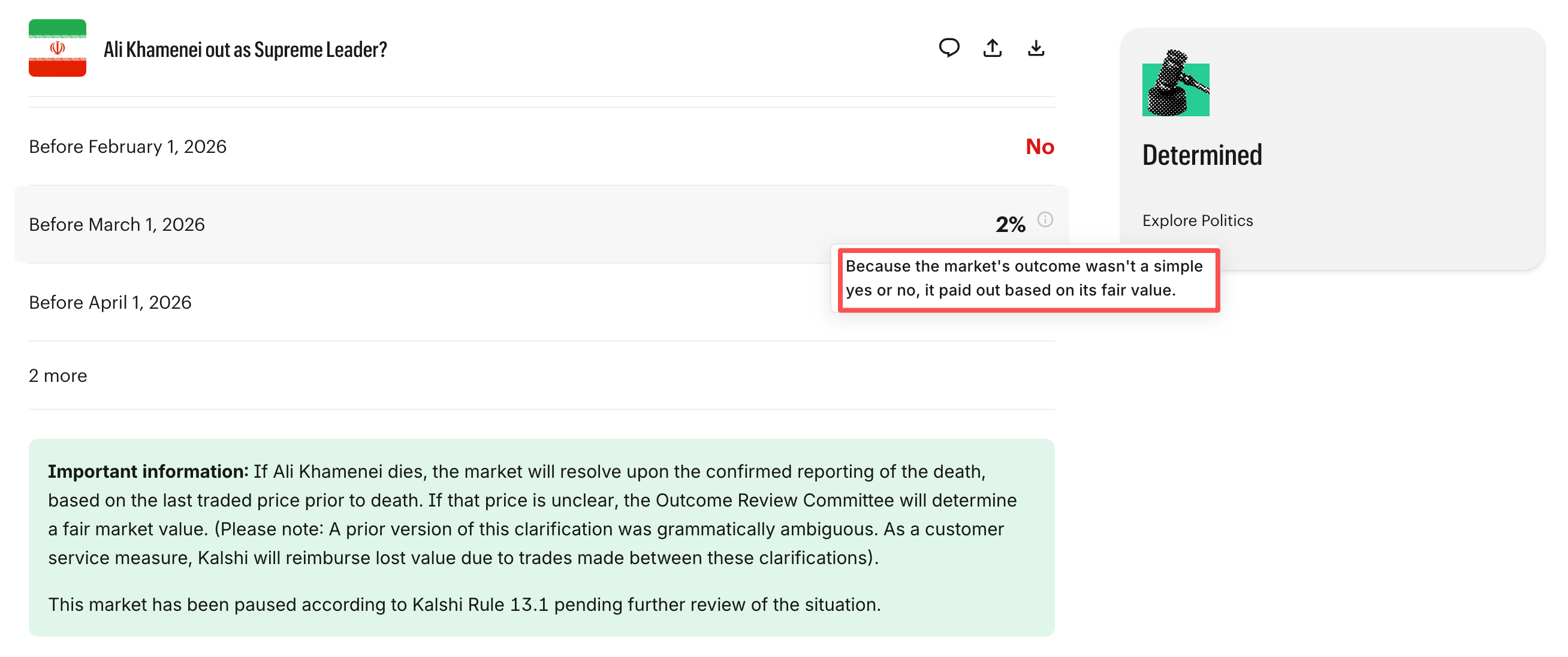
Opening the relevant event page on Kalshi shows that the event has now been paused from trading and specially marked by Kalshi. Kalshi also noted that "because the market outcome is not a simple YES or NO, it will be settled at its fair value."
Kalshi's approach has sparked intense debate within the community.
- Those supporting Kalshi believe that avoiding events related to "death" aligns with mainstream values and regulatory constraints on commodity contracts (the current regulatory framework for prediction market events). Especially considering that prediction markets have shown a certain reactive influence on the real world, without setting boundaries, long-term betting could indirectly incentivize "physical harm or murder," leading prediction markets to gradually become akin to the dark web.
- Those opposing Kalshi argue that this move undermines the inherent fairness of prediction market trading and diminishes their hedging value against real-world upheavals — those who bet YES did not receive their expected profits; although Tarek Mansour claimed "no user will lose even $1 in this market," in reality, those who bet NO and cut their losses early cannot receive corresponding compensation.
In contrast, Polymarket has not yet made any statement on this matter, and the event remains open for normal trading. The current price for YES shares on stepping down before March 31 is temporarily reported at 99.9 cents, with NO at 0.2 cents.
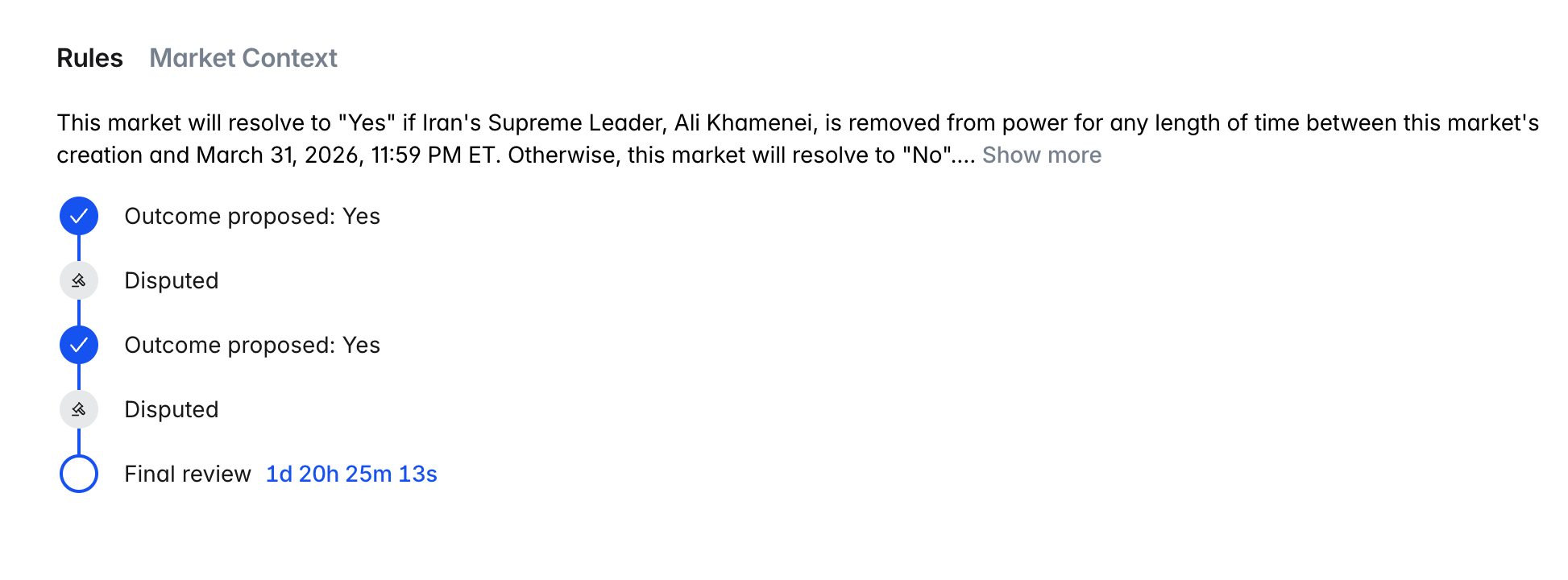
In the judgment rules for this event, Polymarket has stated that "if Khamenei resigns, is detained, or otherwise loses his position or is unable to perform his duties as Iran's Supreme Leader within the timeframe specified by this market, it will be considered removal from office," which appears to cover the unexpected occurrence of death. However, disagreements have still arisen during the settlement process — clearly, divisions exist within the community as well.
- Odaily Note: For details on Polymarket's adjudication mechanism and the handling process when disputes arise, please refer to "Who 'Defines Facts'? The Truth of Power and Potential for Malice in Polymarket's Adjudication Mechanism".
Regulatory Calls for a Ban
The debate over whether prediction markets should list events related to "individual death" had already occurred on the regulatory side, even before Khamenei's death drew widespread industry attention.
On February 24, just days before the end of Khamenei's life, six US Democratic senators, including Adam Schiff, jointly sent a letter to US Commodity Futures Trading Commission (CFTC) Chairman Michael Selig, urging the CFTC to categorically prohibit any prediction market contracts with settlement conditions tied to or highly correlated with individual death.
The legal basis cited in the letter is that under federal commodity regulations, the CFTC has already "categorically prohibited" contracts involving or referencing terrorism, assassination, war, or similar acts.
Adam Schiff and others argued that such events could incentivize "physical harm or even death," constituting a "dangerous national security risk" — "These contracts could incentivize real-world harm by establishing economic rewards for turbulent events or physical injury and encouraging actors to influence or bring about these outcomes for personal gain."
The CFTC did not immediately issue a public response to the letter. A few days later, news of Khamenei's death quickly made headlines across major media outlets, and Kalshi and Polymarket found themselves in a whirlwind of public opinion before regulators had clarified their stance.
Free Market vs. Social Responsibility
Prediction markets offer a novel path to glimpse the probability of future events using market mechanisms, but this does not mean prediction markets are necessarily suitable for all events.
From the operational perspective of prediction markets themselves, platforms tend to prefer listing events with clearly defined outcomes that are not easily manipulated by single points, to avoid disputes over clause interpretation or fairness. From the perspective of external influence and regulatory pressure, prediction markets need to avoid events that conflict with mainstream values as much as possible — if the very setup of a prediction market could lead people to disrupt social order or harm others for profit, it easily faces ethical and legal challenges.
The controversy surrounding whether "death"-related events should be banned is, at its core, a divergence in inclination between the free market and social responsibility. Those emphasizing the free market value the unique advantage of prediction markets in pricing future events and are unwilling to compromise this capability due to any external restrictions. Those prioritizing social responsibility worry that excessive laissez-faire could gradually evolve into a threat to public interest and social stability. Such divergences have always had a universal solution: as friction emerges and deepens, both sides gradually find an appropriate balance point through negotiation and compromise.
Like every other emerging industry, the detailed regulatory rules and industry self-discipline for prediction markets will not materialize out of thin air. The future of the industry will be shaped by participants, regulators, and society together. The path is walked by people. Khamenei's death is pushing prediction markets to personally step across the ethical boundary.