



Iranian Missiles Hit Dubai: Three Chinese Share Their 48-Hour Experience



- Core Viewpoint: Iran's missile attack on the UAE shattered Dubai's long-standing image as a stable and secure international business hub, impacting the local economy and public psyche. It exposed the fragility and uncertainty of individual lives amidst the power struggles of regional powers.
- Key Elements:
- Attacks on Dubai and Abu Dhabi's major airports, leading to shutdowns, severed critical international transportation hubs, directly affecting personnel movement and business activities.
- Damage to iconic landmarks (e.g., Burj Al Arab, Palm Jumeirah). Although most missiles were intercepted, falling debris and psychological panic dealt a blow to the city's image.
- Divergent reactions within the local Chinese community (approx. 300,000). Some chose to evacuate to places like Oman, while others adopted a wait-and-see approach. Basic supplies remained available for the time being, but panic buying occurred in Chinese supermarkets.
- Binance CEO He Yi pointed out that the psychological pressure and economic damage caused by the attack might be more severe than the actual physical destruction.
- The incident highlighted that with sophisticated air defense systems, war risks are shifting from "bombing zones" to the more unpredictable "interception debris fall zones," increasing civilian risk.
- The sense of security for businesspeople who have long relied on Dubai's "certainty" (zero tax, stable regulations) has been shaken by geopolitical conflict, challenging the foundation of trust.
Original Author: Lin Wanwan
The world's busiest international airport, Dubai Airport, has been hit.
This is no ordinary airport. Atlanta has the highest total passenger traffic, but that's largely due to domestic U.S. flights. The true king of international flights is Dubai, a super-hub connecting Europe, Asia, and Africa, with 1,200 flights taking off and landing daily. Two hours later, Abu Dhabi Airport was also hit. The UAE's two major airports were rendered inoperable overnight.
The exit was cut off.
At 4 PM on February 28th, a Chinese developer, Wu, had just returned home from the city center when three bangs sounded outside his window. He immediately knew they were missiles. He had heard that sound before during events in Lebanon and Iraq.
The rumbling grew denser, continuing until midnight. He saw a missile intercepted in the direction of the Marina, exploding in the air.
"I'd only seen it in movies before," he said. "This time, Earth played a native blockbuster for me."
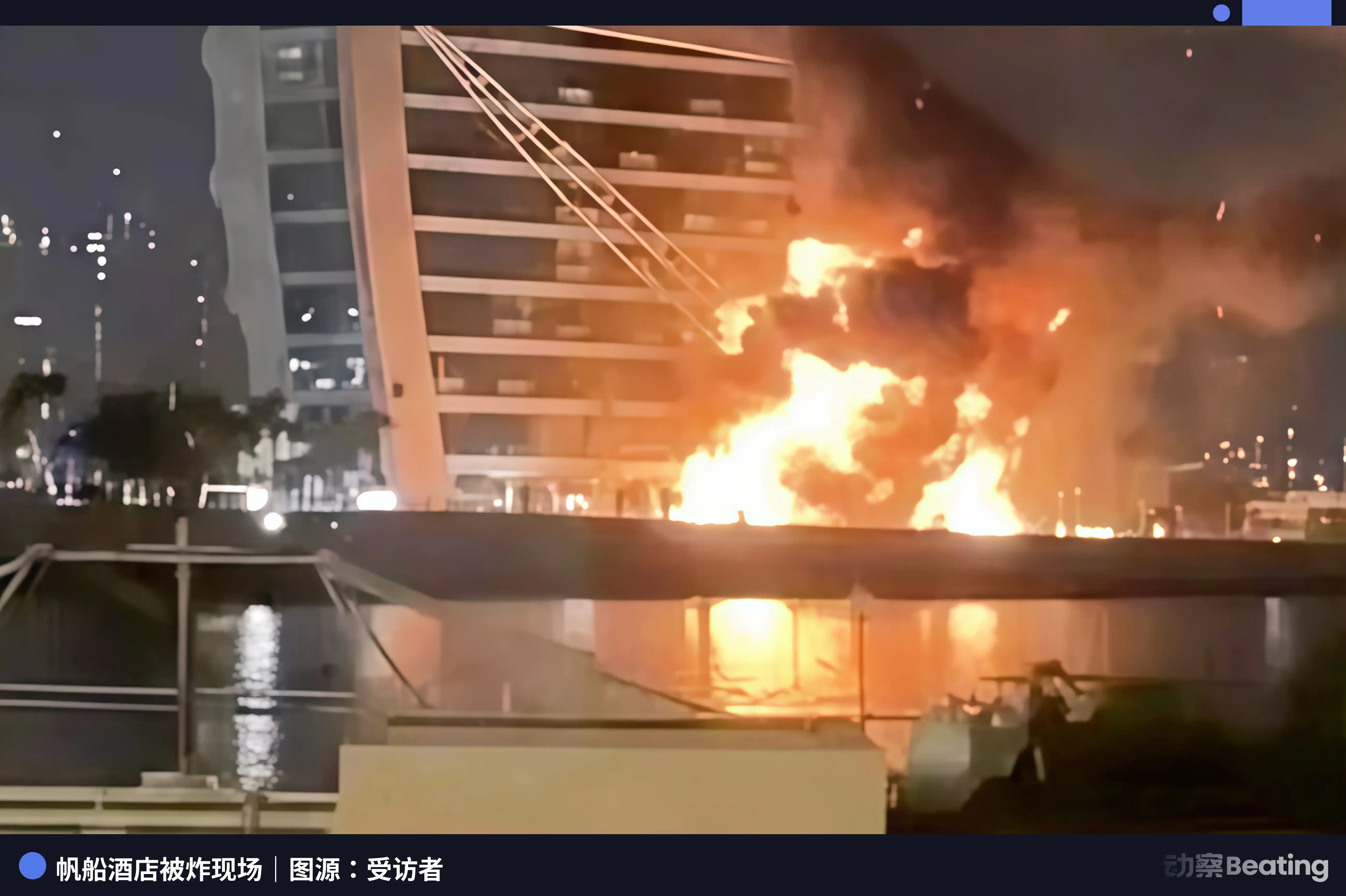
Dubai's landmark Palm Island hotel was bombed, the seven-star Burj Al Arab caught fire, and the sky above the world's tallest building, the Burj Khalifa, flashed with interceptor fire. These names usually appear in travel ads; now they're in war news.
That morning, the U.S. and Israel jointly struck Iran. Iran retaliated within hours, launching missiles toward Israel and across the Gulf. Bahrain, Qatar, Kuwait, Saudi Arabia—all were hit. Iran made it clear: those who help the U.S. are targets.
As of press time, Iran has launched at least six waves of attacks, involving 167 missiles and over 500 drones.
Binance CEO He Yi, currently in the UAE, mentioned in an exclusive interview with us, "Rationally speaking, because there are air defense systems, safety is fundamentally guaranteed overall. However, those who may lack information retrieval capabilities might panic more."
In addition, she noted, "Bombing and missiles cause mass casualties. But currently, this kind of interceptor debris and drone attacks inflict more psychological pressure on the public and cause greater economic damage."
The proportion of Chinese in Dubai has grown very rapidly, with approximately 300,000 Chinese residents by 2025. Dubai's Dragon Mart, a Chinese commodity city built in the desert 15 kilometers from the old city, was once touted as "the largest Chinese trade center outside mainland China." Huawei, Xiaomi, and OPPO have also set their Middle East headquarters here, with Chinese internet companies viewing it as a bridgehead for overseas expansion.
People in Web3, trade, tourism, real estate, finance—Chinese from all walks of life have put down roots in this desert city.
Over the past decade, they grew accustomed to the UAE's political stability, zero income tax, and the feeling that "the chaos in the Middle East has nothing to do with me."
Until the missiles came.
A Chinese wrote on their social media feed, "I came to Dubai to avoid taxes; now I'm squatting in a bomb shelter to avoid bombs."
We interviewed four people in Dubai to discuss the real situation.
Even Though It's Been Bombed, You Can Still Order Takeout
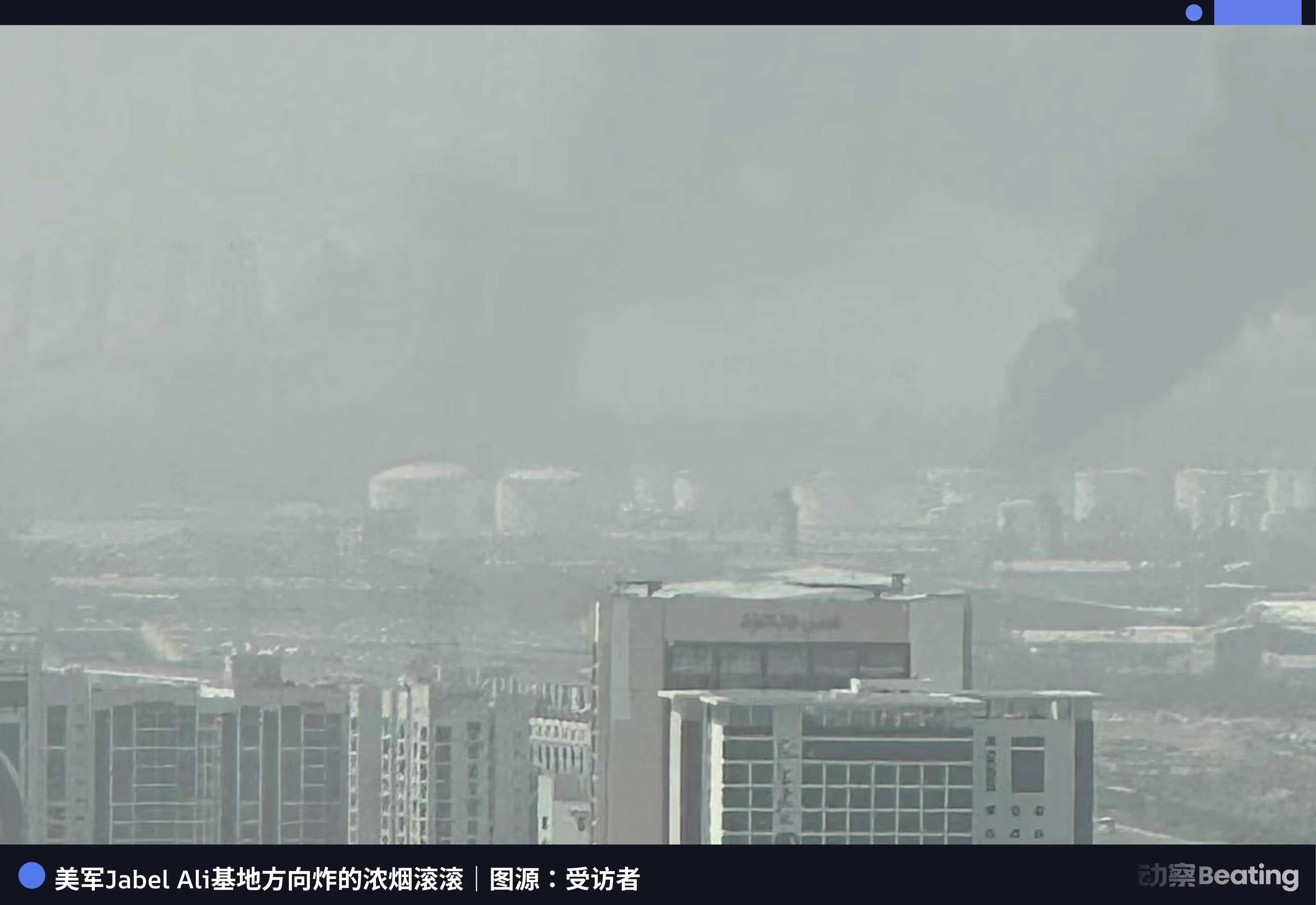
Wu works on developer tools in Dubai, living near the Marina, not far from the entrance to Palm Island. This location is usually a selling point; now it's a problem: it's relatively close to the U.S. military base at Jebel Ali.
At 4 PM on February 28th, he had just finished a meal near the Burj Khalifa and returned home when three bangs sounded outside his window.
He didn't freeze; he had heard that sound before during developer events in Lebanon and Iraq.
But those places didn't have anti-missile systems; if a missile hit, it hit, and you just avoided the strike zone. Dubai is different; it has THAAD. Missiles might be intercepted and detonated mid-air, or deflected, leading to random impact points, potentially landing in civilian areas.
The rumbling grew denser, mixed with sirens and ambulance sounds. People on the streets were mostly on the phone checking on family, hurrying along.
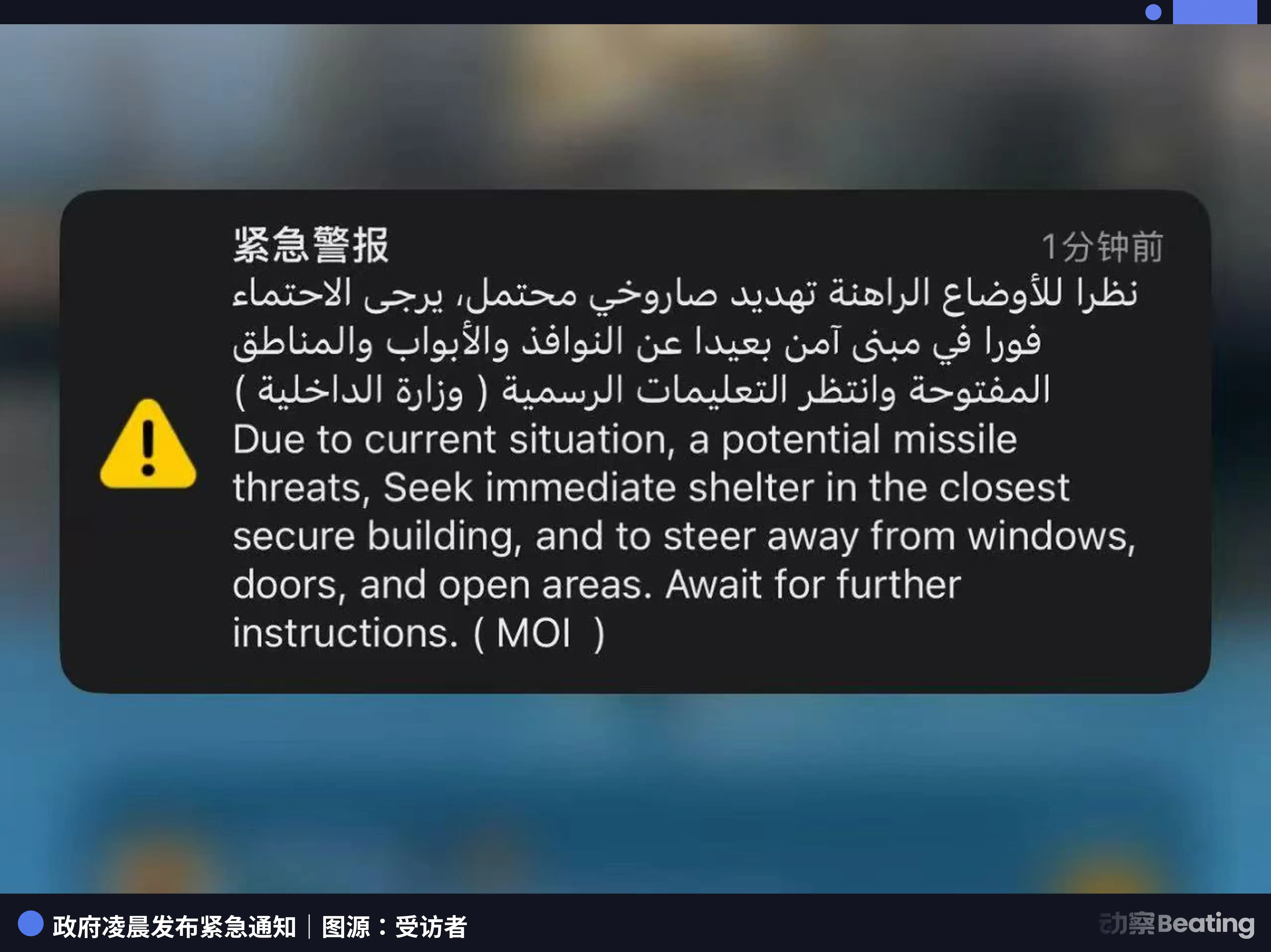
At midnight, a government alert sounded on his phone. Beep beep beep beep beep—piercing, non-stop for three or four minutes. Then the building alarm sounded too. He and his wife headed to the underground garage.
The garage was already packed. Some held children, others stuffed water and crackers into car trunks. Engines were left running, ready to leave at any moment. Worst-case scenario: drive away.
At 8 AM the next day, a huge blast woke his wife. She shook him awake: "That was really close." He looked at the window; the glass was vibrating. The glass in the building opposite was vibrating too.
But today, the government didn't sound the alarm. He guessed they didn't want to cause panic. Or maybe they thought civilian areas wouldn't be hit.
Yet most of the city was still functioning normally, not in the panic reported externally.
Wu went downstairs to the supermarket. Shelves were full, milk and bread available, no one was hoarding. He ordered McDonald's; it arrived in half an hour, and the delivery guy even joked with him.
But Chinese supermarkets were the opposite. An order placed at 9:30 PM last night showed the system was too busy. Tried again at 10 PM, still couldn't place it. The goods hadn't arrived today either. The official reason was too many people panic-buying, overwhelming supply.
Wu's British neighbor left early in the morning, dragging a suitcase, walking fast.
Currently, evacuation seems to be in three main directions:
First, some drove overnight to Oman, the only surrounding country Iran hasn't struck, but the road to Oman is now almost impassably congested.
Second, some evacuated to Al Ain, in the middle of the desert, where missiles are unlikely to target.
Third, others moved to Sharjah, which has no military facilities. Border crossings are probably jammed solid.
Wu plans to wait and see. "Iran can't have an unlimited supply of missiles, so the situation is expected to become more controllable later." Yesterday officials said 132 out of 137 missiles were intercepted; today there were over a dozen more explosions.
His escape route will also be one of these three options. Water and food are already in the car, and an emergency wallet is kept on hand.
He has a friend who works in sales at the airport. When Terminal 3 was hit, the friend messaged immediately: smoke, evacuating. The Chinese peer-to-peer network is faster than official channels and more accurate than the media. Whose building was hit, which intersection is blocked, which supermarket still has stock—all spread through WeChat groups.
Chinese friends living downtown started moving out, looking for shorter buildings. Because the Burj Khalifa is just too tall, too conspicuous. The Burj Al Arab and Palm Island were both hit, raising suspicion that Iran might have an interest in landmarks.
He said if Iran continues like this, he might consider leaving. "Trust is hard to build. Once broken, it's hard to go back."
Now they can only wait. Wait to see if the U.S. stops, if Iran finishes its strikes, if the sounds get closer or farther away.
Wanting to Stroll Over to See the Bomb Site
Mason lives in Dubai Silicon Oasis; there's supposedly a U.S. military base nearby, which he never paid much attention to.
On the afternoon of February 28th, he was eating when a hotel on Dubai's landmark Palm Island was hit by a missile. He finished his meal and wanted to drive to see the site, but the navigation showed the road to the bombed location was completely gridlocked, so he gave up.
Mason wasn't scared. "Maybe it's too far from me."
Ten minutes before speaking with the author, he heard another explosion, this time right overhead. A missile was intercepted, exploding in the air with an extremely loud sound. He looked out the window; people were still strolling downstairs.
Just last night, his several phones rang in succession. Government alerts pierced the night, roughly advising: avoid going out if possible, stay away from windows. He heard a tearing sound in the sky, couldn't tell if it was a fighter jet or a missile, but it flew past without exploding nearby. Then he went to sleep.
Waking up and checking the news in the morning, he learned Terminal 3 was hit by a drone at 1 AM. Mason had planned to fly to Milan for the Winter Paralympics; now the airport is indefinitely suspended. Twitter is flooded with airport videos; he glanced—about half true, half false.
Some people started evacuating. In some local Dubai groups Mason is in, a tour guide mentioned VIP clients wanting to leave, but the Oman border is already jammed. Getting a visa usually involves long queues; now it's even more impossible. Someone asked if he wanted to evacuate too. He did a mental calculation: over 1,000 km to Saudi Arabia, a few hundred to Oman. "Going to Oman now might be more dangerous; who knows what you'd encounter on the road."
Mason decided to stay put.
"It's all exaggerated," he said of the online videos. "The Burj Al Arab is a landmark; someone filmed it being hit, so it spreads wildly."
Mason believes modern missiles are precision-guided, targeting bases, not randomly bombing everywhere. Unless intercepted, debris might fall elsewhere.
He has a friend in real estate; they just talked. Several clients who were supposed to come to Dubai to view properties can't come now. "Property prices will definitely be affected." But he thinks it's short-term. The real problem is what outsiders think. Planes fly here, but what if missiles fly too? What if they come but can't fly back?
"If you're coming here, you need to be mentally prepared."
Mason still wants to go see the bombed Burj Al Arab site. The guard advised against going out; he feels a bit regretful.
Alerts That Pierce Through Do Not Disturb Mode
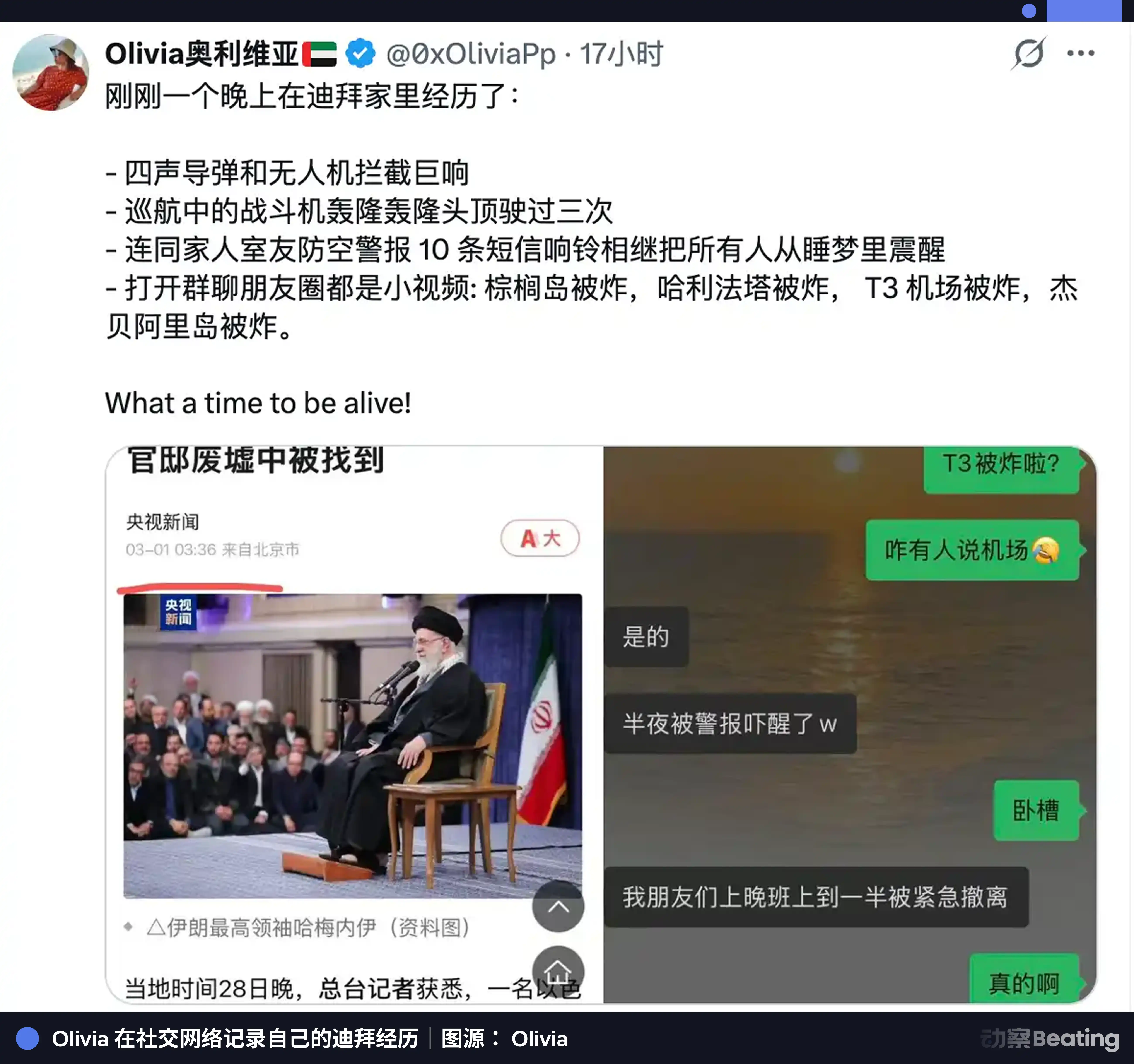
Olivia lives in a densely populated residential area, 8 kilometers from the coastline. That coastline faces Iran; the Burj Al Arab, Palm Island, and Dubai Marina are all on that side.
On the afternoon of February 28th, she was napping. Waking up, she found many people on WeChat asking if she was safe, only then realizing something was wrong. A few hours later, she heard an explosion outside her window. Her windows are modified—original double-pane, plus another double layer she added herself, four layers total—yet the sound was still ear-shatteringly penetrating.
She had a cosmetic procedure appointment, which she canceled directly. However, life wasn't too disrupted for most; by the pool downstairs, because it was the weekend, people were still sunbathing.
Three consecutive explosions sounded in the evening. Before sleep, fighter jets patrolled overhead, rumbling past repeatedly. She fell asleep around midnight, but her phone's vibration woke the whole family—Do Not Disturb was on, but the alert pierced through it. Three people in the house, four or five phones, all sounding alarms simultaneously.
A group member went to Oman; the road was jammed. She has a friend, founder of a New York company, who sent employees on business trips to Oman overnight, then used a private jet to bring them back to the U.S.
She originally planned to return to China in March or April. Now, with the airport indefinitely suspended, if that route is blocked, she'll detour through neighboring countries.
Online videos are scary, but she feels it's not that exaggerated.
Olivia believes the situation will improve. Khamenei is already dead; those remaining are fighting to the end. "When they exhaust their ammunition, this will be over."
When hanging up, she said she didn't sleep well last night and was going to nap a bit more.
Waiting for the Wind to Stop
Dubai has no seasons. Only hot, and hotter.
But these past two days, three hundred thousand Chinese have felt another kind of temperature. Uncertainty.
Wu saw neighbors holding children in the garage; Mason still wants to see the Burj Al Arab ruins; Olivia set Do Not Disturb but alerts pierced through. He Yi is right; people with information retrieval capabilities aren't too panicked, but that background noise persists. The rumbling outside the window, the alerts on the phone, the constantly updating messages in groups. Which building was hit, which road is blocked, which supermarket still has stock.
We're all refreshing, all waiting.
Waiting for the U.S. to stop, for Iran to finish, for the airport to reopen, for that "all clear" notification.
Some fled overnight. Some decided to stay. Some sunbathe by the pool; others stuff passports and cash into emergency bags. No one's choice is right or wrong; it's just betting on a probability.
Most Chinese who came to Dubai didn't come for adventure. Quite the opposite—they came for certainty. Certain taxes, certain regulations, certain business. This city built an order in the desert over thirty years.
Palm Island, Burj Al Arab, Burj Khalifa—all are monuments to this order. Humans can conquer the desert, create prosperity from barrenness.
But some things are beyond human control.
Two countries fail at the negotiating table, and missiles fly. It has nothing to do with whether you've taken sides, whether you're a good person, how much tax you've paid, how many people you've employed, how many buildings you've built. You just happen to be here.
This is the world in 2026. Flights can stop, borders can close, meticulously planned lives can be disrupted in an afternoon. Not because you did anything wrong, but because on the chessboard of great power games, no one asks the pawns for their opinion.
Wu says if the situation stabilizes, he might stay. "Maybe it will be even more peaceful afterward."
This might be the calmness only those who have experienced it can have. After this round, talks will happen, ceasefires will occur. That's how Middle Eastern history is written: fighting and stopping, life goes on.
Mason still wants to see the bombed site. Maybe just to confirm those images, confirm he really experienced this, confirm the city is still here, he is still here.
Another sound outside the window.
Can't tell if it's a missile or an interception, far or near.
It doesn't matter. As long as the sound is still distant, life can go on. McDonald's still delivers, supermarkets still have stock, if the alarm sounds go to the garage, if not, keep sleeping.
Three hundred thousand Chinese, just waiting like this.
Waiting for the wind to stop.
Interview Acknowledgments: Vinko, Beca, Sleepy, Tomas