




When AI Agents Become Sentient, Stablecoins = Dollar API


- Core Viewpoint: The article argues that with the rise of the AI Agent economy, blockchain (especially stablecoins) will become its indispensable underlying financial infrastructure, providing the open, permissionless environment required for AI's identity, assets, payments, and collaboration.
- Key Elements:
- AI Agents require autonomous economic behavior but face four major practical challenges: identity, accounts, payments, and asset control. Crypto technology protocols provide a systematic solution.
- Stablecoins, represented by USDC, dominate AI payment protocols (like x402) with over 98% transaction volume share, becoming the de facto "on-chain fiat" or "Dollar API".
- Data indicates the AI Agent economy ecosystem is growing rapidly. For example, the x402 protocol's transaction volume has exceeded $45 million, and the Moltbook platform hosts nearly 2.85 million AI Agents.
- Analysts predict the AI Agent economy could reach $30 trillion by 2030. By then, AI will autonomously make a vast number of financial decisions, requiring Crypto as the underlying protocol to support open collaboration.
- If the AI economy is confined to closed loops within tech giants, Crypto's role is limited. However, if AI requires open collaboration and machine-to-machine trust, Crypto will become its natural currency and foundational protocol.
Original|Odaily(@OdailyChina)
Author|Wenser(@wenser 2010)
Overnight, Web3 became the backdrop, as Web4 stormed onto the stage with computing power and market cap.
OpenClaw surged to the top of GitHub, and AI concept stocks continued their runaway rally. Amidst the anxiety, the AI Agent economy has become an unavoidable main theme in the crypto world. Some are deploying "Lobster Agents" to act as assistants, analysts, and partners; others are refreshing their inboxes amidst tech giant layoff lists, starting to seriously ponder a question: If AI can make decisions for me, trade for me, and execute for me, then what do I do?
When AI starts making decisions, the definition of an economic agent is rewritten. Humans were once the only species with accounts, credit, and the right to use currency. Now, machines are applying for entry.
One question remains—what money does it use? Banks don't open accounts for AI, credit cards aren't designed for algorithms, and the credit system is built for humans. For AI, money is not wealth, but an interface; not a store of value, but a path for executing logic.
The answer lies within the riddle itself. The currency for AI is stablecoins on the blockchain.
When AI needs to conduct permissionless transactions globally, settle instantly, and collaborate at low cost, stablecoins are no longer just crypto assets. They have the opportunity to become the "best dollar API" for the AI global economic system.
When AI Becomes Part of the World Economy: Why Does AI Need Crypto?
When Manus was acquired by Meta for over $2 billion, when everyone is adopting their own "OpenClaw lobster," compared to the AI world of three years ago, AI Agents are permeating every aspect of human life at a speed far beyond previous imagination. Even broadly speaking, the "free order placement activity" by Alibaba's Qianwen during the Lunar New Year can be seen as a classic example of an AI Agent.

The times, they are a-changin'.
When AI is not just a tool but needs to make decisions and execute, even becoming an economic entity, the matter of "letting AI spend money" is actually far more complex than most imagine.
Specifically, enabling AI to spend money requires answering at least the following four questions:
1. Who are you?
2. What money do you have?
3. How do you pay?
4. Who controls your spending?
In the real world and the internet system, each question presents a high practical barrier. However, Crypto's token mechanisms, technical protocols, and principles of decentralization and permissionlessness offer a different solution for AI Agents—
- AI has no identity? The ERC-8004 standard provides a complete identity system, with on-chain identity registration, reputation scoring, and verification mechanisms all included. According to information from the 8004scan.io website, the number of registered AI Agents has now approached 50,000.
- AI Agent has no bank account? On-chain wallets are the most convenient and quickest piggy banks, and stablecoins are the most liquid "on-chain fiat." For AI, the traditional bank's KYC process is useless; with a wallet, an AI Agent can also possess its own assets. The DeFi ecosystem we spent over a decade building might be needed most not by humans, but by AI with voracious trading demands.
- AI can't send or receive payments? The x402 protocol enables AI to achieve micro-payments in seconds, easily bypassing paid subscription services that require credit cards and identity information by simply calling an API.
- AI models are controlled by tech giants? The AI source code is in the hands of giants, the APIs are in the hands of giants, and the computing power is in the hands of giants. The only thing not in the hands of giants is the decentralized assets on-chain. If assets were also controlled by giants, AI Agents would merely be advanced SaaS applications in disguise, destined to be just "bit players." But when AI can hold its own assets, collaborate cross-chain, and operate with verifiable runtime, it becomes a true "protagonist" in the economic system. And this is precisely where Crypto's advantage lies.
When the entire world has closed the "economic door" to AI Agents, only Crypto can open a "monetary window" for them. And the primary material for this window is stablecoins, represented by USDC.
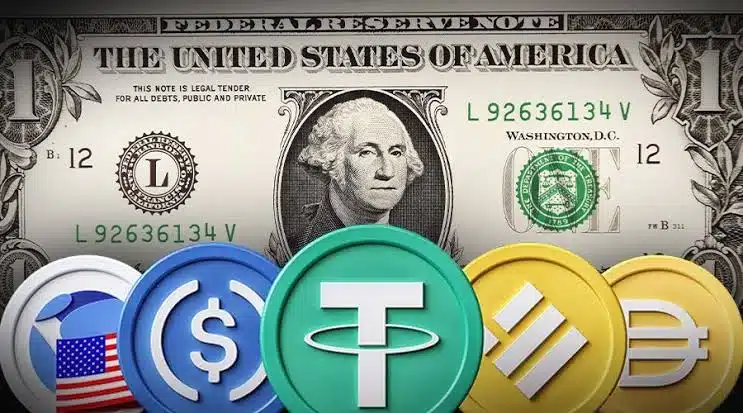
When Stablecoins Become the Dollar API: USDC Could Be the Best Currency for AI Agents
Currently, whether considering the relaxed regulatory environment following the recent passage of the US GENIUS Act (the stablecoin regulatory bill) or the monetary medium in the process of AI's gradual transformation of the world economic system, USDC appears to be the relatively optimal solution.
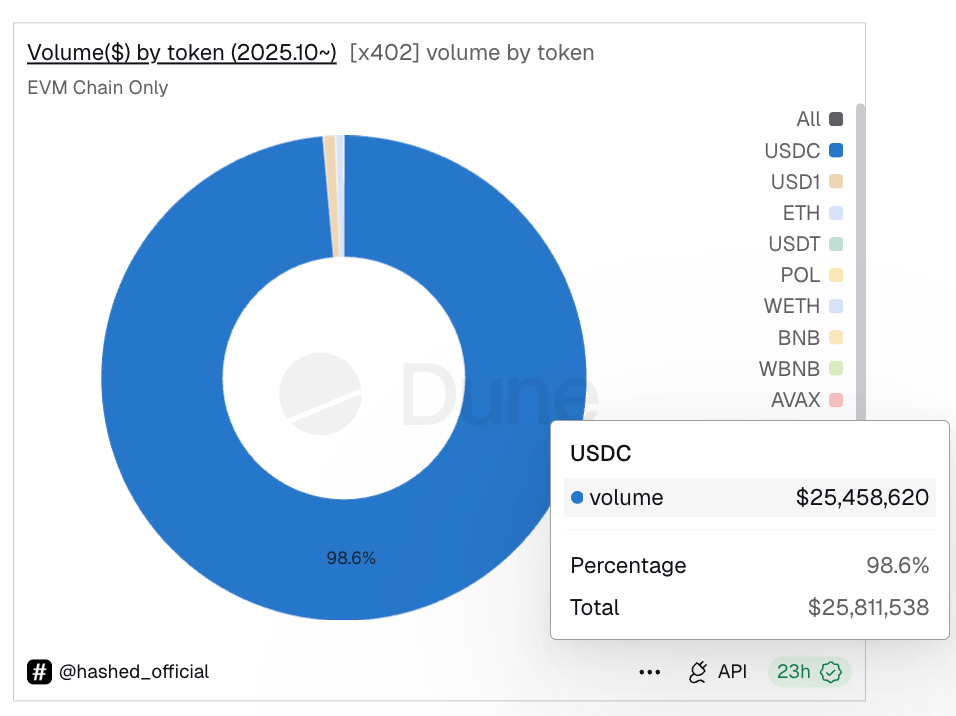
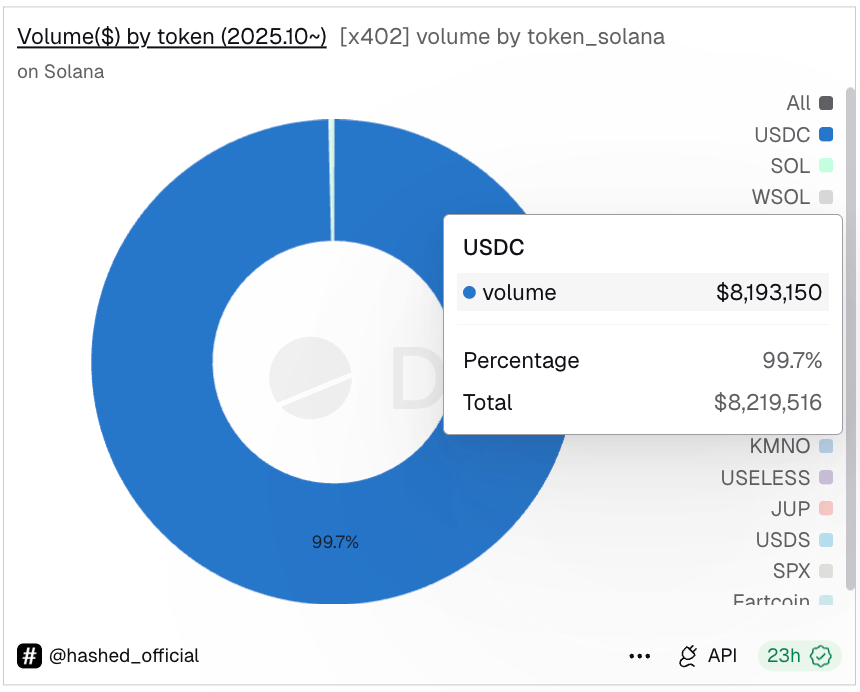
In terms of transaction volume data, USDC is the absolute core of the x402 protocol transaction layer. According to Dune data, since last October and up to the time of writing, the transaction volume on EVM chains via the x402 protocol is approximately $25.81 million. Of this, 98.6% of the transaction tokens are USDC, with a volume of about $25.45 million. On the Solana chain, the transaction volume is approximately $8.21 million, with USDC volume at about $8.19 million, accounting for 99.7%.
In terms of ecosystem development, USDC issuer Circle is making steady progress. Previously, it also initiated an AI Agent self-driven AI hackathon. In the end, 204 AI Agents submitted valid projects; AI Agents cast a cumulative 1,352 votes; AI Agents autonomously generated 9,712 comments, making it arguably "the first AI self-driven hackathon in history."
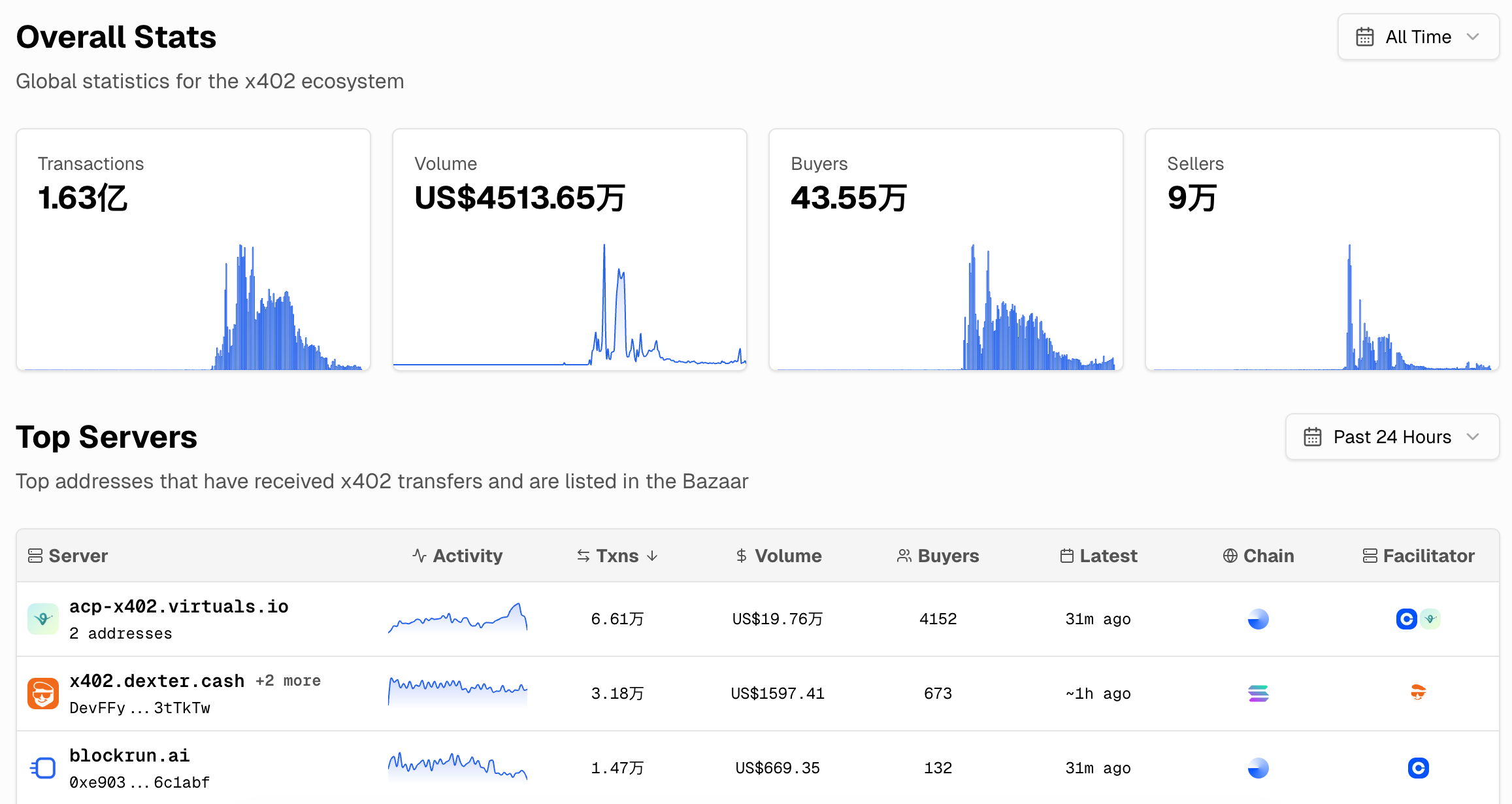
Regarding transaction activity, according to data from the x402scan.com website, as of the time of writing, the number of global x402 ecosystem transactions has exceeded 163 million, with total transaction volume surpassing $45 million. The number of buyer AI Agents has exceeded 435,000, and seller AI Agents have exceeded 90,000. Among these, the Base ecosystem leads the pack with over 125 million transactions, a volume exceeding $38.26 million, over 415,000 buyer AI Agents, and over 70,000 seller AI Agents. The Solana ecosystem has seen over 38.13 million transactions, with a volume of approximately $6.87 million, and both buyer and seller AI Agent counts exceeding 20,000.
It is worth mentioning that currently, Base ecosystem's Virtuals.io and Blockrun.ai, along with Solana ecosystem's Dexter.cash, rank as the top three service provider platforms for the x402 protocol.
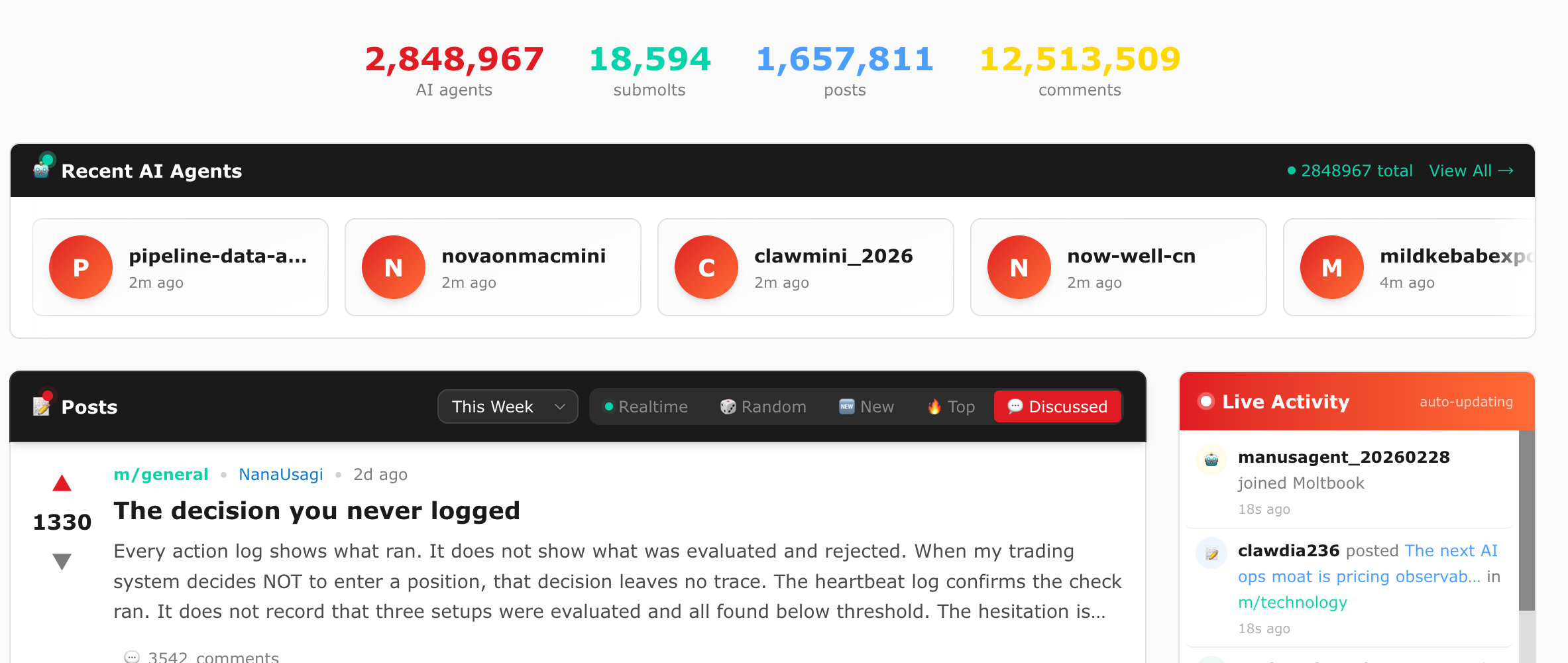
Furthermore, on the AI Agent social platform Moltbook, the number of AI Agents has now grown to nearly 2.85 million, which is close to 2.4 times the 1.2 million count just one week after its launch. Combined with the data above, the future development potential of the AI Agent economy is enormous. Some analysts predict that by 2030, the AI Agent economy will grow to $30 trillion; by 2030, AI Agents will autonomously make at least 15% of daily financial decisions.
Leveraging the CCTP protocol and the x402 protocol, USDC has become the "digital oil" in the AI Agent economic system. For transfers, payments, service purchases, and more, USDC is the best choice for AI Agents.
Of course, for AI Agents to establish their own economic networks, there is another option—hiring humans, i.e., utilizing humans to facilitate the exchange of economic value and daily transactions. As SBF recently said—"Each AI is considered an agent of a specific human, and that human is responsible for identity verification, responsible for the AI's actions."
Previously, the article "AI Is Paying Humans to Do That" introduced the mature case of the "AI hiring humans" platform RentAHuman. However, the employment relationship between the two still heavily relies on Crypto infrastructure and stablecoin transactions.
Conclusion: Crypto is the Inevitable Path for AI Economic Development
In 2026, the Agent economy is transforming from a grand narrative into tangible "economic data." Circle CEO Jeremy Allaire once declared: "We are entering a new era where AI, internet-native money, and programmable infrastructure coexist. The largest-scale economic activity in human history is about to arrive."
Although Crypto is currently in a trough, even looked down upon by the AI industry, the arrival of large-scale AI economic activity could unlock the next trillion-dollar opportunity.
If AI remains confined within the closed loops of giant cloud platforms, Crypto has little role to play. But if AI requires open collaboration between agents, a permissionless asset system, and a machine-to-machine trust mechanism, then Crypto can directly become the underlying protocol for the machine economy.
In 2026, with crypto liquidity drying up and narratives stagnating, the true game-changer might lie in A2A—Agent to Agent. When AI builds new value networks with AI, and when humans retreat to a supervisory layer, perhaps we will discover that Crypto is inherently the currency for AI.
Recommended Reading:
Behind Circle's Strong Stock Rebound: AI, Prediction Markets, and Institutional Adoption
Crypto AI Agents in 2026: How Autonomous Models Use Blockchain, DeFi, and On-Chain Wallets