






InfoFi Deep Dive: When the Market Begins to Price Attention and Credibility



- Core Viewpoint: In an era where AI exacerbates information overload, InfoFi emerges as a crypto-native information coordination system. It coordinates attention allocation and information filtering through economic incentive mechanisms. Its value lies in providing a market-based pricing mechanism for uncertainty and relevance, rather than guaranteeing information accuracy.
- Key Elements:
- AI has significantly reduced the cost of information production, but simultaneously amplified noise, making it difficult to identify effective signals, turning attention into a new scarce resource.
- The core of InfoFi is to coordinate the actions of information producers, curators, and evaluators through economic incentives like tokens, to address the attention bottleneck.
- The value formation of InfoFi highly depends on incentive mechanism design. Effective design can reduce information friction, while imbalances may amplify noise or herd effects.
- Evaluating InfoFi tokens should focus on whether the incentivized behaviors improve signal quality and coordination efficiency, rather than simply looking at price or activity levels.
- InfoFi does not guarantee truth; it prices consensus judgment and attention. Its risks include the potential for incentive arbitrage and attention loop-based market manipulation.
Information has never been as abundant as it is today, yet understanding it has never been so difficult.
The real structural problem lies not in access, but in information overload. Signals now must compete with a deluge of commentary, summaries, re-processed content, and AI-generated text. The proliferation of AI has drastically lowered the cost of information production, but it has not simultaneously solved the judgment challenges of credibility, relevance, and timeliness; instead, it has amplified this imbalance.
As AI continues to amplify content supply, the bottleneck is shifting from "production capacity" to "attention allocation." What truly determines value is not who can generate information, but which piece of information can be seen, trusted, and acted upon at the right time. This structural tension is precisely the backdrop against which InfoFi was born.
InfoFi can be understood as a market-based solution to information overload. It no longer treats information as static content but views attention allocation, information filtering, and credibility assessment as problems that need to be coordinated through economic mechanisms. Within the framework of the XT AI Zone, InfoFi exists alongside the infrastructure layer and the AI Agent layer, but its operational logic and value capture mechanisms are fundamentally different.
This article will systematically analyze: what InfoFi is, why it has emerged, how value is formed, and how users should rationally evaluate InfoFi-type tokens. It is important to clarify that InfoFi does not guarantee truth nor promise accuracy; it merely provides a mechanism for pricing uncertainty, relevance, and attention.

Key Takeaways
- AI has drastically lowered the cost of information production, but simultaneously amplifies noise and weakens the discernibility of effective signals.
- InfoFi coordinates attention allocation, information filtering, and credibility assessment through market-based incentive mechanisms.
- Such systems price uncertainty and relevance, not objective truth itself.
- InfoFi tokens incentivize participation and curation behavior, not model performance.
- If incentive mechanisms are poorly designed, the system can amplify both insights and noise.
Definition and Boundaries of InfoFi
The Functional Role of InfoFi in the Information Economy
InfoFi is a category of information coordination systems native to the crypto ecosystem. Its core logic is to coordinate the discovery, filtering, evaluation, and prioritization of information through economic incentive mechanisms. Unlike the traditional assumption that "quality information will naturally surface," InfoFi explicitly rewards behaviors that can effectively discover, judge, and organize information in an overloaded environment.
From a foundational logic perspective, InfoFi treats attention as a scarce resource, credibility as a cost to be incurred, and timeliness as key value. The system aligns incentives among information producers, curators, and evaluators through market mechanisms, token models, and staking structures, thereby forming a dynamic network for coordinating information value.
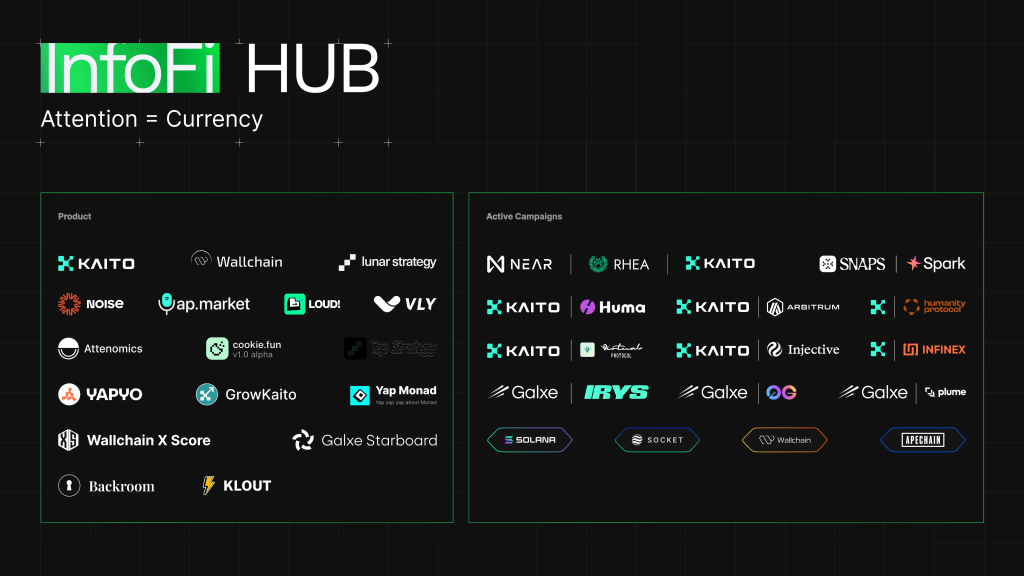
Source: rzlt.io
The Essential Differences Between InfoFi and Media, Social Platforms, and Prediction Markets
InfoFi is not a media platform.
Its goal is not to publish content or maximize engagement metrics.
It is not a social feed.
Pure popularity or virality does not constitute a core signal.
It is not a pure prediction market.
Although some systems involve probabilistic judgments, InfoFi's focus is on information relevance and coordination mechanisms, not event outcome settlement.
It is not a traditional research tool.
Its output is not static reports or authoritative conclusions, but results dynamically generated by participant behavior and incentive interactions.
Why InfoFi Emerges in the AI Era
For most of the digital age, progress in information systems came from two directions: faster dissemination and broader access. Today, the real limiting factor has shifted. Information is no longer scarce; what truly impacts decision quality is the ability to judge which information is important, when it is important, and why it is trustworthy. The proliferation of AI is accelerating this structural change. It has dramatically increased the speed, scale, and replicability of information generation but has not simultaneously solved the problem of information prioritization.
As AI-generated summaries, analyses, and viewpoints continue to expand, a series of structural effects are becoming apparent:
- The cost of information production is approaching zero.
- Effective signals are becoming increasingly difficult to distinguish from repetitive content.
- Attention is becoming increasingly fragmented across platforms and narratives.
- Credibility is shifting from an absolute standard to a contextual and temporal judgment.
Centralized platforms attempt to address this through algorithmic recommendations and content moderation, but these systems are often optimized for engagement and retention rates, not information relevance or coordination efficiency. Consequently, the mechanisms for allocating attention are often opaque and difficult for external parties to verify or challenge.
It is against this backdrop of structural imbalance that InfoFi systems have begun to emerge. They no longer rely on centralized ranking logic but introduce market-based mechanisms, forcing participants to bear economic consequences for how they discover, filter, and evaluate information. In essence, InfoFi does not reduce information supply; instead, it addresses the attention bottleneck created by AI-driven information surplus by restructuring how attention and credibility are coordinated.
How InfoFi Systems Create Value
Within InfoFi systems, value formation is not evenly distributed but highly dependent on the participation methods of different roles. Where value accumulates and where risk concentrates fundamentally depends on the interaction patterns of participants within the information coordination structure.
Information Producers
Information producers are responsible for providing analysis, synthesis, or interpretation. In an era where AI has drastically lowered content production costs, mere output capability is increasingly prone to homogenization. Real value no longer depends on output quantity but on whether information can be effectively presented and recognized at critical junctures.
Curators and Filters
Curators are responsible for filtering and contextualizing information. By enhancing signal quality, they often create the most practical value. However, if incentives favor exposure over relevance, curation power may also gradually centralize, forming new structures of influence.
Evaluation Mechanisms and Market Signals
The market aggregates participant judgments through economic signals, coordinating consensus in uncertain environments. This mechanism helps form dynamic signals, but if participation is driven more by sentiment and momentum than independent evaluation, it can also lead to herd effects and amplify volatility.
Incentive Mechanism Design
Token and reward structures determine the direction of behavior. Effective incentive design can align filtering and evaluation behaviors with system goals; poor design can amplify noise or reward participation behaviors disconnected from information value.
Control and Failure Risks
Governance structures and parameter controls influence long-term direction. Overly concentrated control increases systemic risk. Common failure scenarios include incentive arbitrage, rule gaming, and self-reinforcing attention loops.
In InfoFi systems, value typically accumulates at coordination nodes that effectively reduce information friction; risk often concentrates where attention and control are highly centralized. Structural design determines long-term outcomes.
Core Reference Tokens in the XT AI Zone
KAITO
KAITO (KAITO/USDT spot market) focuses on organizing and indexing crypto-native information, building information filtering and prioritization capabilities through AI-driven discovery mechanisms overlaid with incentive structures. Within the InfoFi framework, KAITO's role is to help users discover relevant signals more efficiently in a highly fragmented attention landscape.
With recent platform policy adjustments, particularly those affecting incentivized social data access mechanisms, KAITO is gradually shifting from a broad interaction-reward model towards a mechanism design more focused on curated discovery and data analysis capabilities. This shift also illustrates how external platform dependencies directly impact the incentive structure and long-term strategy of InfoFi projects.
The core behavior KAITO incentivizes is not mere content production, but enhancing the discoverability and relevance of information.
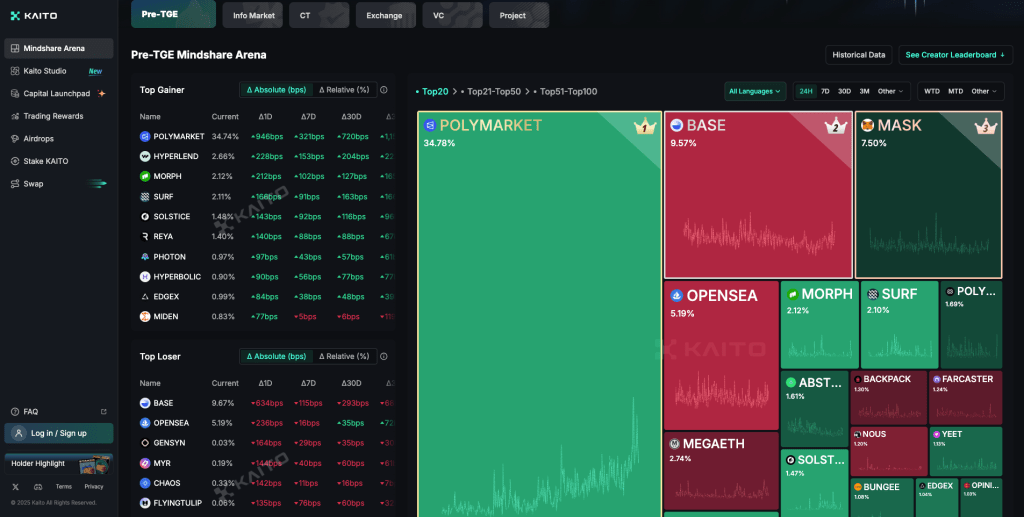
Source: Kaito.ai
For KAITO, the key question is: after reducing reliance on external traffic platforms, can its new incentive model consistently generate stable signals? Or will it slide back towards a visibility-optimization path oriented around short-term exposure?
COOKIE
Cookie DAO (COOKIE/USDT spot market) sits at the intersection of attention analysis and participation incentives, attempting to quantify information flow paths and the structure of attention aggregation around narratives or signals. The behavior COOKIE incentivizes revolves around observing, measuring, and participating in attention dynamics.
COOKIE's key question is: Can quantifying attention genuinely improve information coordination efficiency? Or is it merely building a new monetization layer on top of existing noise cycles?
IQ
IQ (IQ/USDT spot market) emphasizes knowledge curation and structured information contribution, typically achieved through community-driven classification, verification, and collaboration mechanisms. The behavior IQ incentivizes is collaborative knowledge organization, not predictive accuracy about future outcomes.