




What is VELVET? Understanding Velvet's DeFAI Execution Architecture and Token Mechanism



- Core View: Velvet is a DeFAI platform that integrates a native wallet trading terminal, an AI research execution layer, and a Vault portfolio management system. The value capture of its VELVET token is highly dependent on the platform's actual usage rate and fee revenue.
- Key Elements:
- The platform is positioned as an integrated DeFAI operating system, combining intent-based execution, trading, and Vault portfolio management, aiming to enhance decision-making and execution efficiency.
- The core utility of the VELVET token lies in staking it to become veVELVET, which is used for governance, obtaining fee discounts, and sharing 50% of the protocol's revenue.
- The token economic model emphasizes value capture, with a maximum supply of 1 billion tokens. Its sustainability depends on the real fee revenue generated by the platform.
- Main risks include smart contract and integration risks, insufficient platform adoption leading to revenue decline, and liquidity constraints caused by veVELVET lock-ups.
- Competitive differentiation lies in integrating multiple product layers, competing for the user's "default execution interface," rather than focusing on a single functional module.
Quick Takeaways
- What it is: Velvet is a DeFAI trading and portfolio operating system offering on-chain execution, Vault portfolios, and an AI research layer.
- Core Use: VELVET can be staked as veVELVET for governance, fee discounts, incentive distribution, and fee-linked rewards.
- Key Differentiation: Velvet integrates intent-based execution, a trading terminal, and Vault portfolio products within a single system.
- How Users Participate: Users can trade directly from their wallet, manage DeFi positions, create or join Vaults, and lock VELVET to gain benefits.
- Primary Risks: Token utility depends on sustained platform adoption and the stability of cross-integration and multi-chain execution.
What is Velvet (VELVET)?
Velvet (VELVET) is a DeFi-centric token used within the Velvet ecosystem. Users can trade from their own wallet, manage portfolios through Vaults, and utilize an AI layer for research and intent-based execution. VELVET's primary utility is activated by staking it as veVELVET, enabling holders to participate in governance and receive fee-related incentives, rather than being used to pay network gas fees.
Why is the "DeFAI Portfolio Operating System" Gaining Attention?
The limitation in on-chain markets is no longer access to tokens themselves, but the efficiency of decision-making and execution. Traders face fragmented liquidity, inconsistent routing, and an increasing number of DeFi platform choices. Simultaneously, portfolio products are evolving from passive index exposure to actively strategy-driven Vaults and asset allocation solutions.
In this context, Velvet's significance lies in its design around an integrated workflow: users can discover opportunities, evaluate data, and execute trades or portfolio operations without switching tools. Velvet does not treat AI merely as a marketing concept but positions it as an interface layer for routing user intent into on-chain operations, paired with a Vault system for managing strategy portfolios.
How Does Velvet Work?
Velvet operates as a DeFAI trading and portfolio management tech stack, emphasizing native wallet execution. Users can directly trade tokens, enter or exit DeFi pools on supported chains without depositing assets into a centralized platform. This design keeps asset custody in the user's wallet while offloading the complexity of routing and execution to the application layer.
At the product level, Velvet categorizes user interaction with the ecosystem into four types. First, a trading terminal for browsing tokens, charts, on-chain activity, and executing swaps. Second, an AI framework called "Velvet Unicorn" for research analysis and intent-based operation execution. Third, a portfolio management system where users can create personal or shared Vaults for others to join. Fourth, a custom application mode, allowing teams to deploy products with their own branded interface based on Velvet's underlying architecture.
Demand for VELVET primarily stems from the governance and incentive mechanisms within this system. The token is not positioned as a transaction gas asset but is used for staking as veVELVET, enabling holders to receive fee discounts and fee-related rewards while participating in decisions affecting integrations, incentive structures, and protocol parameters.
VELVET Tokenomics
Core Token Model
VELVET employs a capped supply mechanism, with a maximum supply of 1,000,000,000 tokens. The token's primary utility is activated by staking it as veVELVET. veVELVET follows a vote-escrow design, where users lock VELVET for a period to receive a veVELVET balance that decays over time. Longer lock periods yield more veVELVET; as the lock period nears its end, the balance gradually decreases unless the user extends or re-locks.
According to official documentation, Velvet's value capture mechanism revolves around fee sharing and buybacks. Protocol fee revenue is allocated as follows: 50% is swapped for VELVET and distributed to veVELVET stakers, while the other 50% goes to the DAO treasury. Additionally, veVELVET is linked to several platform benefits, including fee discounts, higher referral shares, incentives tied to "Gems" (reflecting staking and activity), and governance voting rights.
Velvet also introduces a separate payment token concept—Velvet Unicorn (VU). This token is described as the "Gas" token for AI co-pilots and agent strategies. The documentation states that value generated from each VU call will be allocated via a mechanism to burning, the treasury, and reward pools related to veVELVET holders.
Token Economy Overview
MetricValueVerification SourceMain NetworkBNB ChainToken Contract + Ecosystem ListAdditional Chain DeploymentBaseMarket Data Platforms + Block ExplorersToken StandardBEP-20 (Main)BscScan ContractDecimals18BscScanMain Contract (BNB Chain)0x8b194370825e37b33373e74a41009161808c1488BscScanBase Contract0xbf927b841994731c573bdf09ceb0c6b0aa887cddBaseScanMax Supply1,000,000,000 VELVETMarket Data Platforms + BscScanCirculating Supply (Market Data)~ 241,000,929Browser Market DataveVELVET Lock Period1 week → 200 weeksTokenomics DocumentationProtocol Revenue Distribution50% Buyback Distribution / 50% TreasuryTokenomics DocumentationPlatform Trading Fee0.5% (Stated Value)Fee Documentation
Why the Token Economic Model is Important
The long-term sustainability of VELVET primarily depends on whether the platform can consistently generate real fee revenue, rather than relying solely on an inflationary model. If execution volume and Vault activity grow, the fee-sharing rewards for veVELVET will have structural significance. If usage declines, the distribution mechanisms tied to incentives and buybacks may weaken, thereby reducing the token's functional value.
Ecosystem and Core Applications
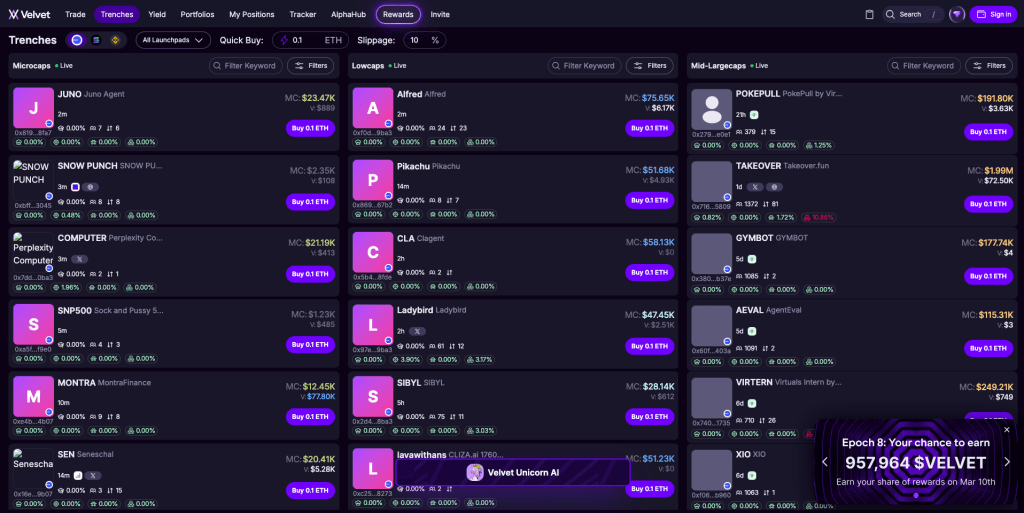
A typical user journey starts with native wallet trading and portfolio monitoring. Users browse tokens, liquidity pools, and yield opportunities, then directly execute swaps or adjust positions from their wallet. For users seeking deeper involvement, the role of VELVET becomes apparent: they can lock the token as veVELVET to obtain fee discounts, activity-linked incentives, and governance participation rights over integration directions and fee distribution logic.
 Source: Dapp.velvet.capital
Core dApps and Use Cases
For trading and managing DeFi positions via a wallet interface.
Velvet's trading terminal allows users to discover assets, view on-chain data, and execute trades or enter yield positions without transferring asset custody.
Supports Vault portfolio products with configurable rules.
Users can create personal, public, or permissioned Vaults and customize deposit limits, asset lists, and fee structures.
Allows strategy managers to monetize through performance tracking.
Vault creators can set management fees, subscription/redemption fees, and performance fees, thereby building structured on-chain strategy products.
Provides an AI interface layer for research and execution.
Velvet Unicorn offers market insights and can translate natural language intent into trades or DeFi operations.
How to Buy, Use, and Participate in VELVET
VELVET can be acquired via supported centralized exchanges or decentralized markets, depending on region and chosen network. On XT.com, users can trade using the VELVET/USDT spot and VELVET/USDT futures markets, allowing participation through direct token holding or derivatives.